Weapon
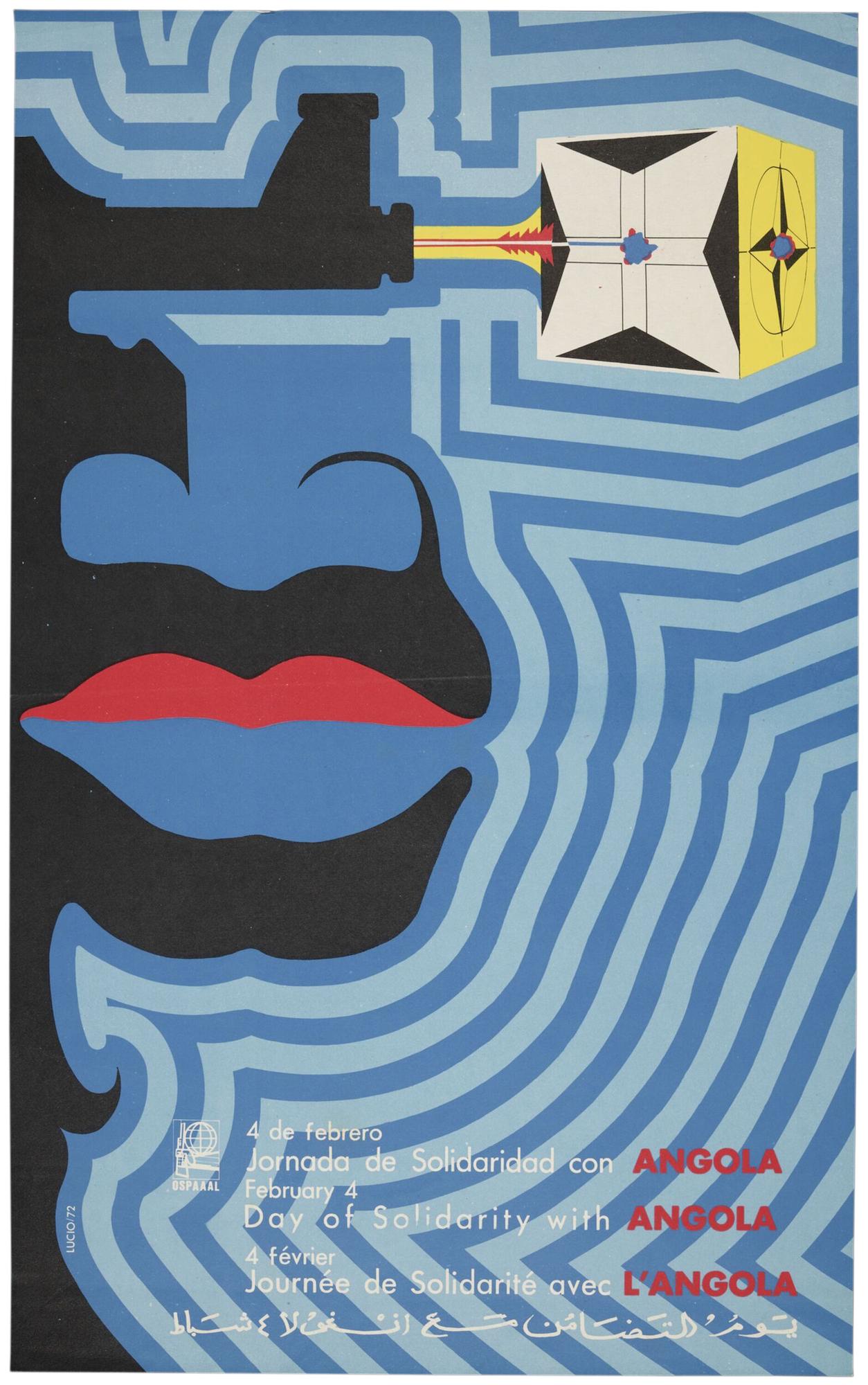
February 4 - Day of Solidarity with ANGOLA, 1972
Between the 1960s and 1990s, more than fifty designers worked at OSPAAAL. Based in Cuba, they made magazines and posters that were sent around the world. Their aim was to promote radical political ideas. Many of their posters celebrated socialist revolutions and liberation movements from the Global South. This poster commemorates the beginning of the Angolan War of Independence on 4 February 1961.
Content warning: weaponry
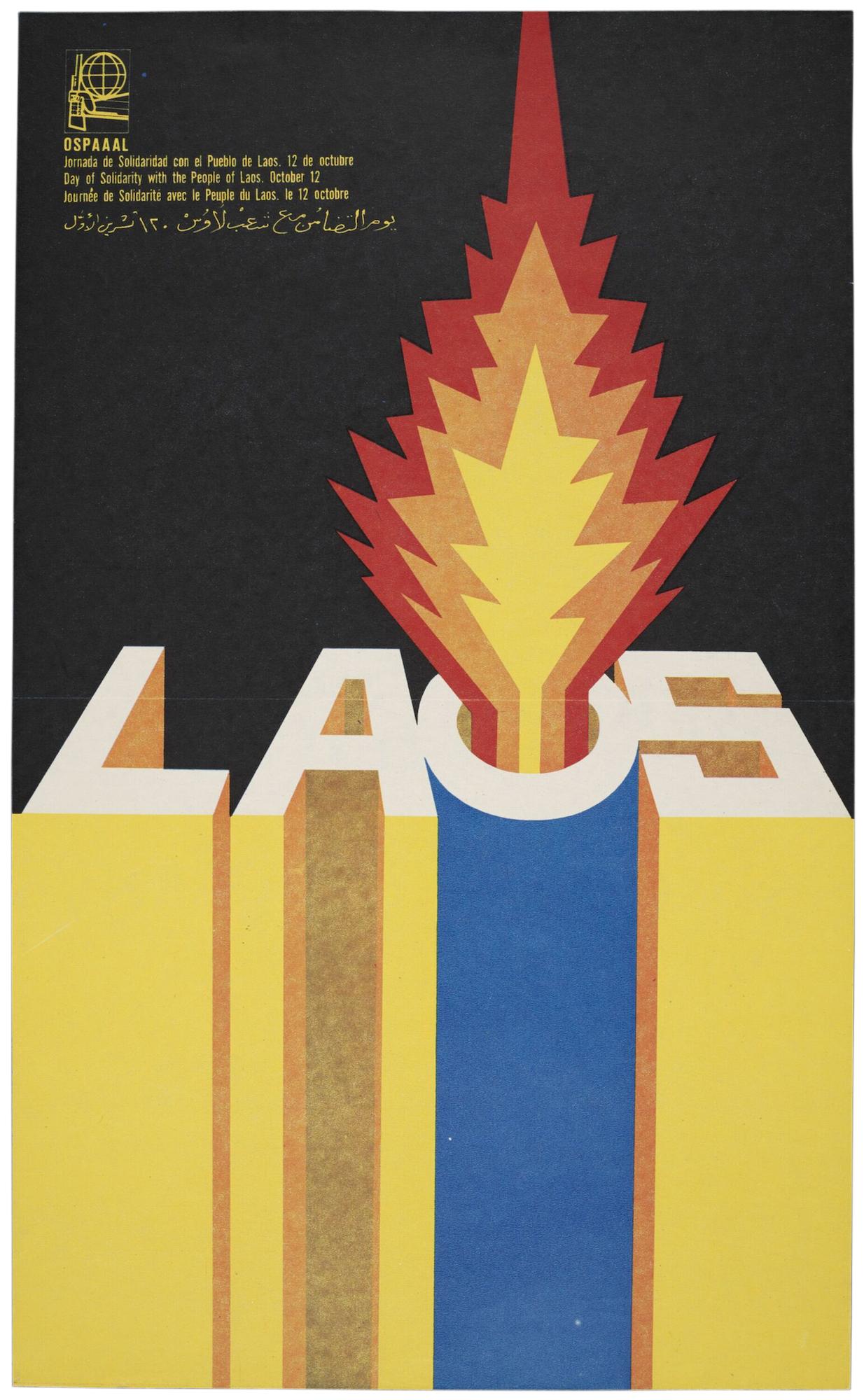
Day of Soldarity With The People Of Laos - October 12, 1970
Between the 1960s and 1990s, more than fifty designers worked at OSPAAAL. Based in Cuba, they made magazines and posters that were sent around the world. Their aim was to promote radical political ideas. Many of their posters celebrate socialist revolutions and liberation movements from the Global South. This design encouraged solidarity with Laotian people on the same date as the founding of the nationalist movement Lao Issara (‘Free Laos’) on 12 October 1945.
Content warning: weaponry
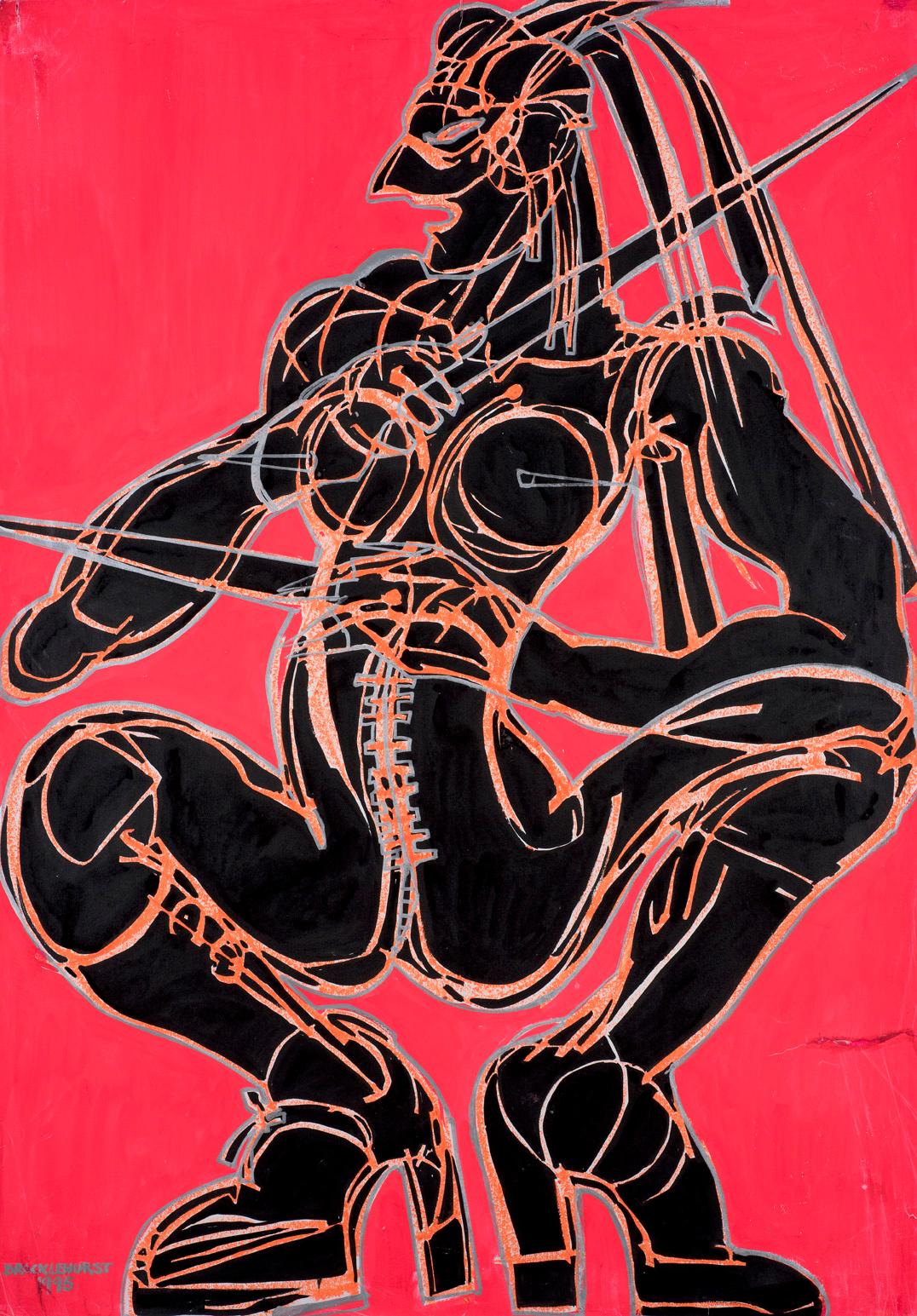
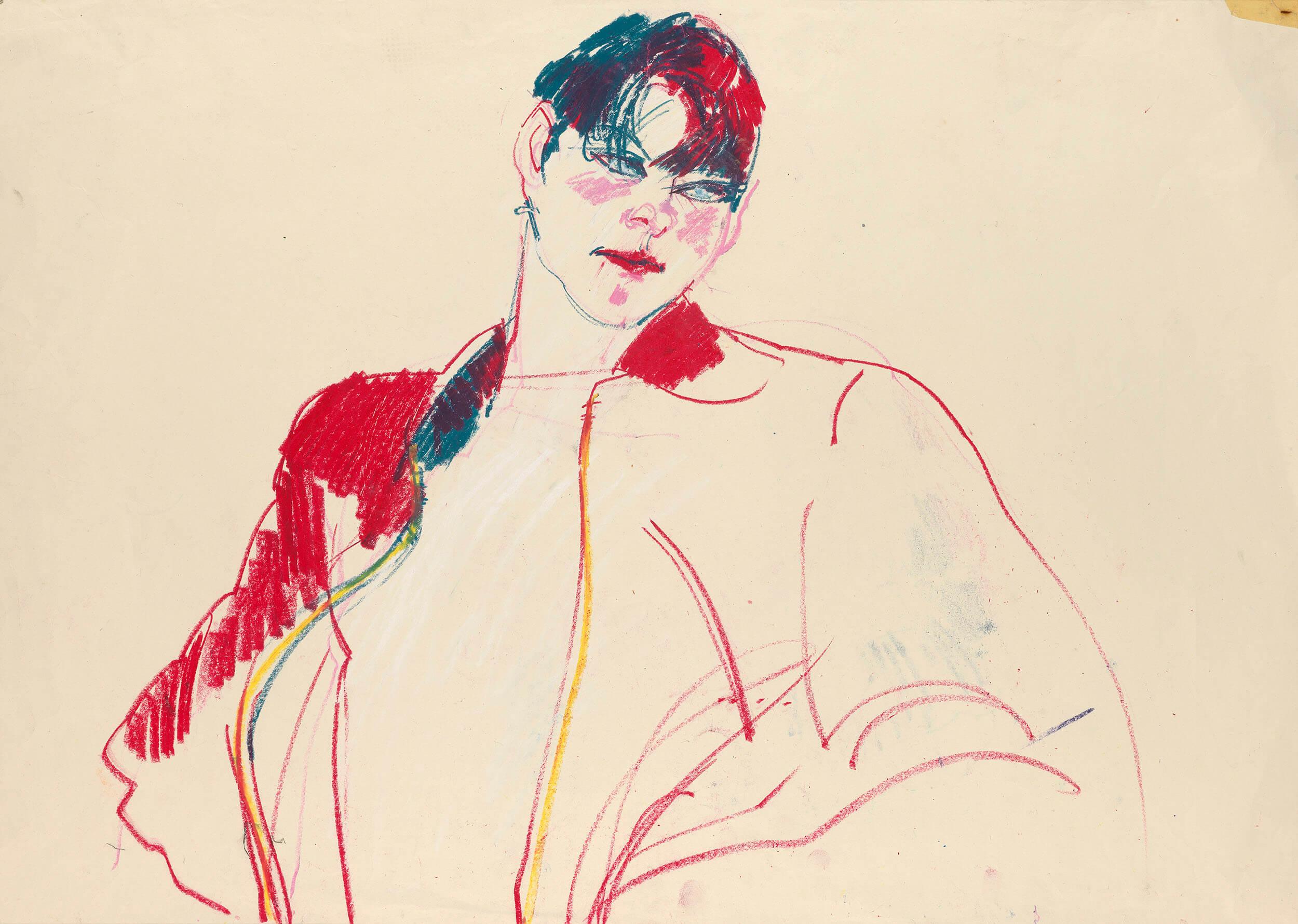
Jo Brocklehurst, Untitled (portrait of Eryka Isaak), 1995
Jo (Josephine) Brocklehurst (1935 - 2006) studied at Central Saint Martins and began her career as a fashion illustrator. She later focused on portraiture, drawing directly from models at her studio in West Hampstead and in nightclubs and theatres in Berlin, London and New York. Her work documents the alternative subcultures of the 1970s, 80s and 90s that went on to shape mainstream fashion and performance scenes. In the 1990s, Brocklehurst began drawing the fashion designers and performers finding space for experimentation in the fetish clubs of Soho and King’s Cross.
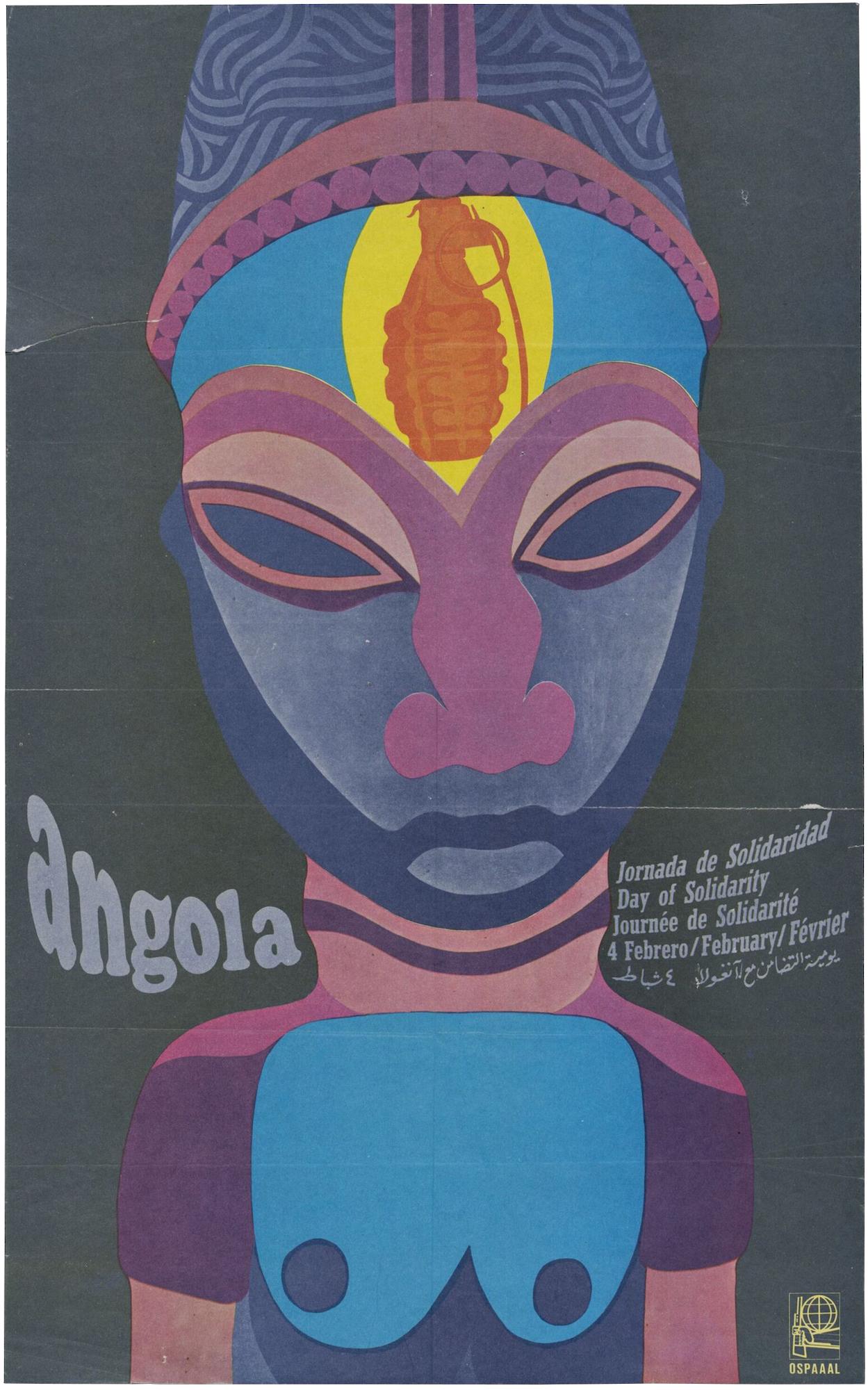
angola - Day of Solidarity - 4 February, 1969
Between the 1960s and 1990s, more than fifty designers worked at OSPAAAL. Based in Cuba, they made magazines and posters that were sent around the world. Their aim was to promote radical political ideas. Many of their posters celebrate socialist revolutions and liberation movements from the Global South. This poster commemorates the beginning of the Angolan War of Independence on 4 February 1961.
Content warning: weaponry
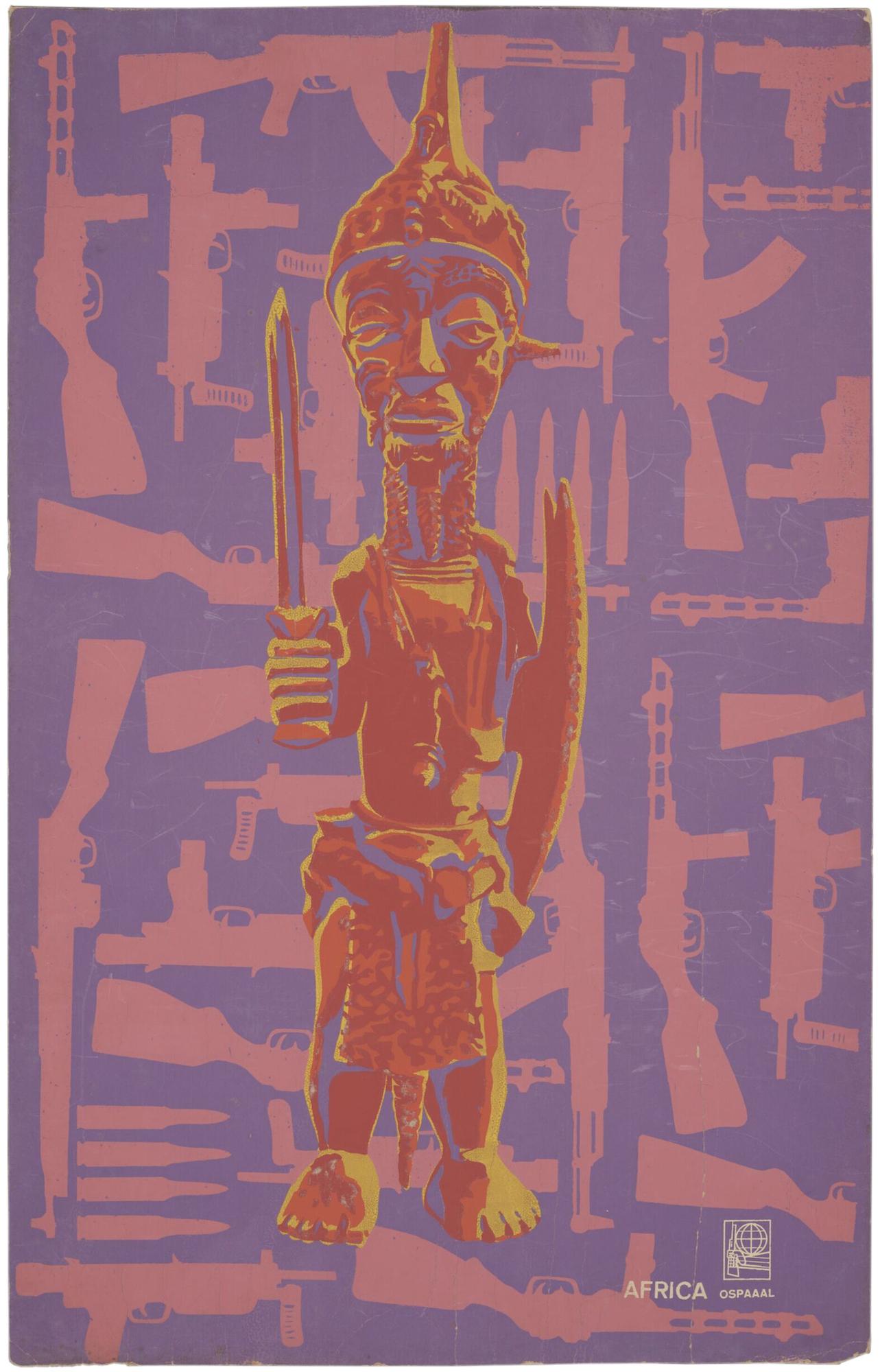
AFRICA, 1969
Between the 1960s and 1990s, more than fifty designers worked at OSPAAAL (the Organisation of Solidarity with the People of Africa, Asia and Latin America). Based in Cuba, they made magazines and posters that were sent around the world. Their aim was to promote radical political ideas. Many of their posters celebrate socialist revolutions and liberation movements from the Global South. Many OSPAAAL designers combined images of Indigenous art and craft with weaponry. Their aim was to argue for the right to self-determination and support liberation movements opposing colonial and imperial powers. However, the designers did not always know the meaning or origin of the iconography they used.
Content warning: weaponry
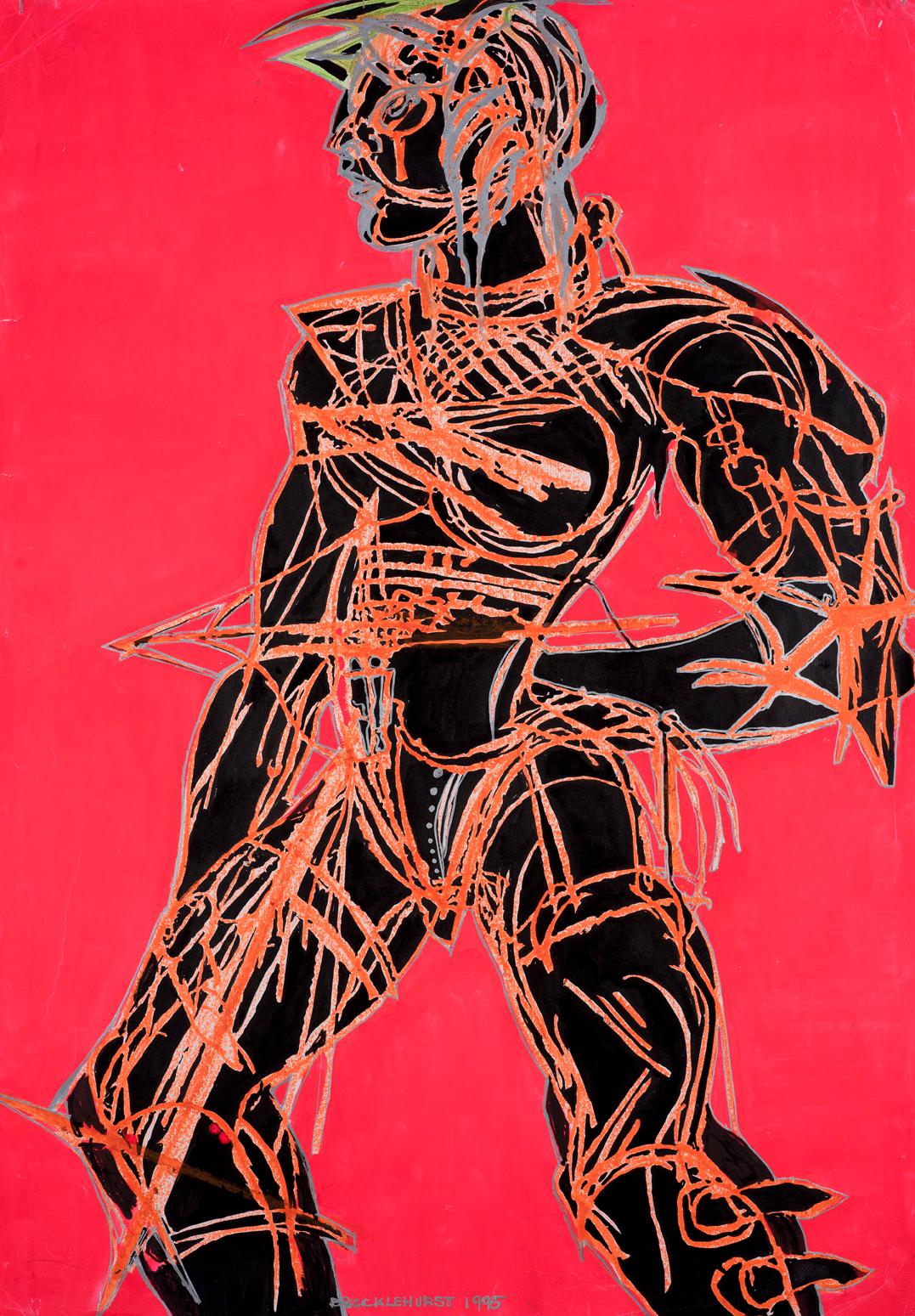
Jo Brocklehurst, Untitled (portrait of Liz de Havilland), 1995
Jo (Josephine) Brocklehurst (1935 - 2006) studied at Central Saint Martins and began her career as a fashion illustrator. She later focused on portraiture, drawing directly from models at her studio in West Hampstead and in nightclubs and theatres in Berlin, London and New York. Her work documents the alternative subcultures of the 1970s, 80s and 90s that went on to shape mainstream fashion and performance scenes. In the 1990s, Brocklehurst began drawing the fashion designers and performers finding space for experimentation in the fetish clubs of Soho and King’s Cross.

Untitled, 1969
Between the 1960s and 1990s, more than fifty designers worked at OSPAAAL (the Organisation of Solidarity with the People of Africa, Asia and Latin America). Based in Cuba, they made magazines and posters that were sent around the world. Their aim was to promote radical political ideas. Many of their posters celebrate socialist revolutions and liberation movements from the Global South. Alfredo Rostgaard’s poster depicts Jesus Christ carrying a rifle on his back. On the reverse of the poster is a quote from Camilo Torres, a Roman Catholic priest and guerrilla who fought with the revolutionary Colombian National Liberation Army. Torres combined his religious faith with Marxist politics and believed that “If Jesus were alive today, he would be a guerrillero”.
Content warning: weaponry
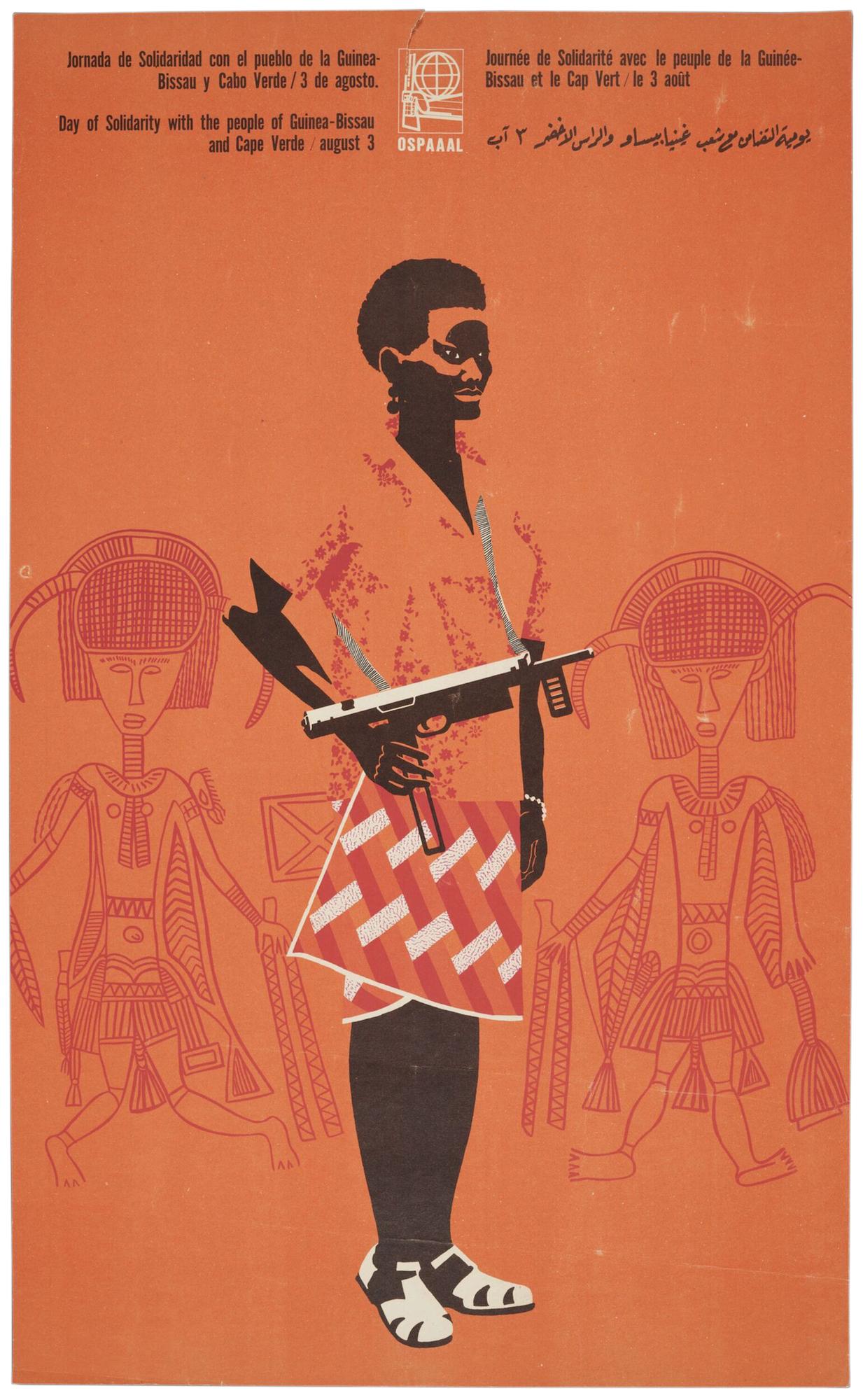
Day of Solidarity with the people of Guinea-Bissau and Cape Verde - august 3, 1968
Between the 1960s and 1990s, more than fifty designers worked at OSPAAAL (the Organisation of Solidarity with the People of Africa, Asia and Latin America). Based in Cuba, they made magazines and posters that were sent around the world. Their aim was to promote radical political ideas. Many of their posters celebrate socialist revolutions and liberation movements from the Global South. This poster was designed to mark a day of solidarity with liberation movements in Cape Verde and Guinea-Bissau seeking independence from Portuguese colonial rule, on the date of the Pidjiguiti massacre. Many OSPAAAL designers combined images of Indigenous art and craft with contemporary weaponry. Their aim was to argue for the right to self-determination and support liberation movements opposing colonial and imperial powers. However, the designers did not always know the meaning or origin of the iconography they used.
Content warning: weaponry
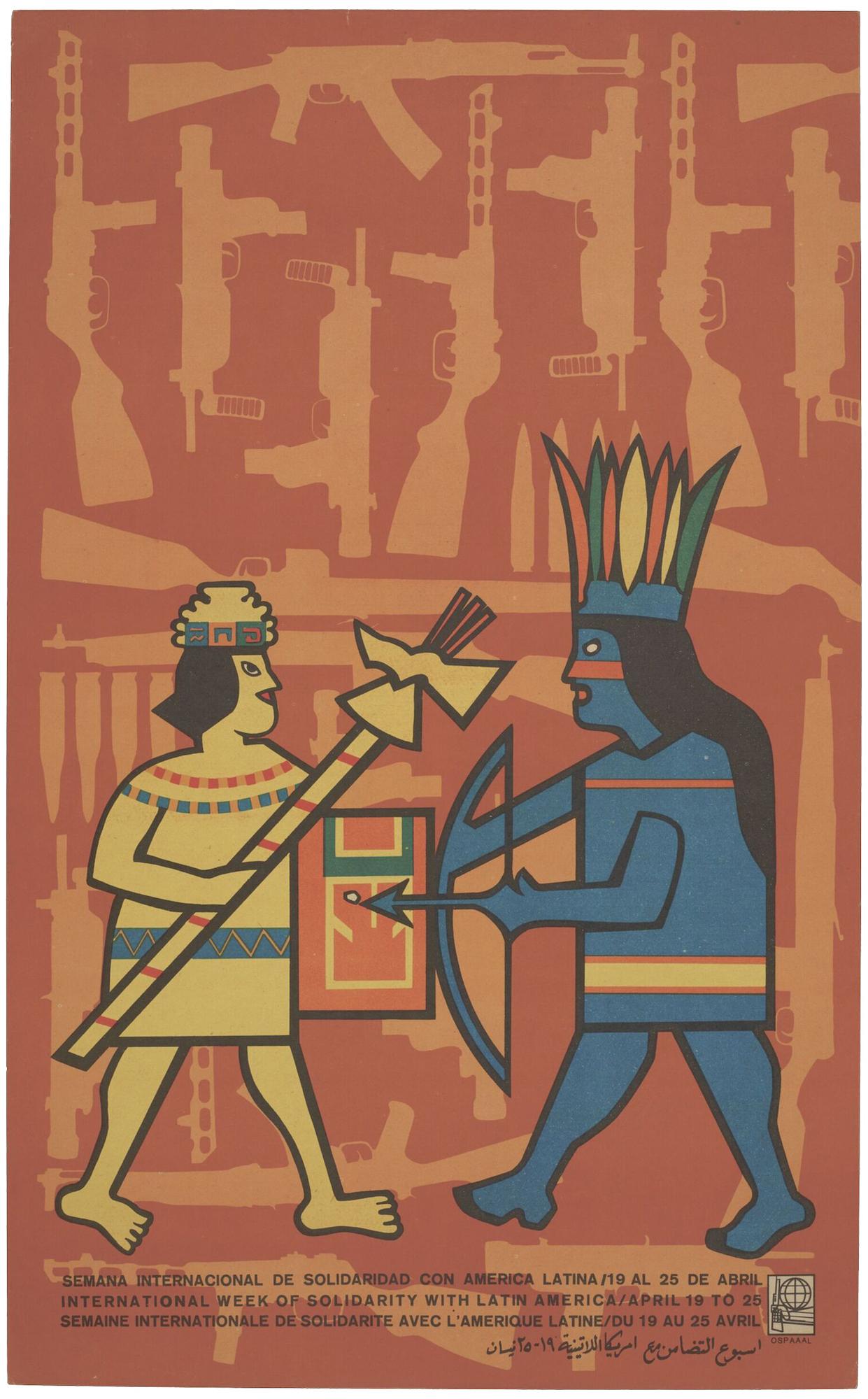
INTERNATIONAL WEEK OF SOLIDARITY WITH LATIN AMERICA - APRIL 19 TO 25, 1969
Between the 1960s and 1990s, more than fifty designers worked at OSPAAAL (the Organisation of Solidarity with the People of Africa, Asia and Latin America). Based in Cuba, they made magazines and posters that were sent around the world. Their aim was to promote radical political ideas. Many of their posters celebrate socialist revolutions and liberation movements from the Global South. Many OSPAAAL designers combined images of Indigenous art and craft with contemporary weaponry. Their aim was to argue for the right to self-determination and support liberation movements opposing colonial and imperial powers. However, the designers did not always know the meaning or origin of the iconography they used.
Content warning: weaponry
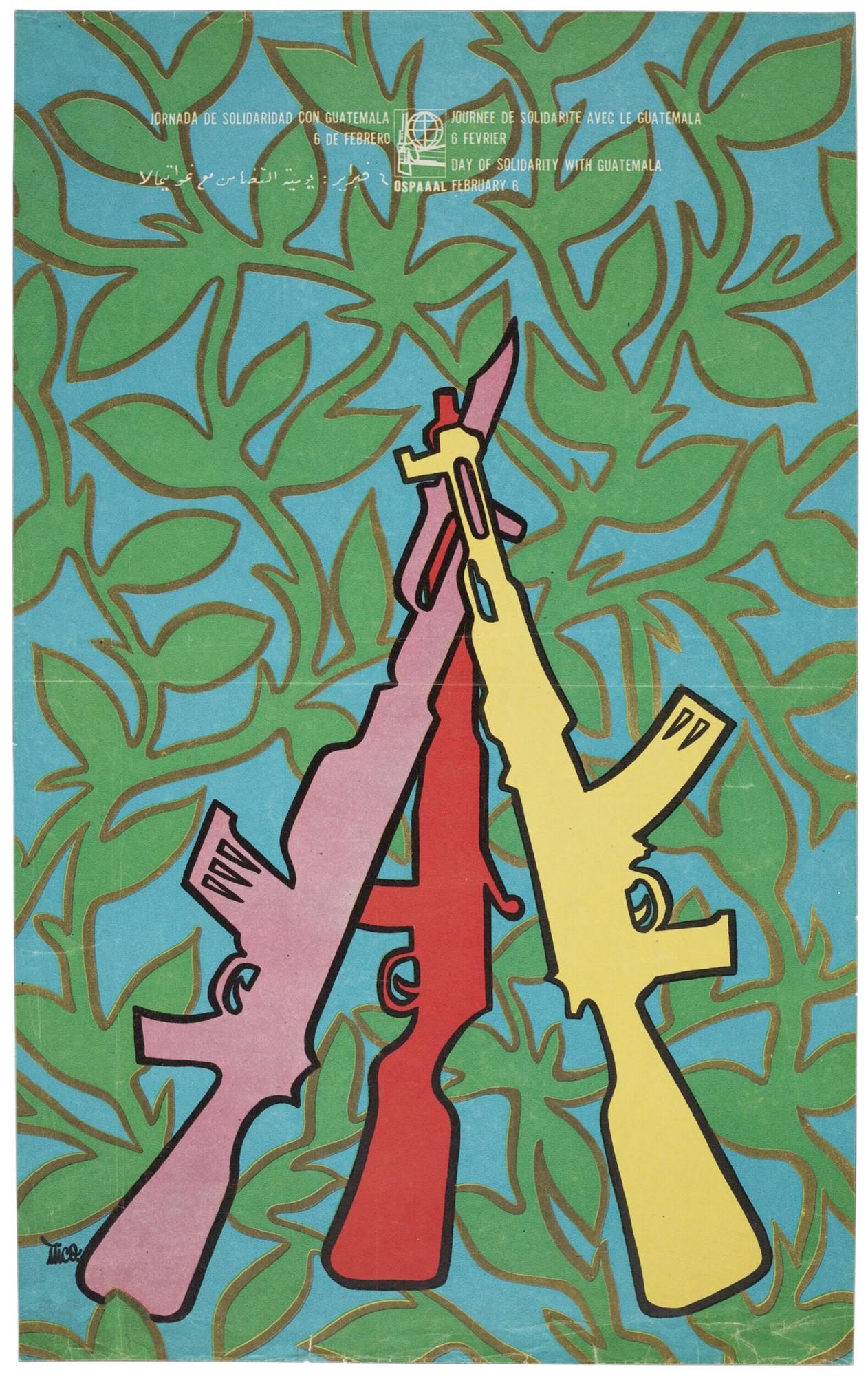
DAY OF SOLIDARITY WITH GUATEMALA - FEBRUARY 6, 1970
Between the 1960s and 1990s, more than fifty designers worked at OSPAAAL (the Organisation of Solidarity with the People of Africa, Asia and Latin America). Based in Cuba, they made magazines and posters that were sent around the world. Their aim was to promote radical political ideas. Many of their posters celebrate socialist revolutions and liberation movements from the Global South.
Content warning: weaponry
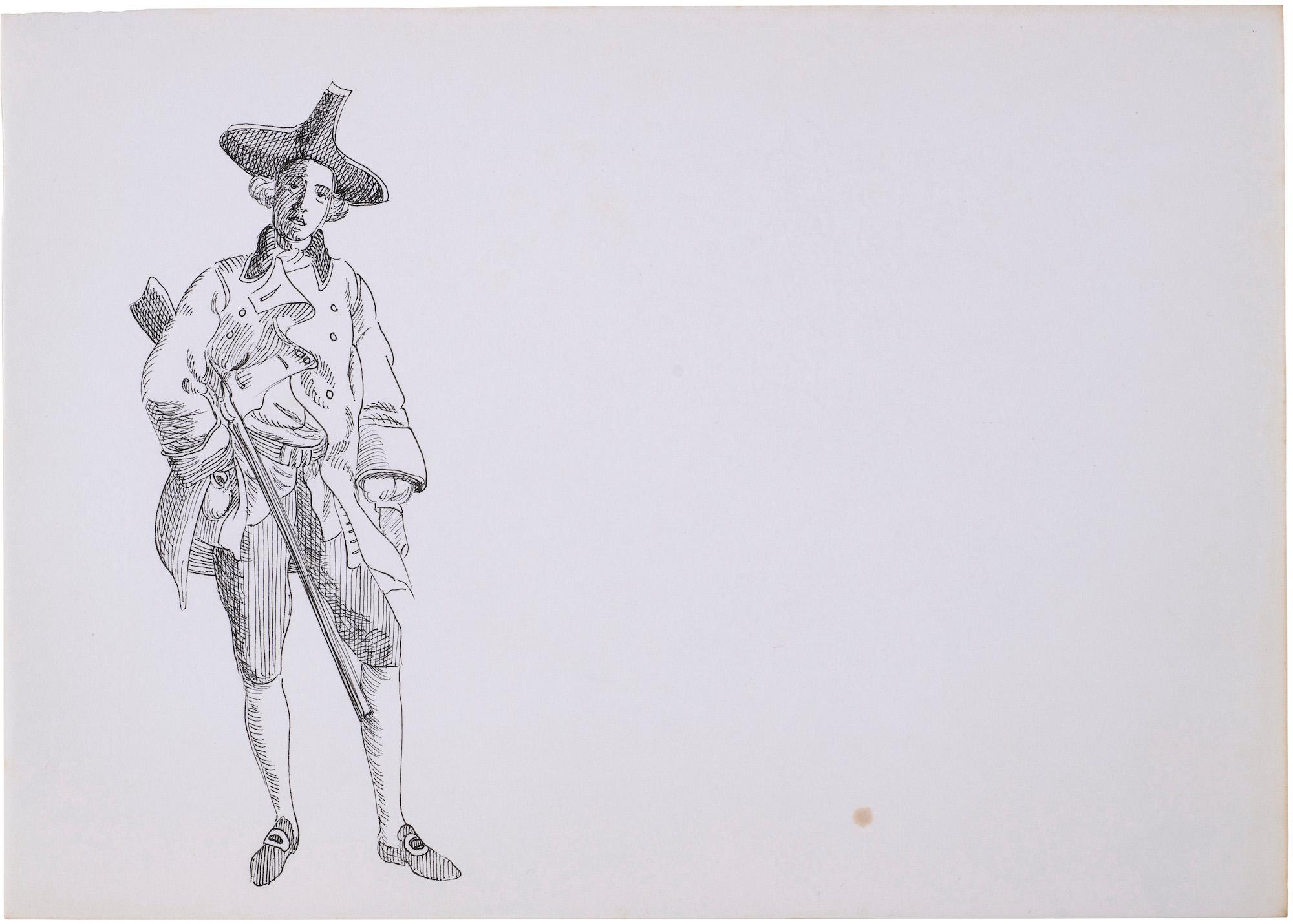
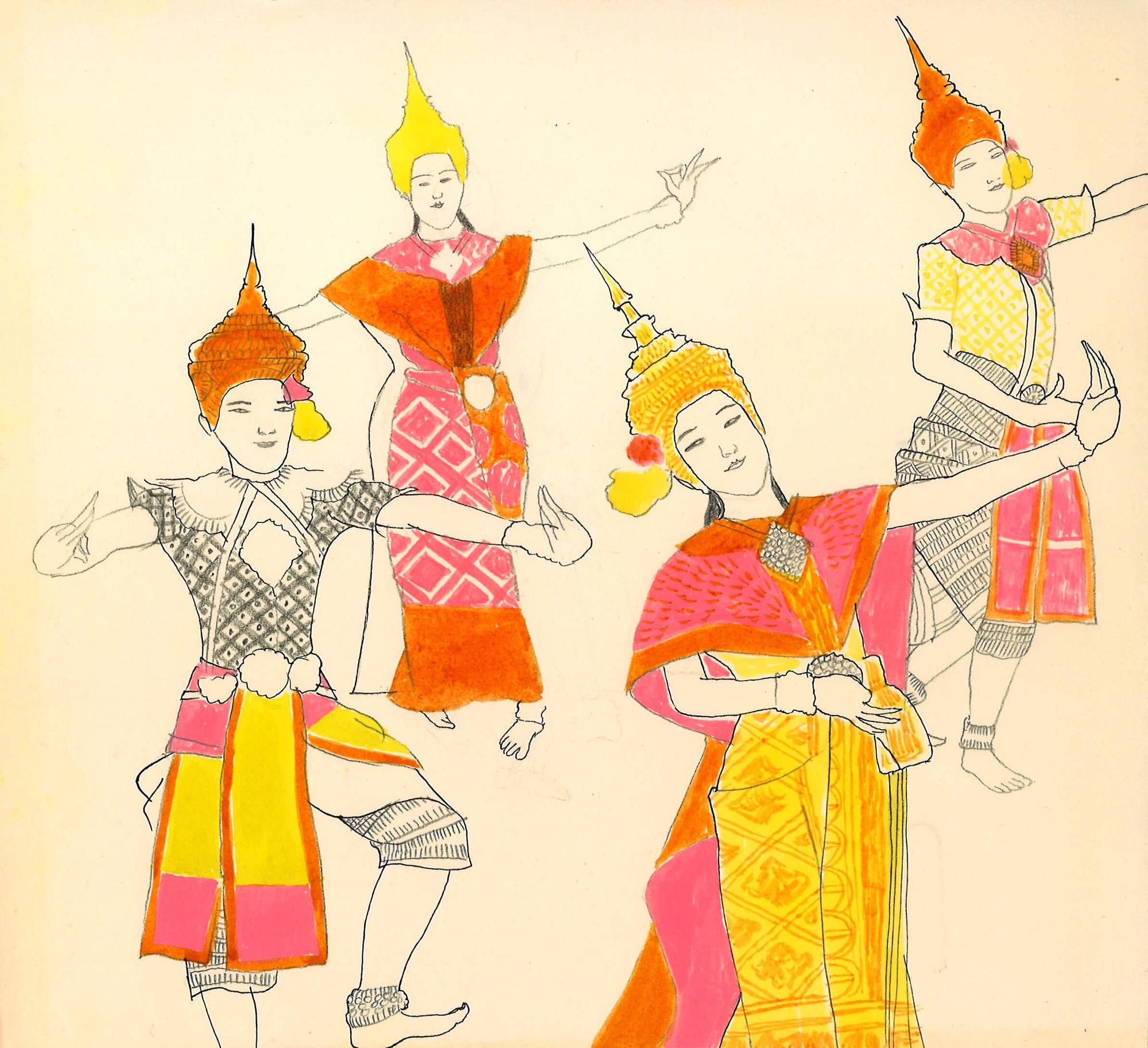
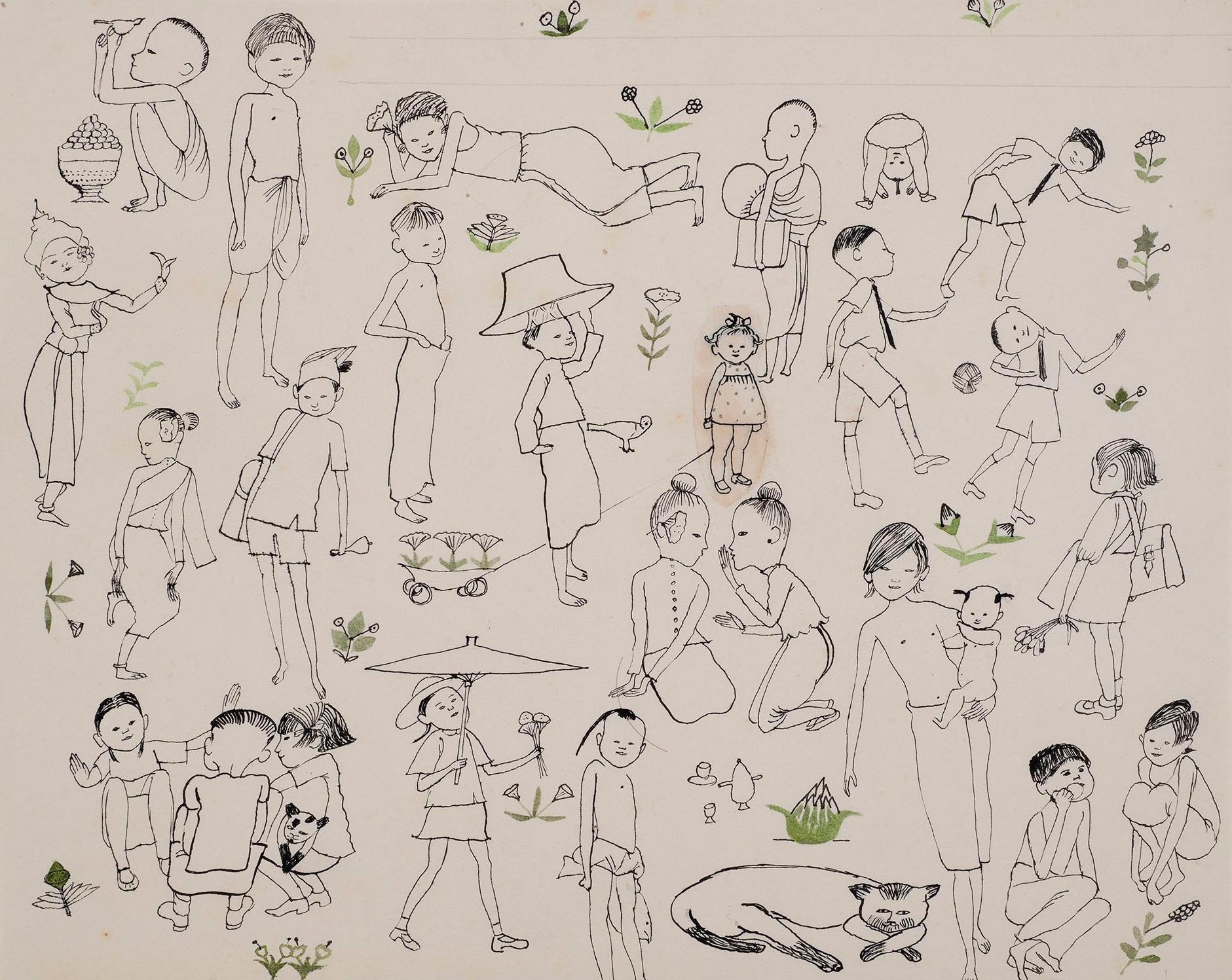
Jacqueline Ayer, Untitled, Date unknown
Jacqueline Ayer (1930–2012) had a career that spanned many creative fields. She began as a fashion illustrator, and later turned her hand to children’s books, textiles and garments, as she worked in New York, Paris, London, Bangkok, Hong Kong and across India. Ayer often used a sketchbook to record her observations and ideas for book narratives and fashion designs. The context for this drawing is unknown.
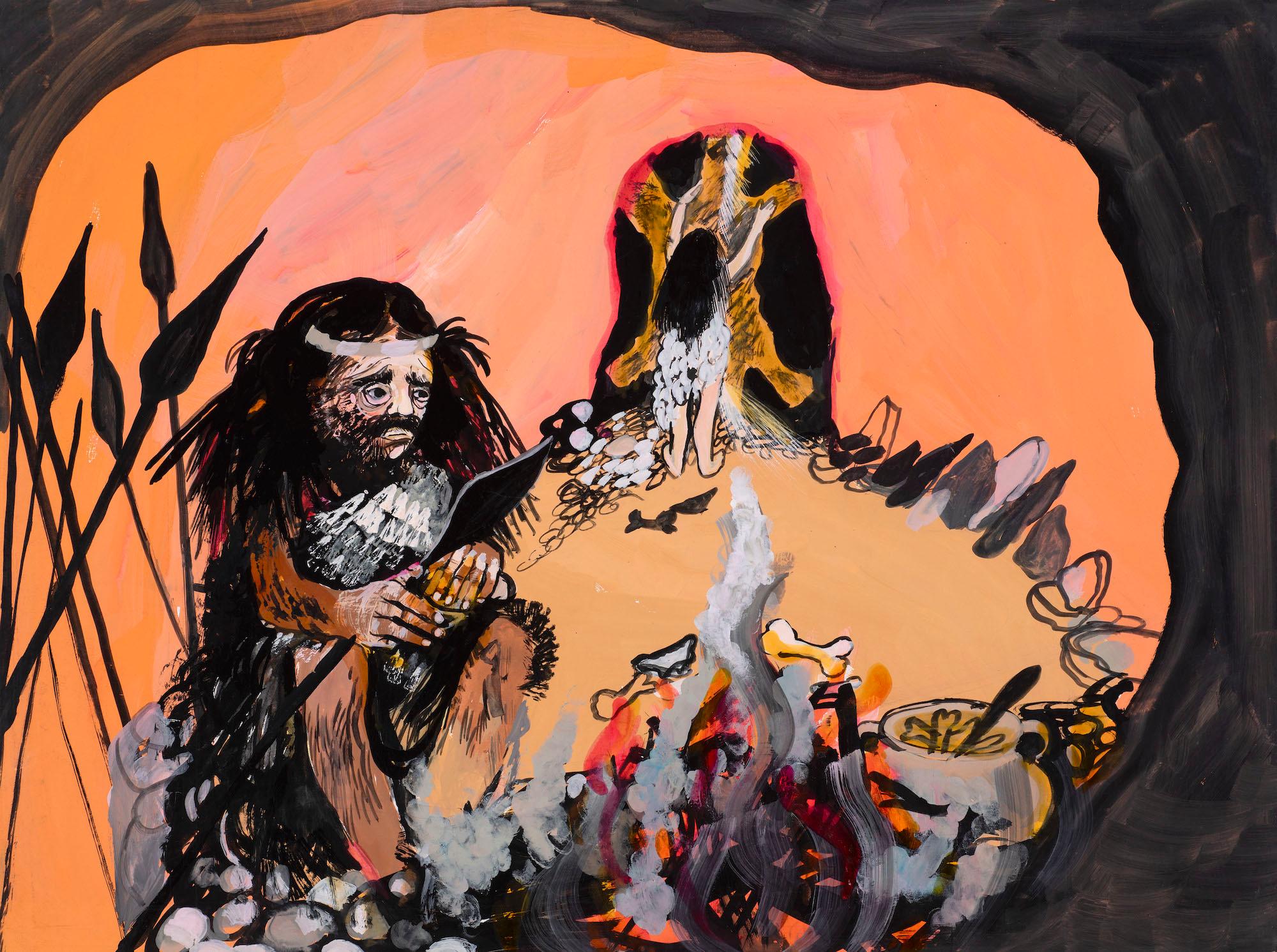
Untitled illustration for Jackanory (Just So Stories: The Cat who Walked by Himself), 1973
Janina Ede (1937-2018) created covers and illustrations for over 100 books in the 1960s, 70s and 80s. Many of her illustrations feature animals, which she drew from life. In the 1970s, Ede was commissioned to create large colourful illustrations for the BBC children’s television series, Jackanory. Each episode was dedicated to a story read by an actor, while specially commissioned illustrations were shown on screen during each programme. Some of these illustrations were for programmes featuring stories by author Rudyard Kipling. His ‘Just So’ stories were short tales that imagined how various animals attained their distinguishing features. Kipling set the stories in parts of India, West Asia and Africa. His descriptions of places and people included racist and exoticised stereotypes. Ede’s illustrations draw extensively on Kipling’s descriptions, and therefore reflect the racism in his work, as well as the prevailing stereotypical views that existed in 1970s Britain. Her own personal views are not documented. This storyboard illustration was produced by Janina Ede for Jackanory episode #1452, 'Just So Stories - The Cat that Walked by Himself'. It aired on 3 January 1973.
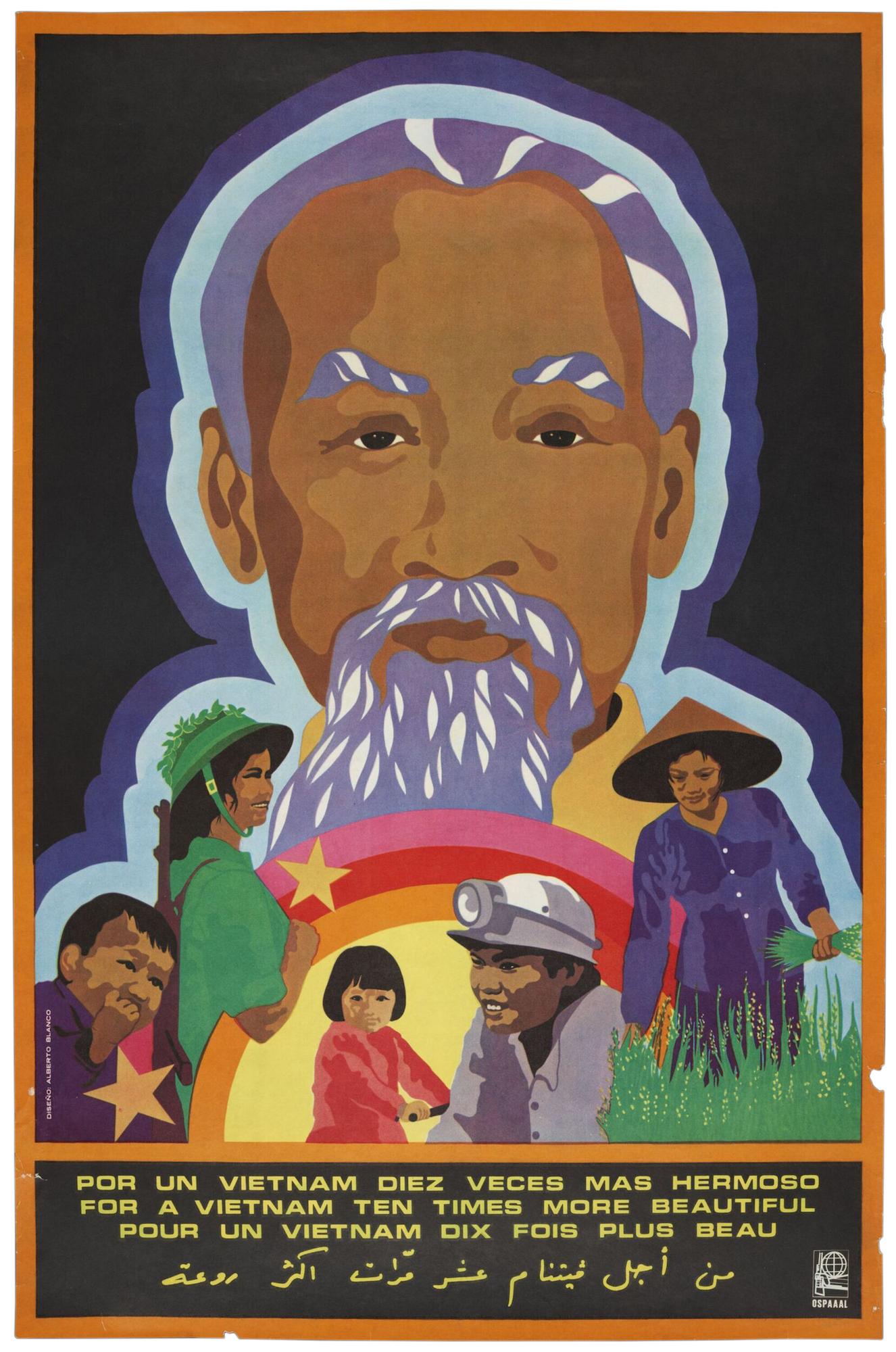
FOR A VIETNAM TEN TIMES MORE BEAUTIFUL, 1980
Between the 1960s and 1990s, more than fifty designers worked at OSPAAAL (the Organisation of Solidarity with the People of Africa, Asia and Latin America). Based in Cuba, they made magazines and posters that were sent around the world. Their aim was to promote radical political ideas. Many of their posters celebrate socialist revolutions and liberation movements from the Global South. President Hồ Chí Minh promised that a country “ten times more beautiful” would be rebuilt after the destruction caused by the war between North Vietnam and South Vietnam, allied with the U.S.A. (known as the ‘Vietnam War’ and ‘War Against the Americans to Save the Nation’).. This posthumous portrait of the leader pictures Vietnamese citizens in the socialist realist style used in propaganda posters from the Soviet Union and People’s Republic of China.
Content warning: weaponry
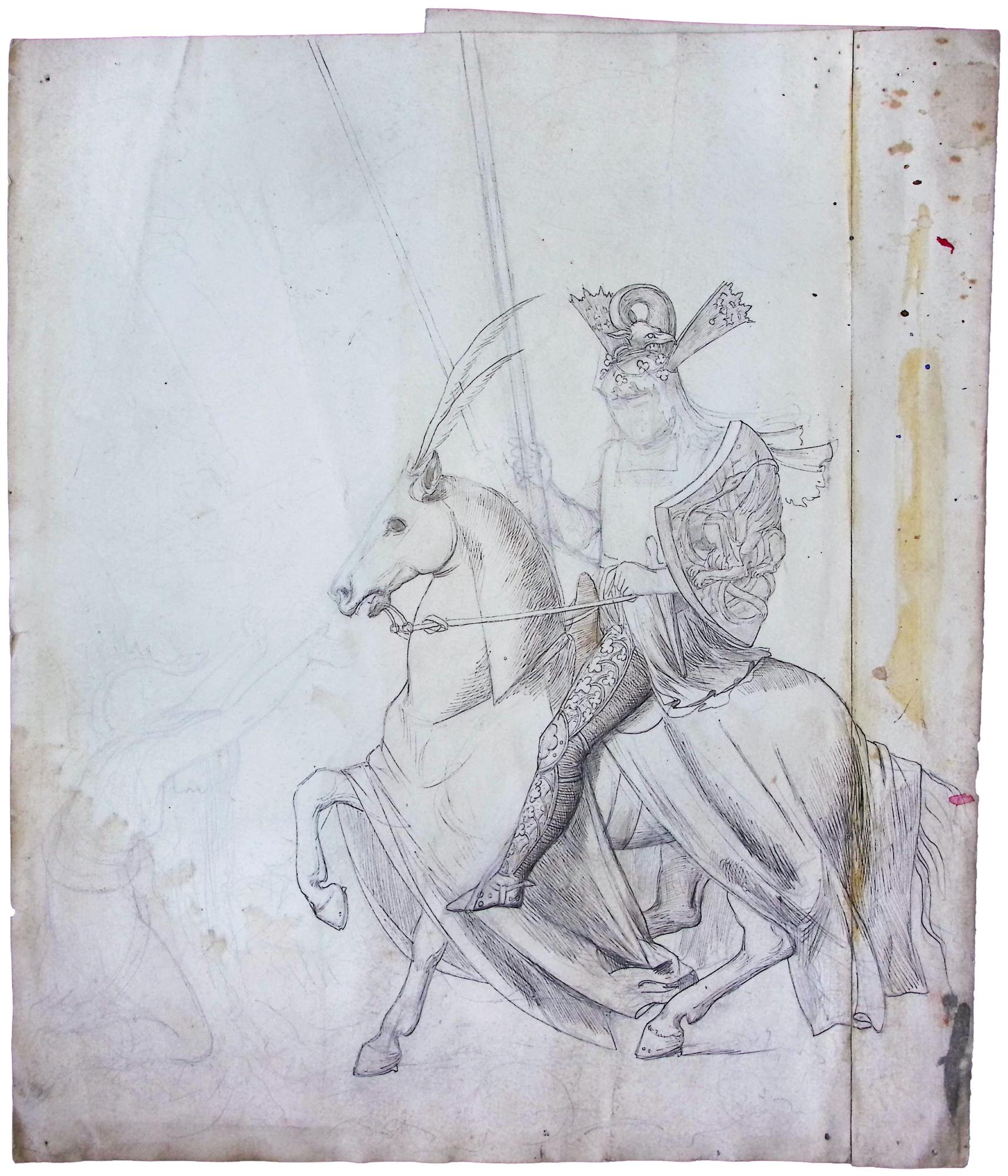
Untitled, Date unknown
Eleanor Vere Boyle (1825 – 1916) illustrated poetry and prose by some of the most popular authors of her time. She regularly drew and painted using ink and watercolour, sketching landscapes, animals and her children from life. She also made drawings from her imagination, often reflecting spiritual themes.
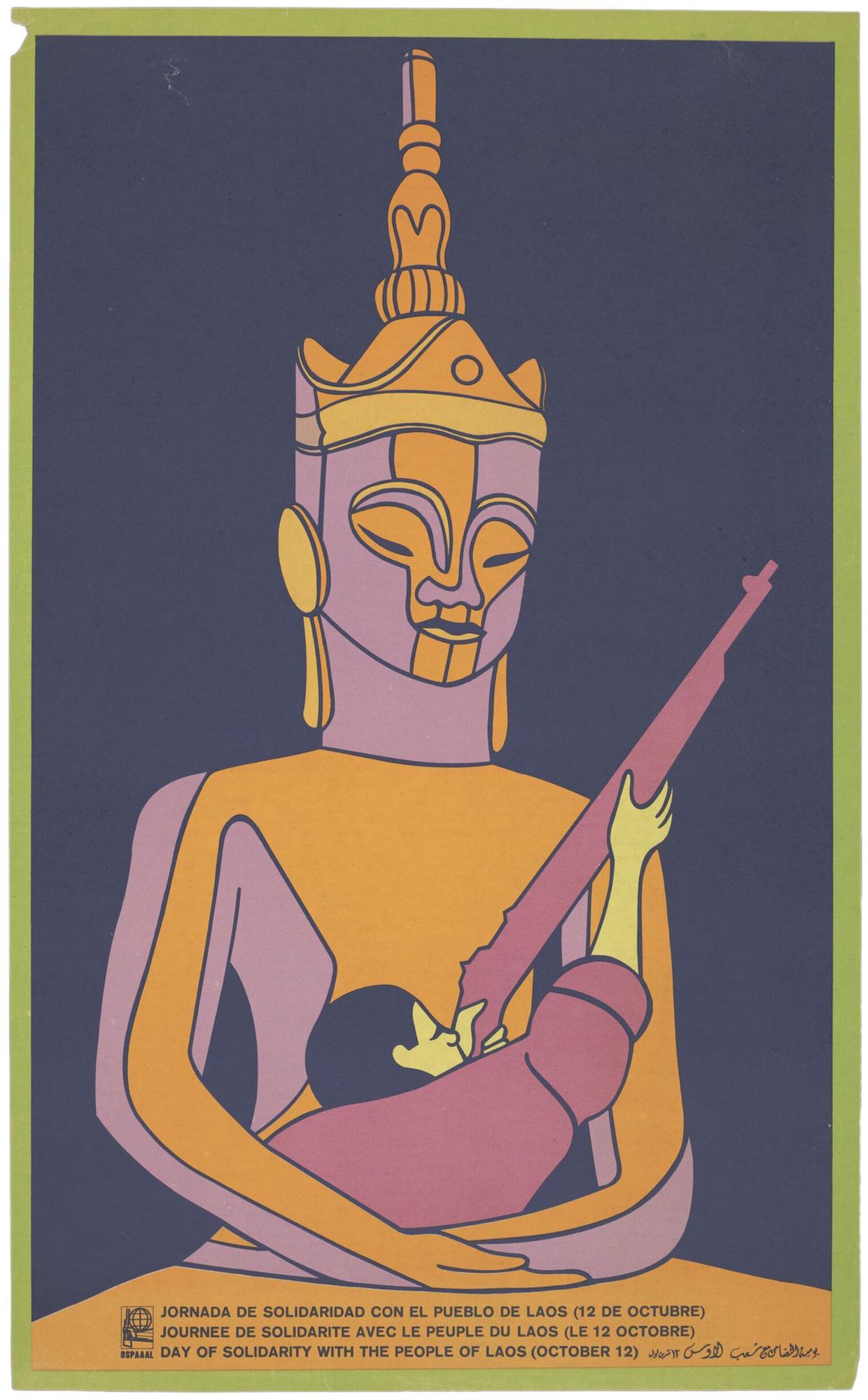
DAY OF SOLIDARITY WITH THE PEOPLE OF LAOS (OCTOBER 12), 1969
Between the 1960s and 1990s, more than fifty designers worked at OSPAAAL. Based in Cuba, they made magazines and posters that were sent around the world. Their aim was to promote radical political ideas. Many of their posters celebrate socialist revolutions and liberation movements from the Global South. This design encouraged solidarity with Laotian people on the same date as the founding of the nationalist movement Lao Issara (‘Free Laos’) on 12 October 1945.
Content warning: weaponry and religious iconography
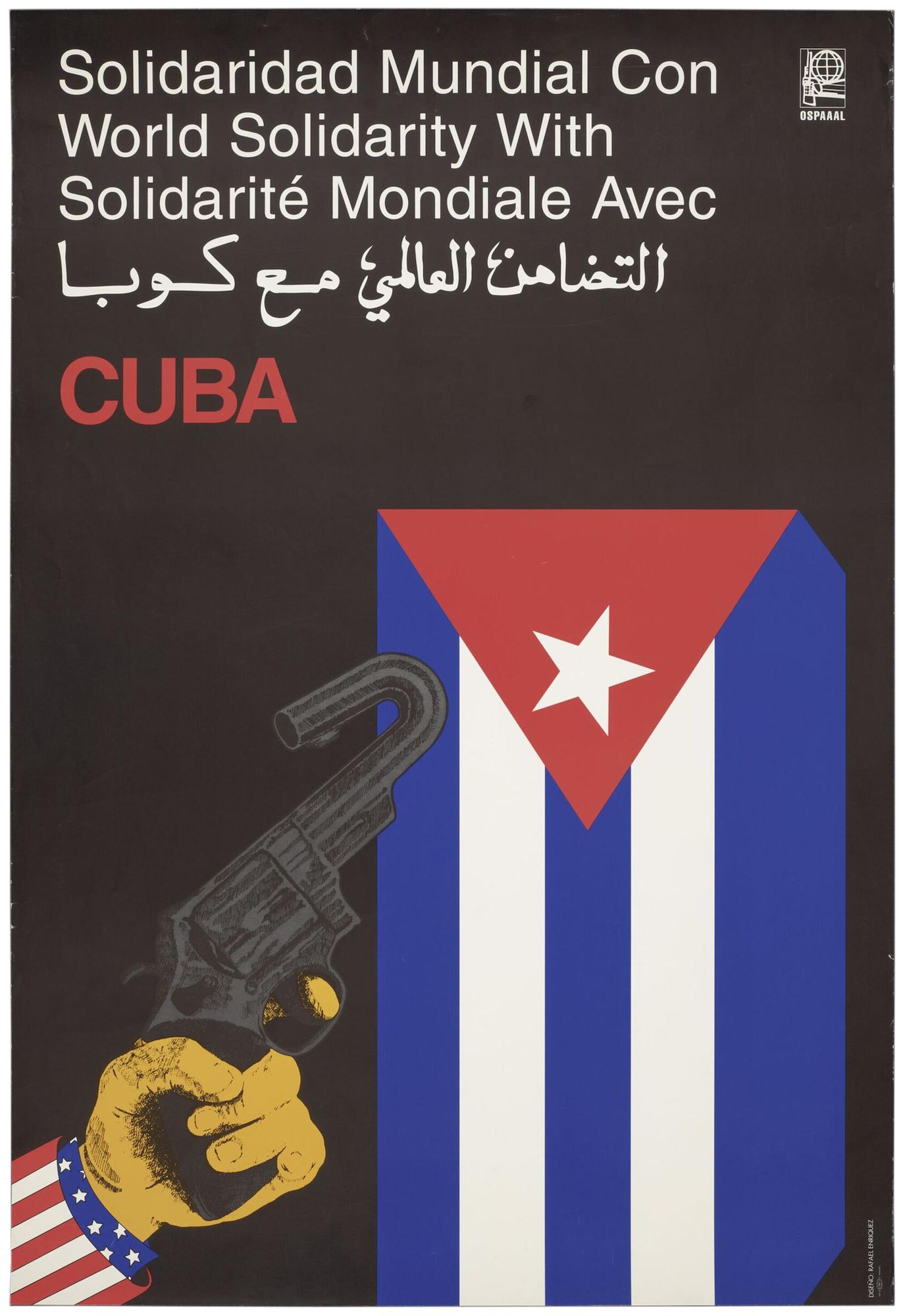
World Solidarity With CUBA, 1980
Between the 1960s and 1990s, more than fifty designers worked at OSPAAAL (the Organisation of Solidarity with the People of Africa, Asia and Latin America). Based in Cuba, they made magazines and posters that were sent around the world. Their aim was to promote radical political ideas. Many of their posters celebrate socialist revolutions and liberation movements from the Global South. They also criticised the foreign policy of the U.S.A. In this design, the Cuban flag represents the Cuban revolution repelling the U.S. military, represented by the hand of fictional character Uncle Sam.
Content warning: weaponry
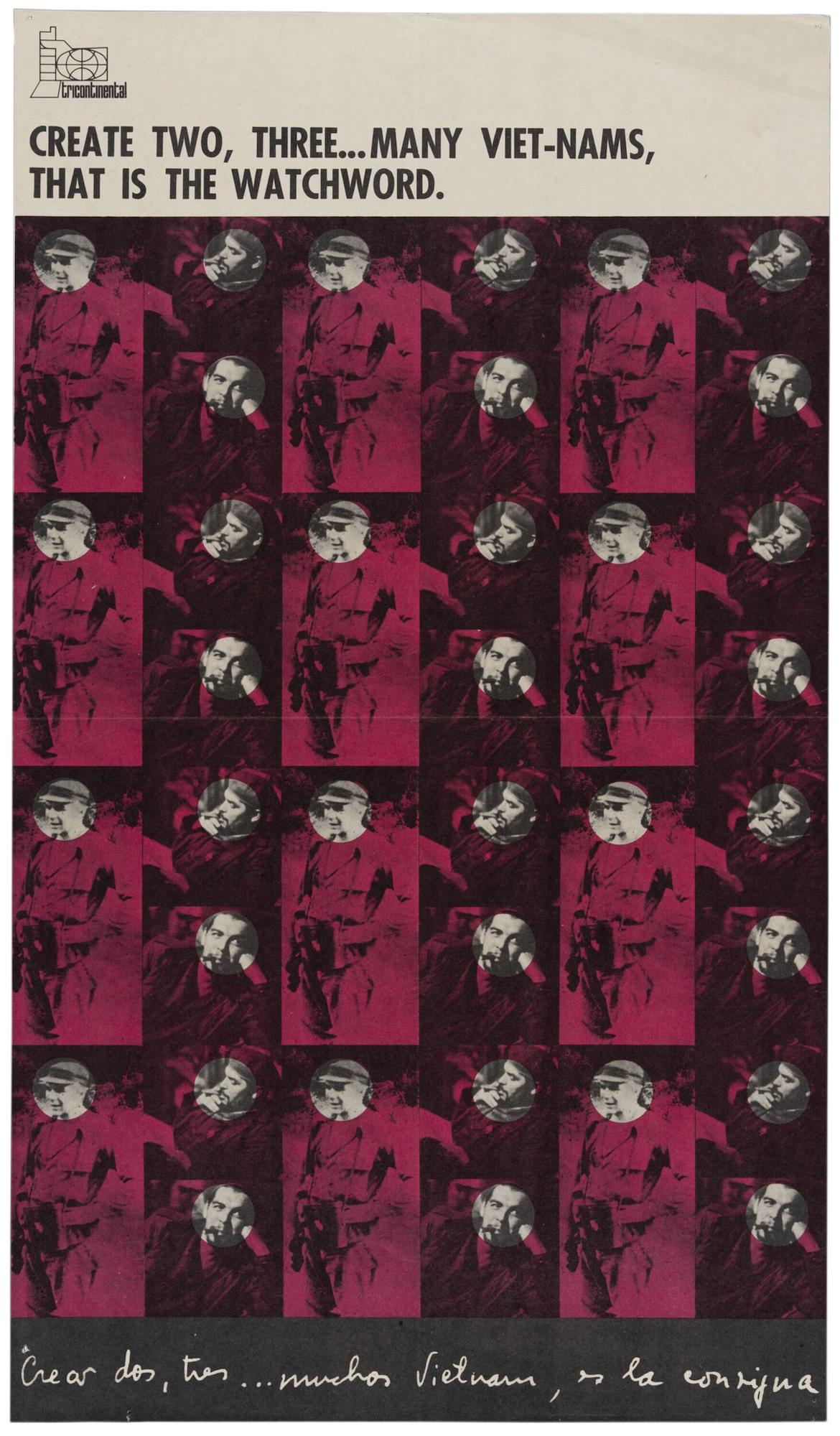
CREATE TWO, THREE...MANY VIET-NAMS, THAT IS THE WATCHWORD, 1967
Between the 1960s and 1990s, more than fifty designers worked at OSPAAAL (the Organisation of Solidarity with the People of Africa, Asia and Latin America). Based in Cuba, they made magazines and posters that were sent around the world. Their aim was to promote radical political ideas. Many of their posters celebrate socialist revolutions and liberation movements from the Global South. The first edition of OSPAAAL’s Tricontinental magazine was a special supplement dedicated to Che Guevara’s Message to the Tricontinental. His manifesto presented Vietnamese Communists opposing U.S. military forces in Vietnam as a model for patriotic resistance. It contained the only poster of the guerrilla leader made during his lifetime – Guevara was killed in Bolivia six months after its issue. OSPAAAL’s designers often used repetition of photographic as a way to create bold illustrations with limited resources. The studio’s first art director Alfredo Rostgaard said that “from the need to solve our material problems, we began to discover new forms”
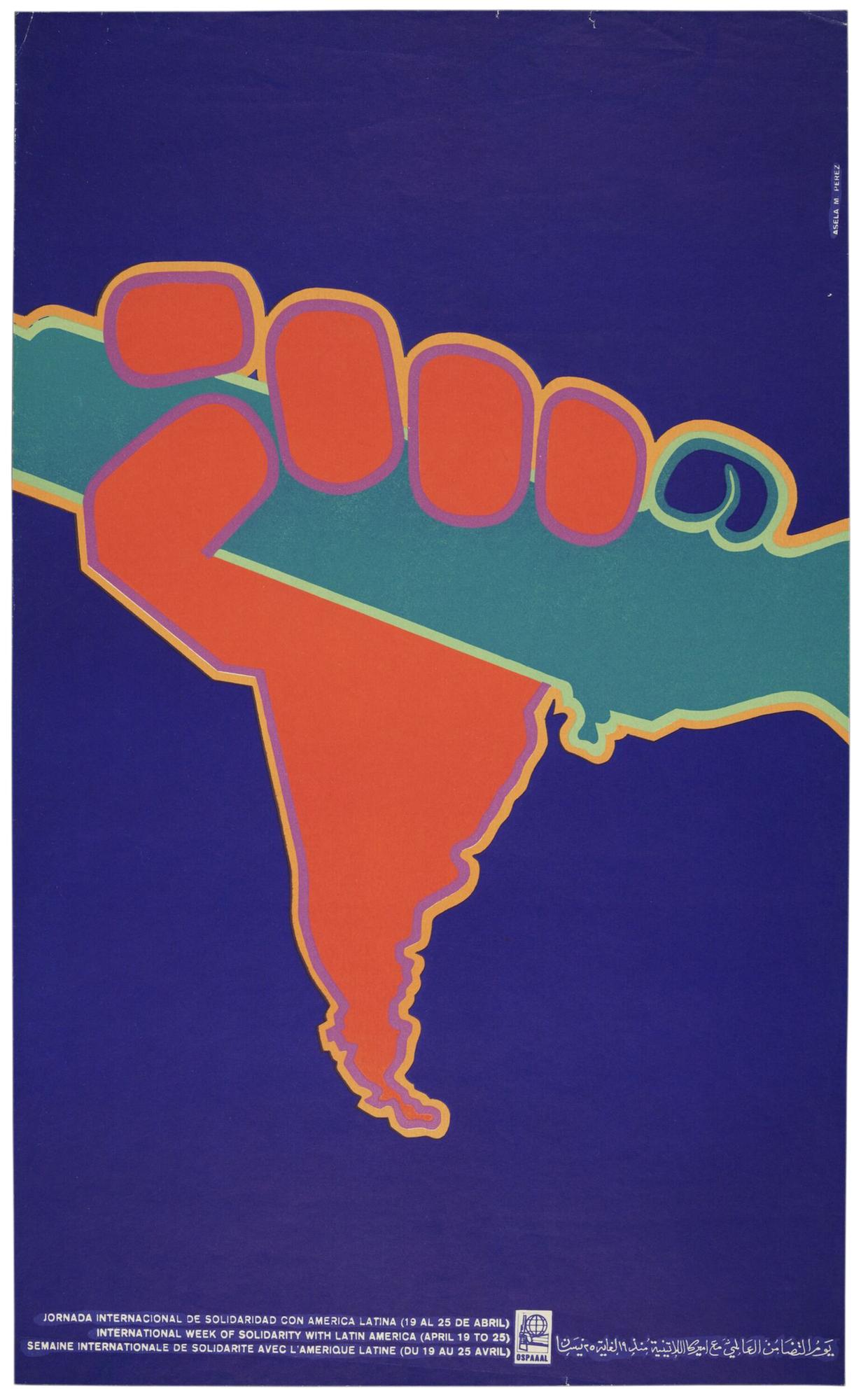
INTERNATIONAL WEEK OF SOLIDARITY WITH LATIN AMERICA (APRIL 19 TO 25), 1970
Between the 1960s and 1990s, more than fifty designers worked at OSPAAAL (the Organisation of Solidarity with the People of Africa, Asia and Latin America). Based in Cuba, they made magazines and posters that were sent around the world. Their aim was to promote radical political ideas. Many of their posters celebrate socialist revolutions and liberation movements from the Global South.
Content warning: weaponry
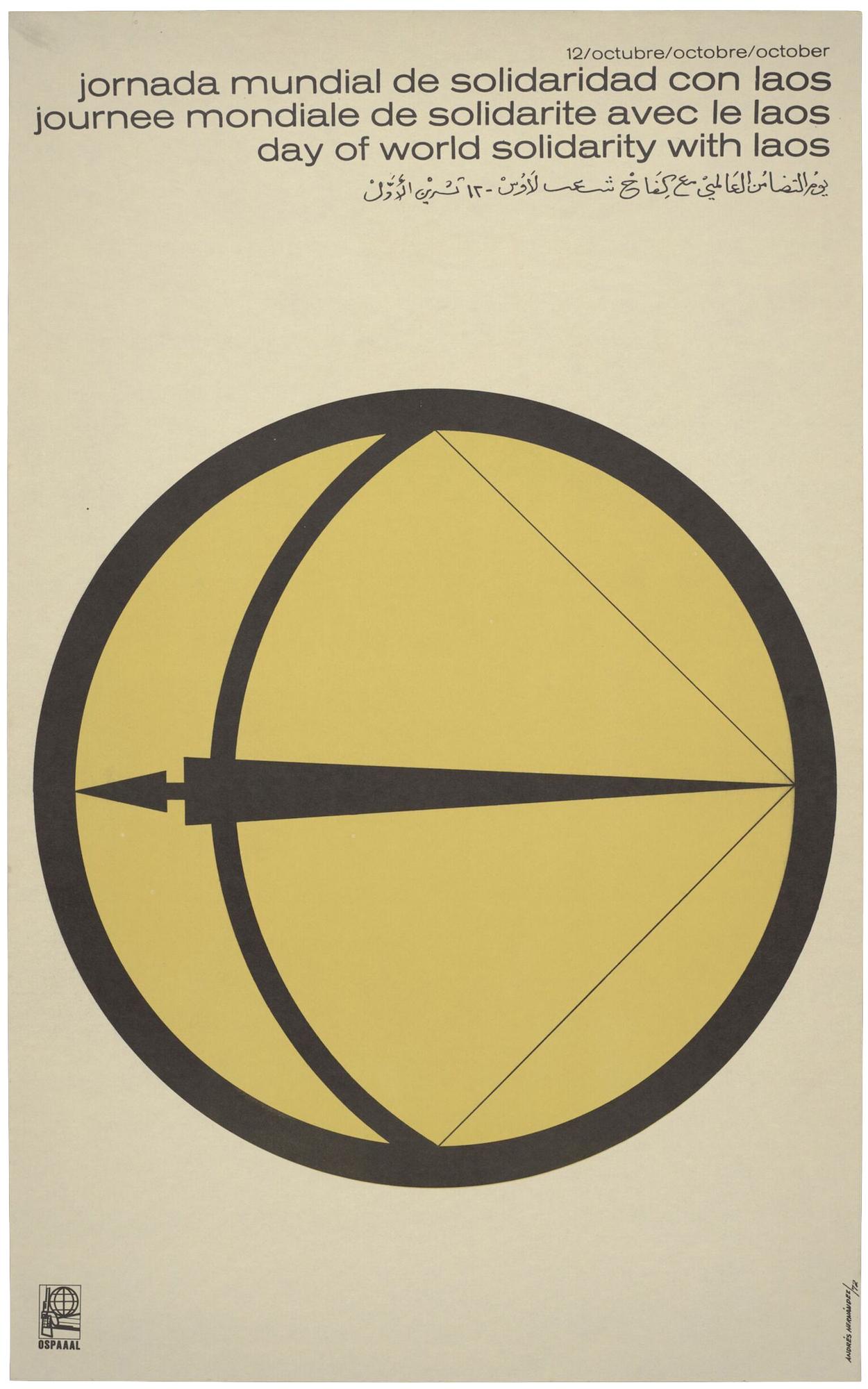
12 october - day of world solidarity with laos, 1972
Between the 1960s and 1990s, more than fifty designers worked at OSPAAAL. Based in Cuba, they made magazines and posters that were sent around the world. Their aim was to promote radical political ideas. Many of their posters celebrate socialist revolutions and liberation movements from the Global South. This design encouraged solidarity with Laotian people on the same date as the founding of the nationalist movement Lao Issara (‘Free Laos’) on 12 October 1945.
Content warning: weaponry
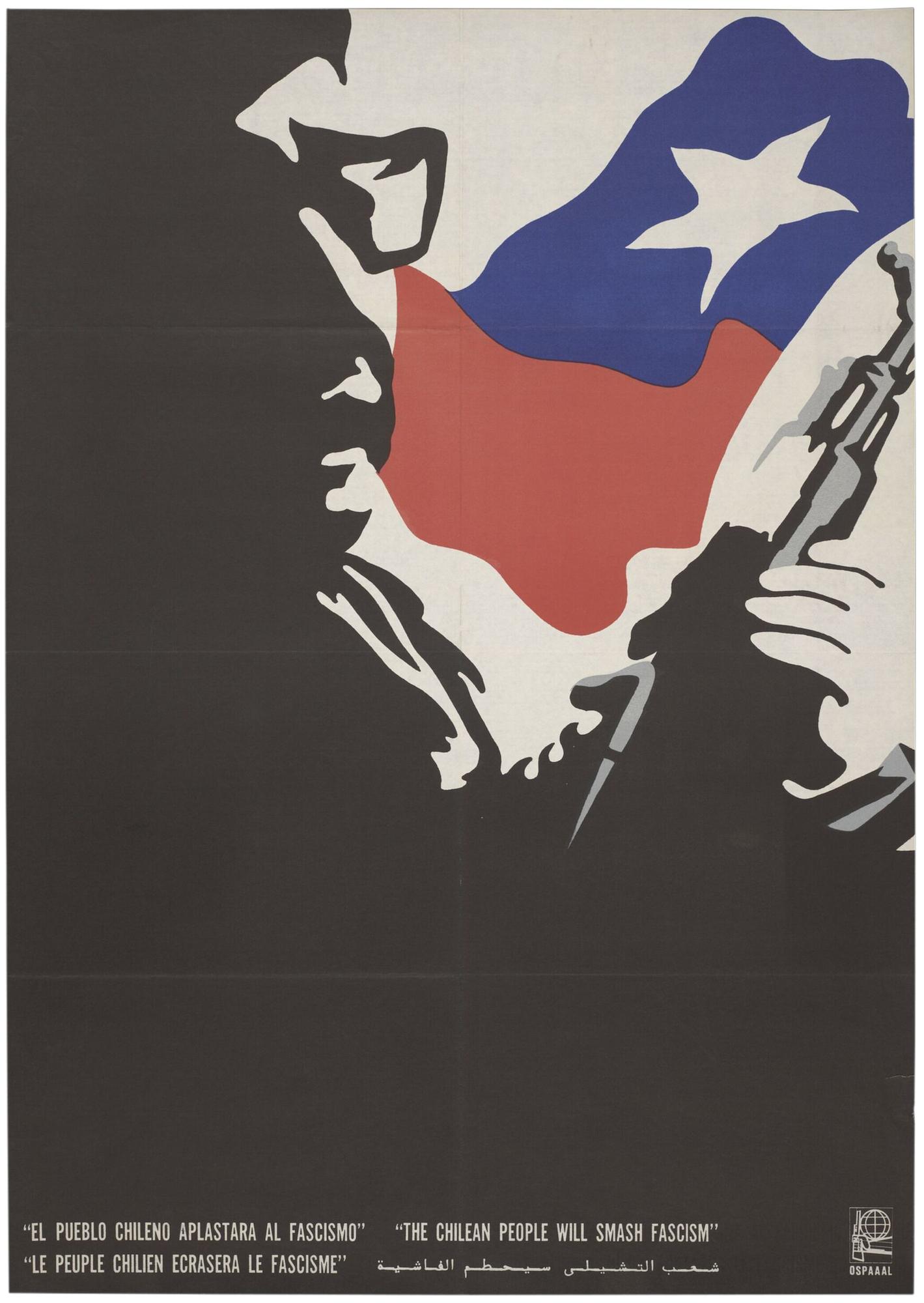
“THE CHILEAN PEOPLE WILL SMASH FASCISM”, 1976
Between the 1960s and 1990s, more than fifty designers worked at OSPAAAL. Based in Cuba, they made magazines and posters that were sent around the world. Their aim was to promote radical political ideas. Many of their posters celebrate socialist revolutions and liberation movements from the Global South. Figurative painter Ernesto García Peña’s only poster for OSPAAAL portrayed the socialist Chilean President Salvador Allende.
Content warning: weaponry
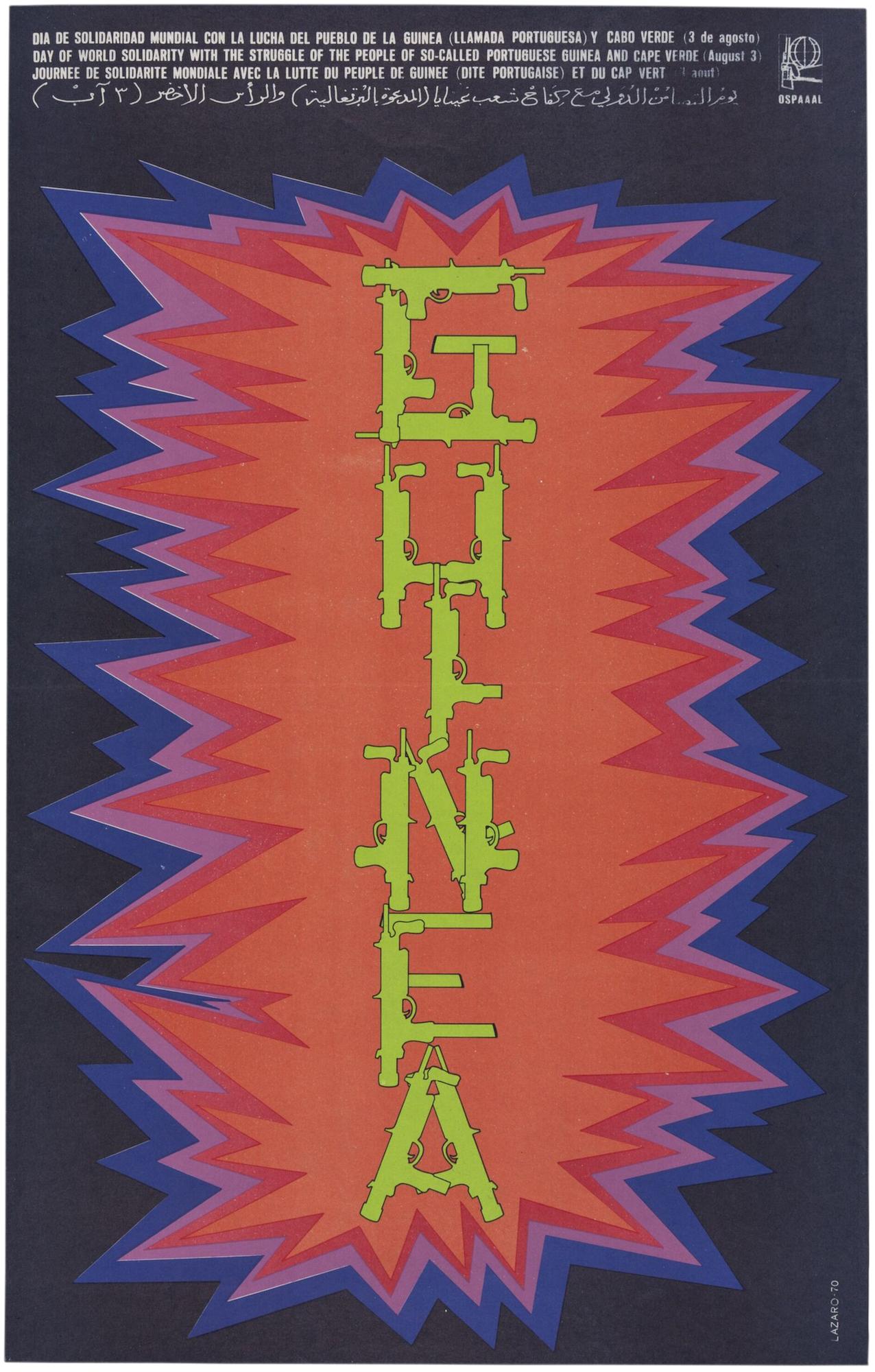
GUINEA - Day of World Solidarity with the Struggle of the People of so-called Portuguese Guinea and Cape Verde (August 3), 1970
Between the 1960s and 1990s, more than fifty designers worked at OSPAAAL (the Organisation of Solidarity with the People of Africa, Asia and Latin America). Based in Cuba, they made magazines and posters that were sent around the world. Their aim was to promote radical political ideas. Many of their posters celebrate socialist revolutions and liberation movements from the Global South. This poster was designed to mark a day of solidarity with liberation movements in Cape Verde and Guinea-Bissau seeking independence from Portuguese colonial rule, on the date of the Pidjiguiti massacre.
Content warning: weaponry
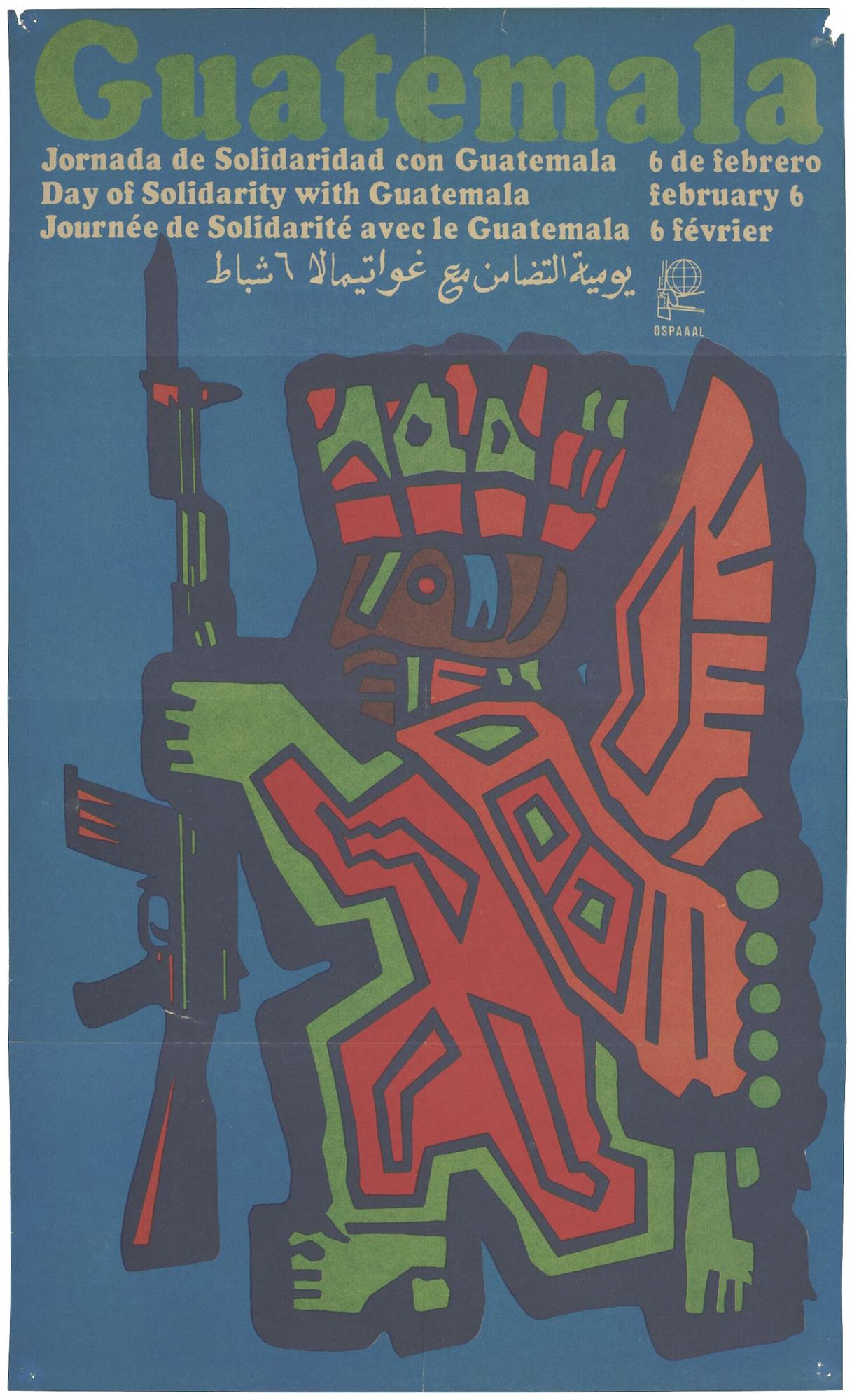
Day of Solidarity with Guatemala - february 6, 1968
Between the 1960s and 1990s, more than fifty designers worked at OSPAAAL. Based in Cuba, they made magazines and posters that were sent around the world. Their aim was to promote radical political ideas. Many of their posters celebrate socialist revolutions and liberation movements from the Global South. This poster was issued in support of leftist rebels fighting against the Guatemalan government during the Guatemalan Civil War. It shows a Mayan god holding an assault rifle. Many OSPAAAL designers combined images of Indigenous art and craft with weaponry. Their aim was to argue for the right to self-determination and support liberation movements opposing oppressive powers. However, the designers did not always know the meaning or origin of the iconography they used.
Content warning: weaponry
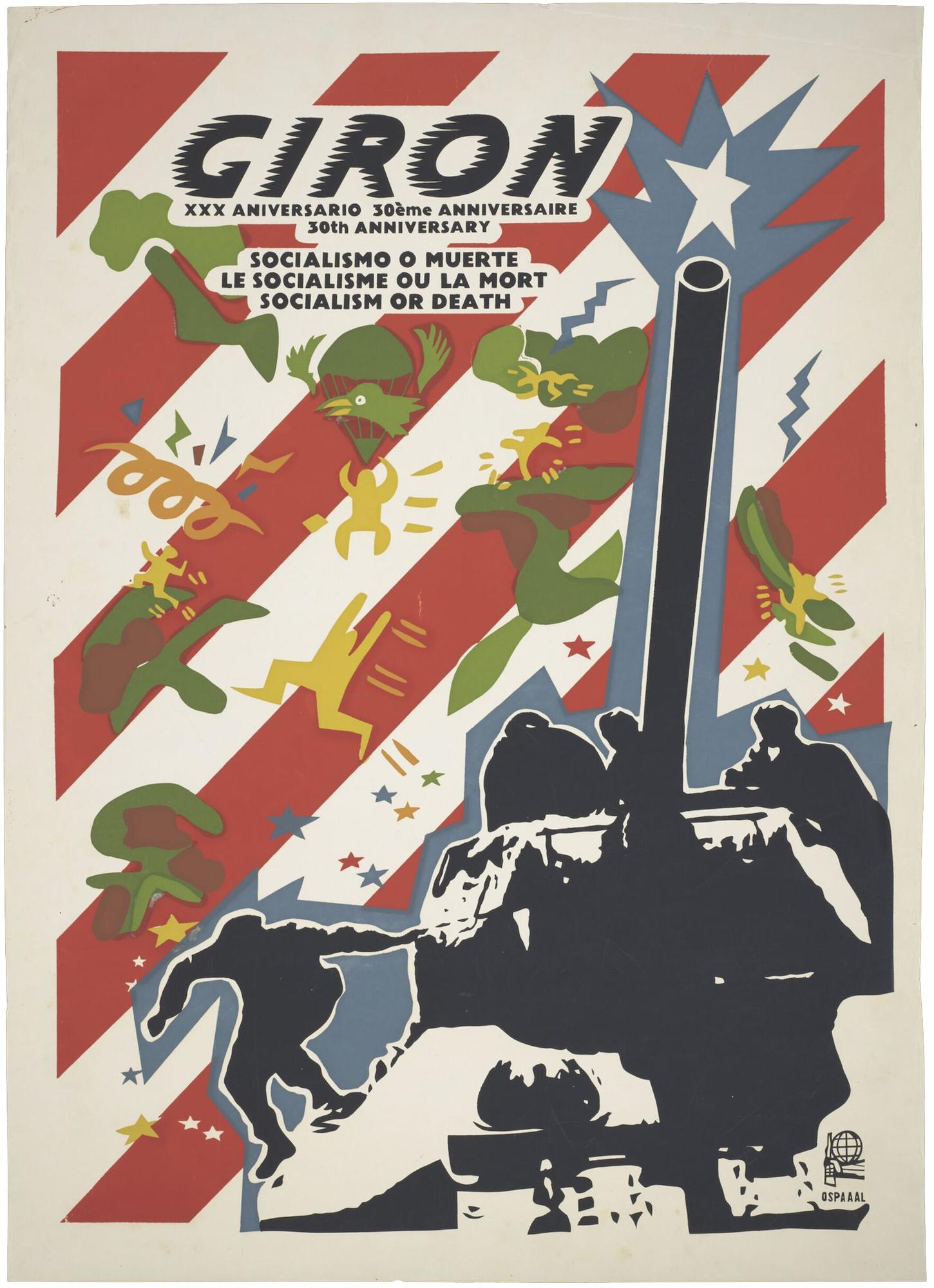
GIRON - 30th ANNIVERSARY - SOCIALISM OR DEATH, 1969
Between the 1960s and 1990s, more than fifty designers worked at OSPAAAL. Based in Cuba, they made magazines and posters that were sent around the world. Their aim was to promote radical political ideas. Many of their posters celebrate socialist revolutions and liberation movements from the Global South. In 1961, a military group sponsored by the U.S. Central Intelligence Agency invaded Cuba in an attempt to overthrow Fidel Castro. Eladio Rivadulla Pérez used a press photograph of Castro jumping from a tank for his commemorative poster design.
Content warning: weaponry
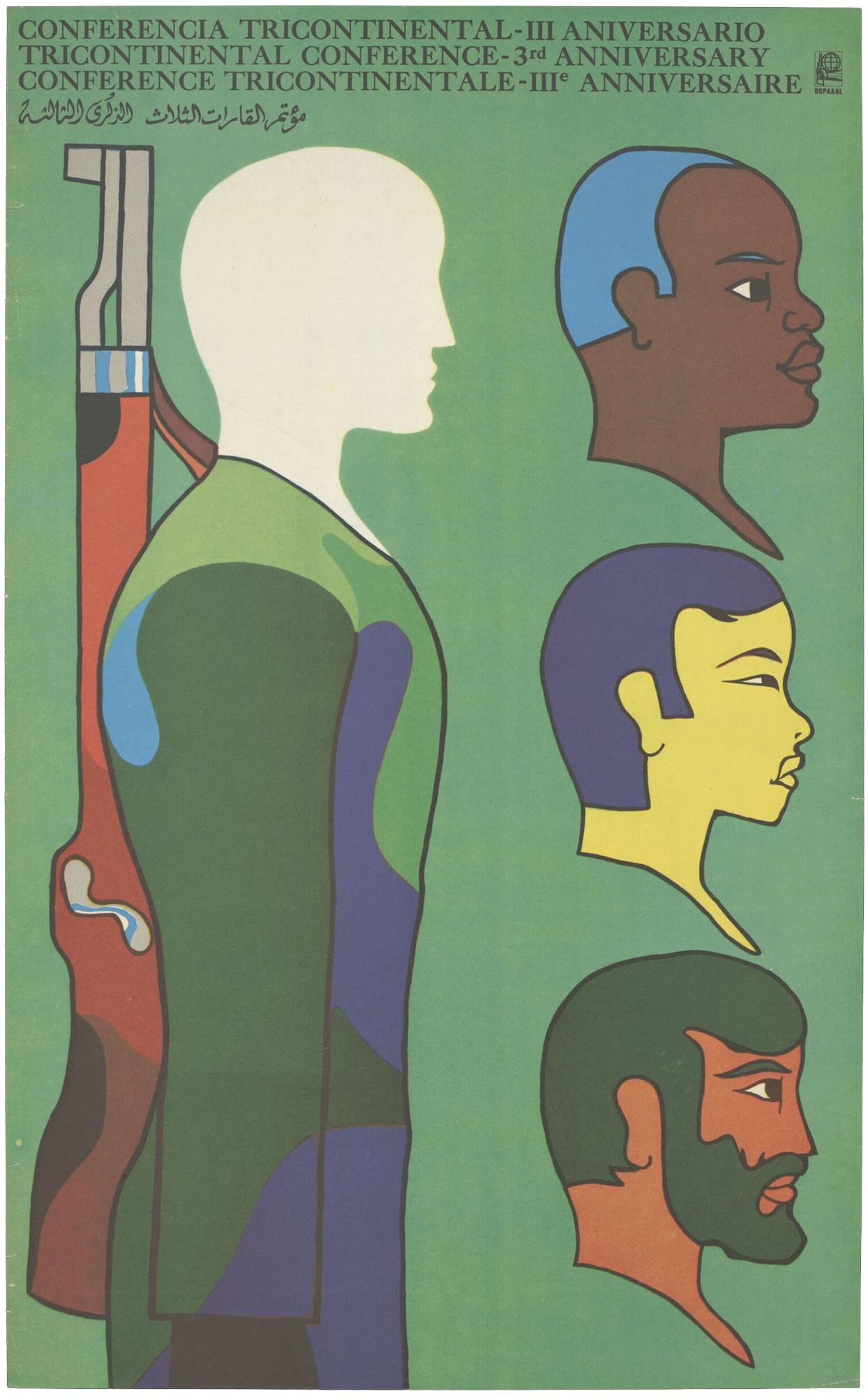
TRICONTINENTAL CONFERENCE - 3rd ANNIVERSARY, 1969
Between the 1960s and 1990s, more than fifty designers worked at OSPAAAL (the Organisation of Solidarity with the People of Africa, Asia and Latin America). Based in Cuba, they made magazines and posters that were sent around the world. Their aim was to promote radical political ideas. Many of their posters celebrate socialist revolutions and liberation movements from the Global South. OSPAAAL was established after the Tricontinental conference held in Havana in 1966. Representatives from 82 governments and national liberation movements discussed their positions on politics, economics, development and culture. Fidel Castro summarised their unifying aim as “the struggle against colonialism, racism and imperialism.” This commemorative poster uses three characters to represent Africa, Asia and Latin America as united by a common purpose.
Content warning: weaponry
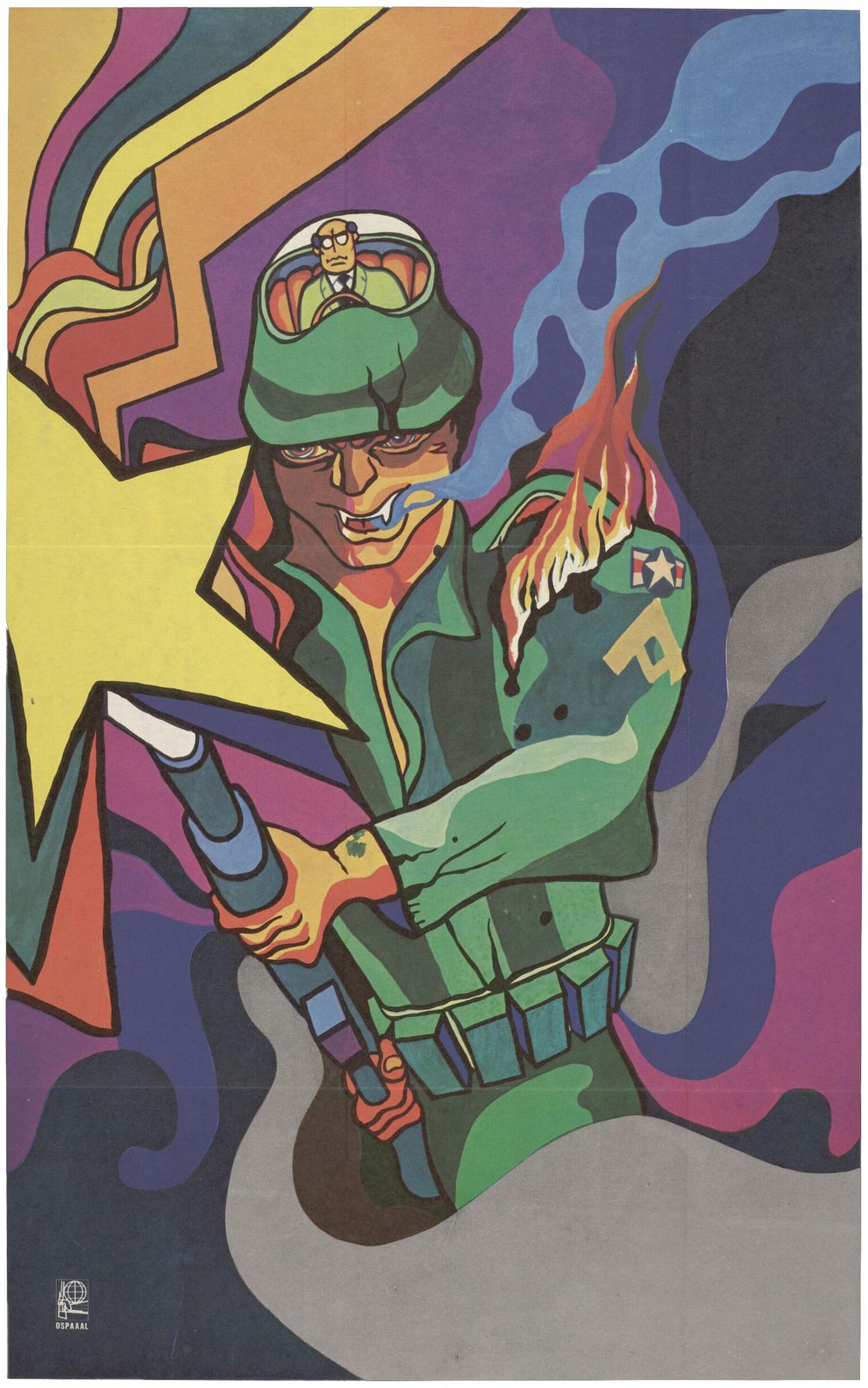
Untitled, 1969
Between the 1960s and 1990s, more than fifty designers worked at OSPAAAL. Based in Cuba, they made magazines and posters that were sent around the world. Their aim was to promote radical political ideas. Many of their posters celebrate socialist revolutions and liberation movements from the Global South. Alfredo Rostgaard was OSPAAAL’s creative director from 1966 to 1976. His began his career as a caricaturist for socialist children’s comic Mella. Rostgaard’s vampire-like US Air Force soldier is being driven like a machine. His design was used by OSPAAAL to criticise US military action.
Content warning: weaponry
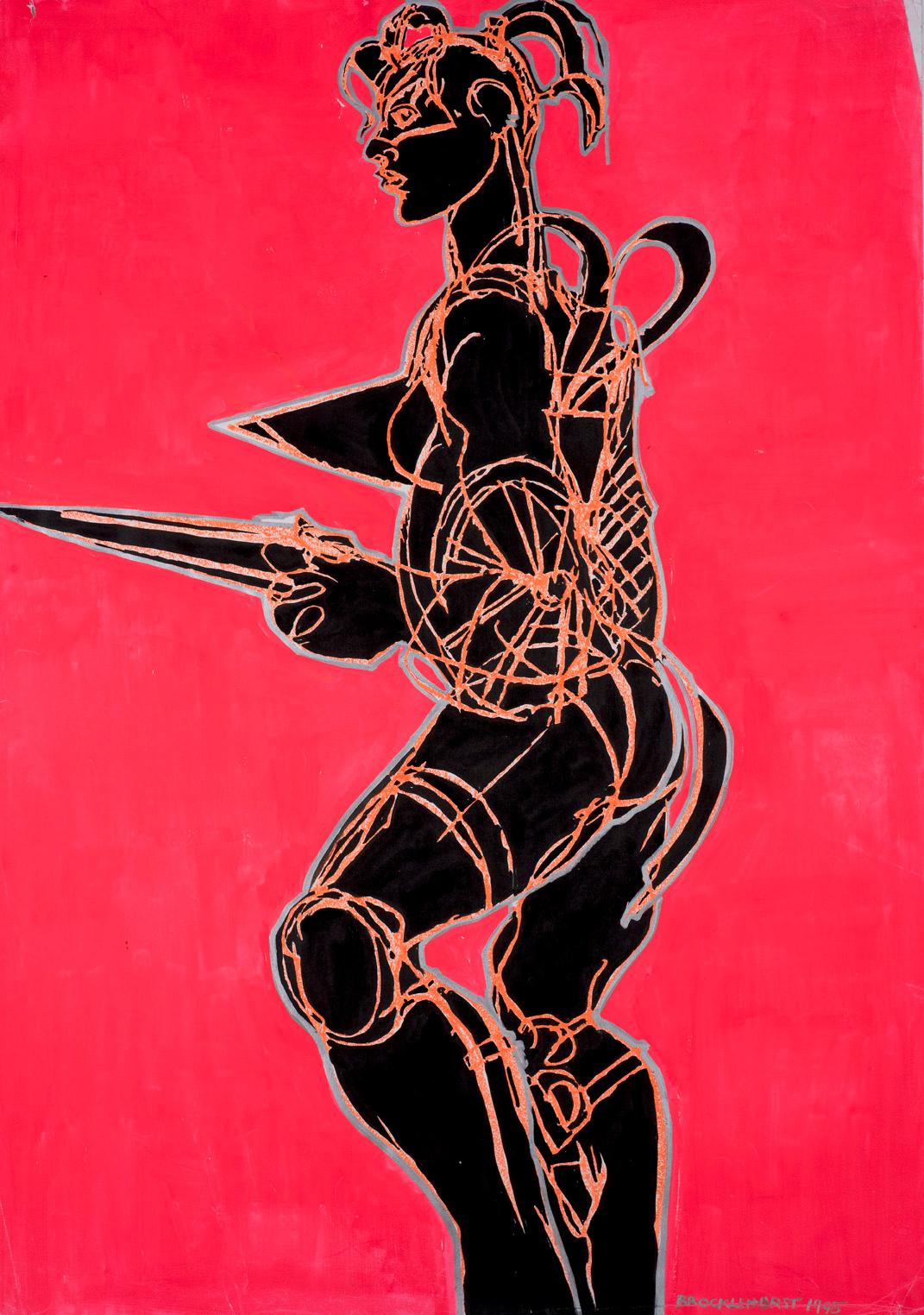
Jo Brocklehurst, Untitled (portrait of Fia Bergsren), 1995
Jo (Josephine) Brocklehurst (1935 - 2006) studied at Central Saint Martins and began her career as a fashion illustrator. She later focused on portraiture, drawing directly from models at her studio in West Hampstead and in nightclubs and theatres in Berlin, London and New York. Her work documents the alternative subcultures of the 1970s, 80s and 90s that went on to shape mainstream fashion and performance scenes. In the 1990s, Brocklehurst began drawing the fashion designers and performers finding space for experimentation in the fetish clubs of Soho and King’s Cross.
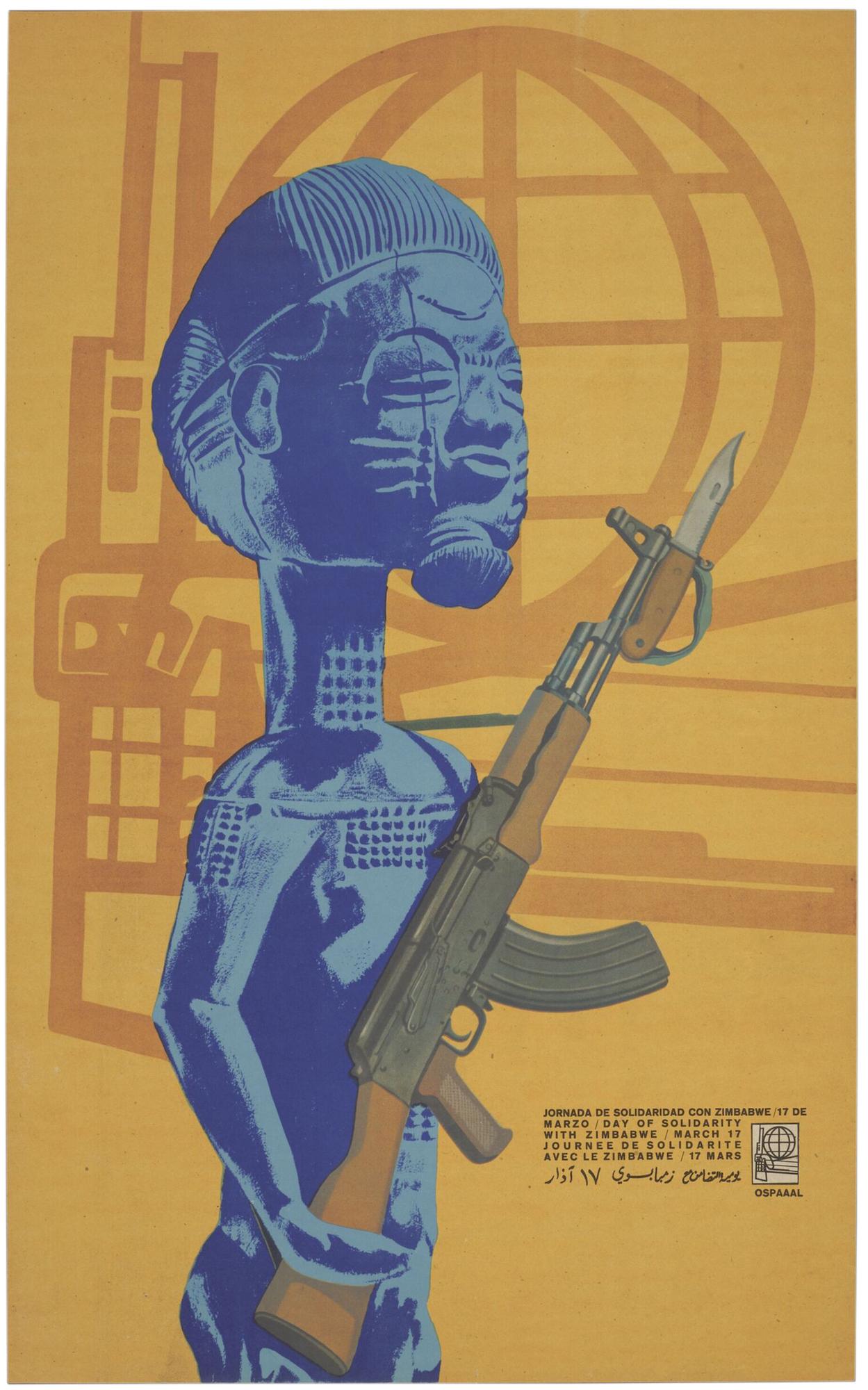
DAY OF SOLIDARITY WITH ZIMBABWE - MARCH 17, 1969
Between the 1960s and 1990s, more than fifty designers worked at OSPAAAL. Based in Cuba, they made magazines and posters that were sent around the world. Their aim was to promote radical political ideas. Many of their posters celebrate socialist revolutions and liberation movements from the Global South. Many OSPAAAL designers combined images of Indigenous art and craft with weaponry. Their aim was to argue for the right to self-determination and support liberation movements opposing colonial and imperial powers. However, the designers did not always know the meaning or origin of the iconography they used.
Content warning: weaponry