Brown
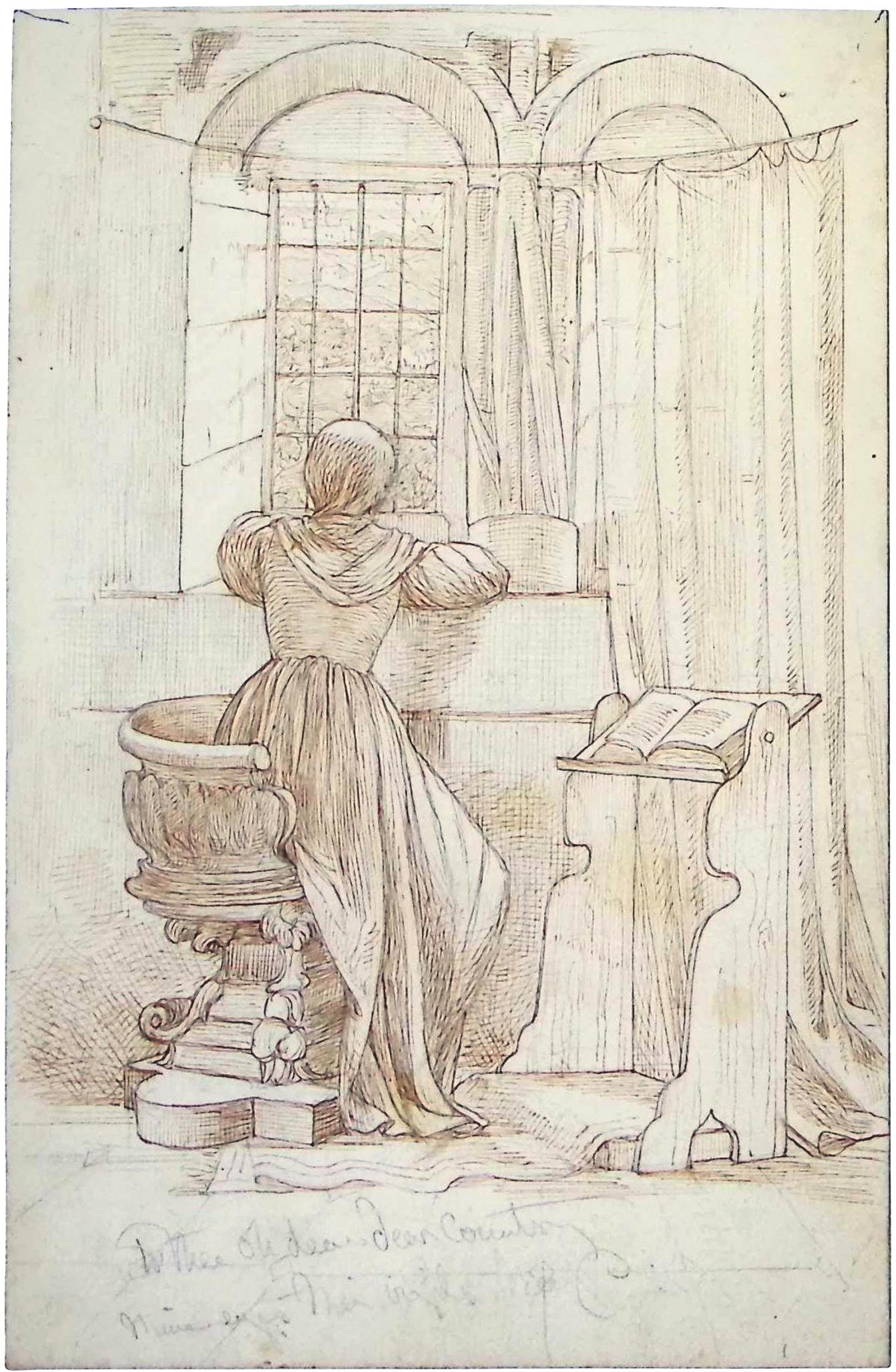
Untitled (For thee, oh dear, dear country), Date unknown
Eleanor Vere Boyle (1825 – 1916) illustrated poetry and prose by some of the most popular authors of her time. She regularly drew and painted using ink and watercolour, sketching landscapes, animals and her children from life. She also made drawings from her imagination, often reflecting spiritual themes.
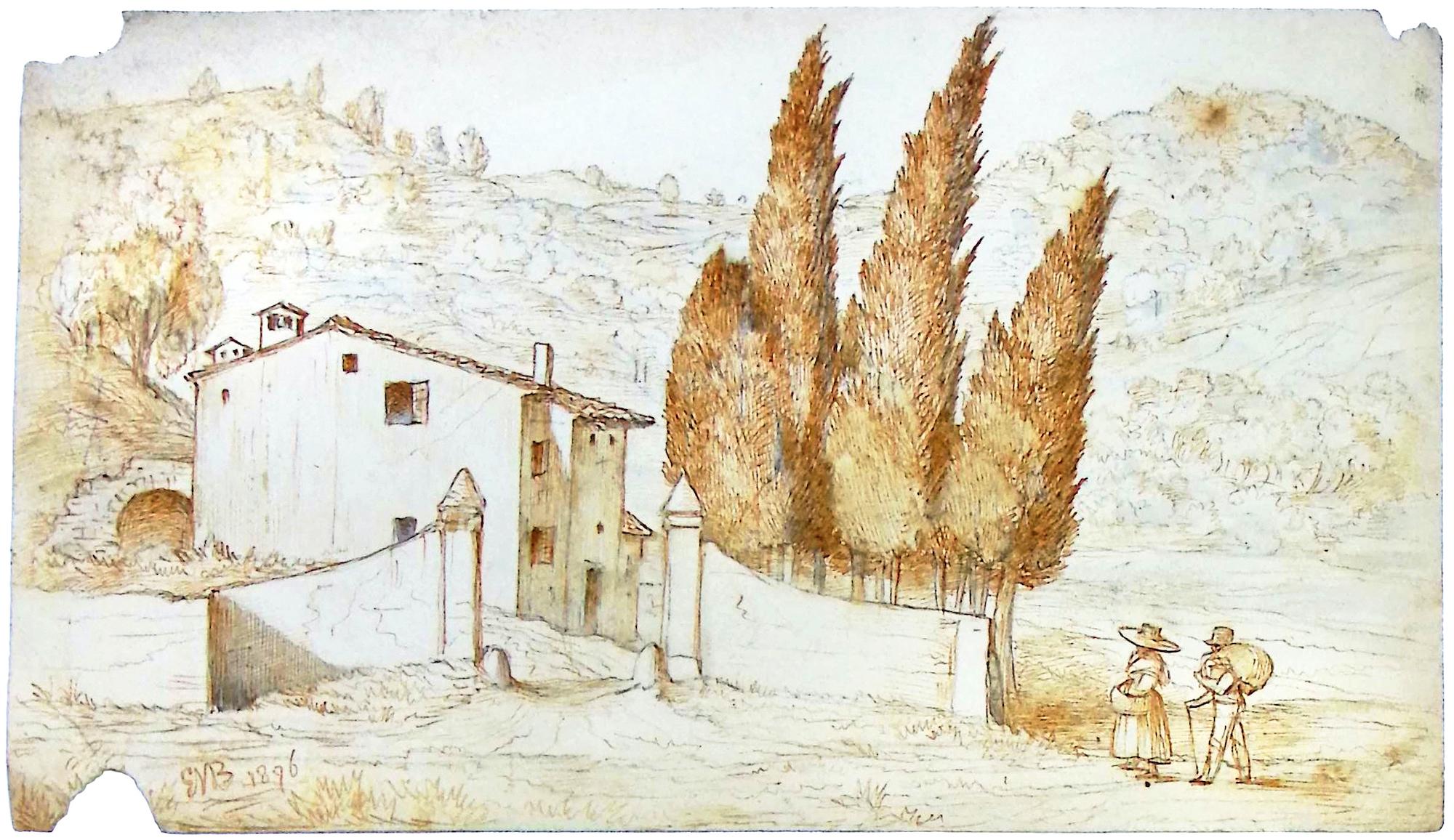
Untitled, 1896
Eleanor Vere Boyle (1825 – 1916) illustrated poetry and prose by some of the most popular authors of her time. She regularly drew and painted using ink and watercolour, sketching landscapes, animals and her children from life. She also made drawings from her imagination, often reflecting spiritual themes.
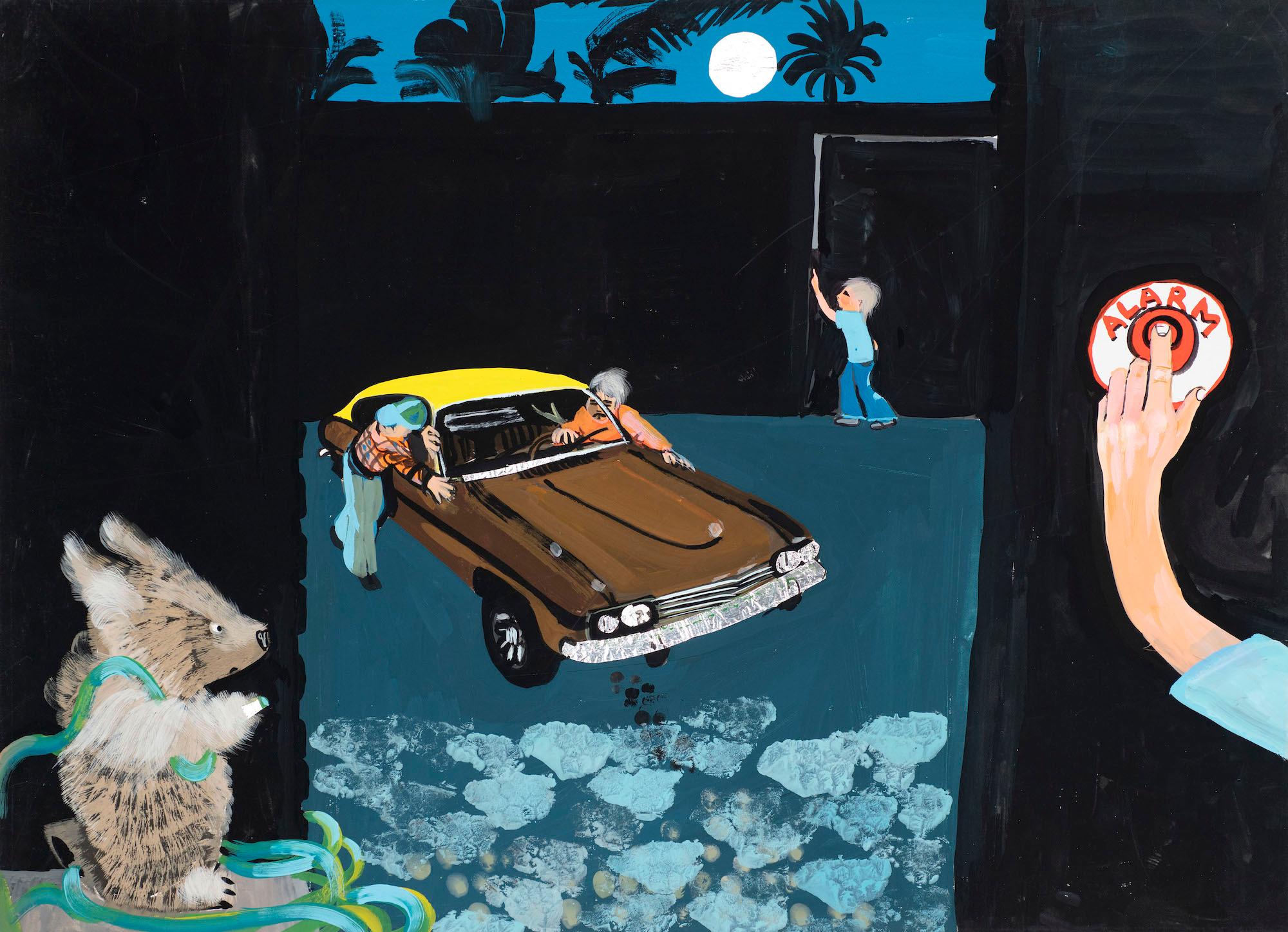
Untitled illustration for Jackanory (Mary Plain Goes to America) , 1972
British illustrator Janina Ede (1937-2018) created covers and illustrations for over 100 books from the 1950s to the 1980s. In the 1970s, she made illustrations for Jackanory, a BBC television programme. During each episode, an actor read a story, while specially-commissioned illustrations were shown on screen. For the televised version of Mary Plain Goes to America, Ede created paintings on large boards. These allowed the camera to pan across her image, showing a little at a time. BBC1 had only been in colour for three years, and so Ede used bold colours painted in gouache and reflective collaged foil to make the most of the new technology. This storyboard illustration was produced by Janina Ede for Jackanory episode #1428, 'Mary Plain Goes to America: Part 3 - Mary the Hero'. It aired on 15 November 1972.
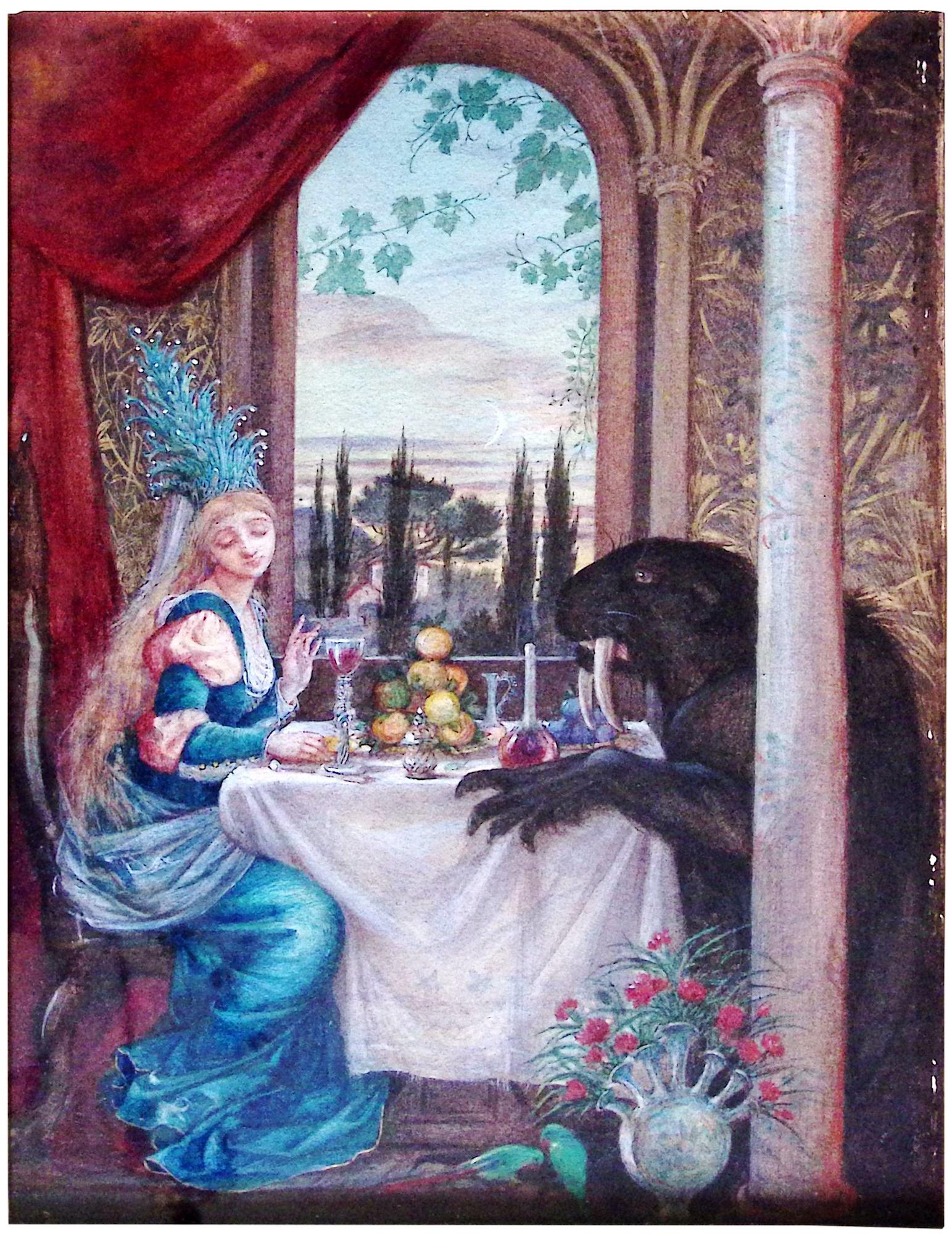
Beauty and the Beast at supper (illustration for Beauty and the Beast), c. 1875
Eleanor Vere Boyle (1825 – 1916) illustrated poetry and prose by some of the most popular authors of her time. She regularly drew and painted using ink and watercolour, sketching landscapes, animals and her children from life. She also made drawings from her imagination, often reflecting spiritual themes. This illustration is from Boyle’s 1875 retelling of Beauty and the Beast, a fairy tale where a woman is imprisoned by a monster and falls in love with him. Unlike other illustrated versions before or since, Boyle gave her beast walrus-like tusks and flippers. In several of her illustrations, Boyle used shell gold – a mixture of finely ground gold powder and gum arabic (tree sap) that would have been stored in a shallow seashell. In the final publication, the caption for this illustration reads, "After supper, every night, the Beast asked Beauty to be his wife: every night she said him nay."
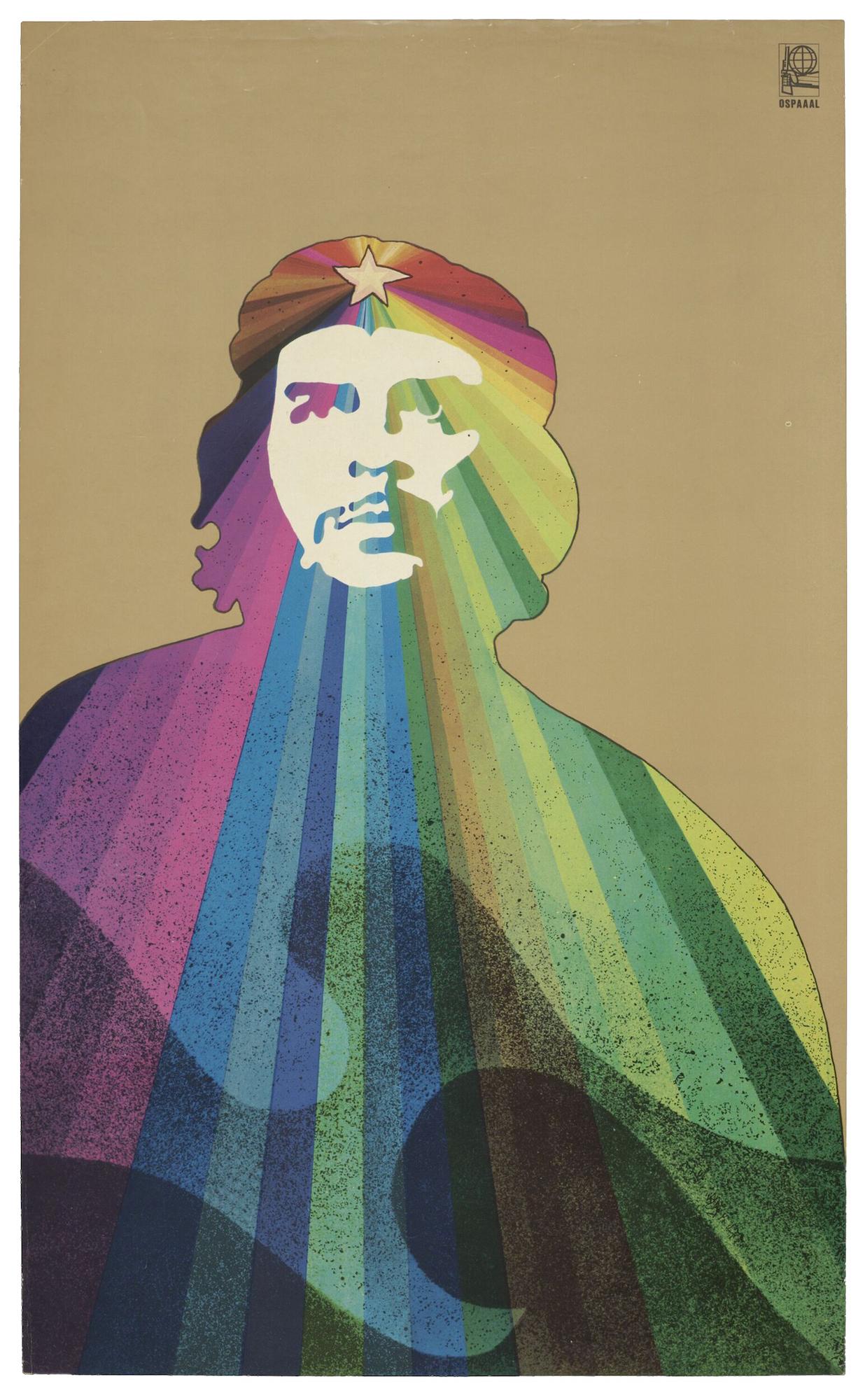
Untitled, 1969
Between the 1960s and 1990s, more than fifty designers worked at OSPAAAL (the Organisation of Solidarity with the People of Africa, Asia and Latin America). Based in Cuba, they made magazines and posters that were sent around the world. Their aim was to promote radical political ideas. Many of their posters celebrate socialist revolutions and liberation movements from the Global South. This design adapts a photograph of Argentinian radical Ernesto (‘Che’) Guevara by Alberto Korda. The photograph was used as the basis of several OSPAAAL poster designs.
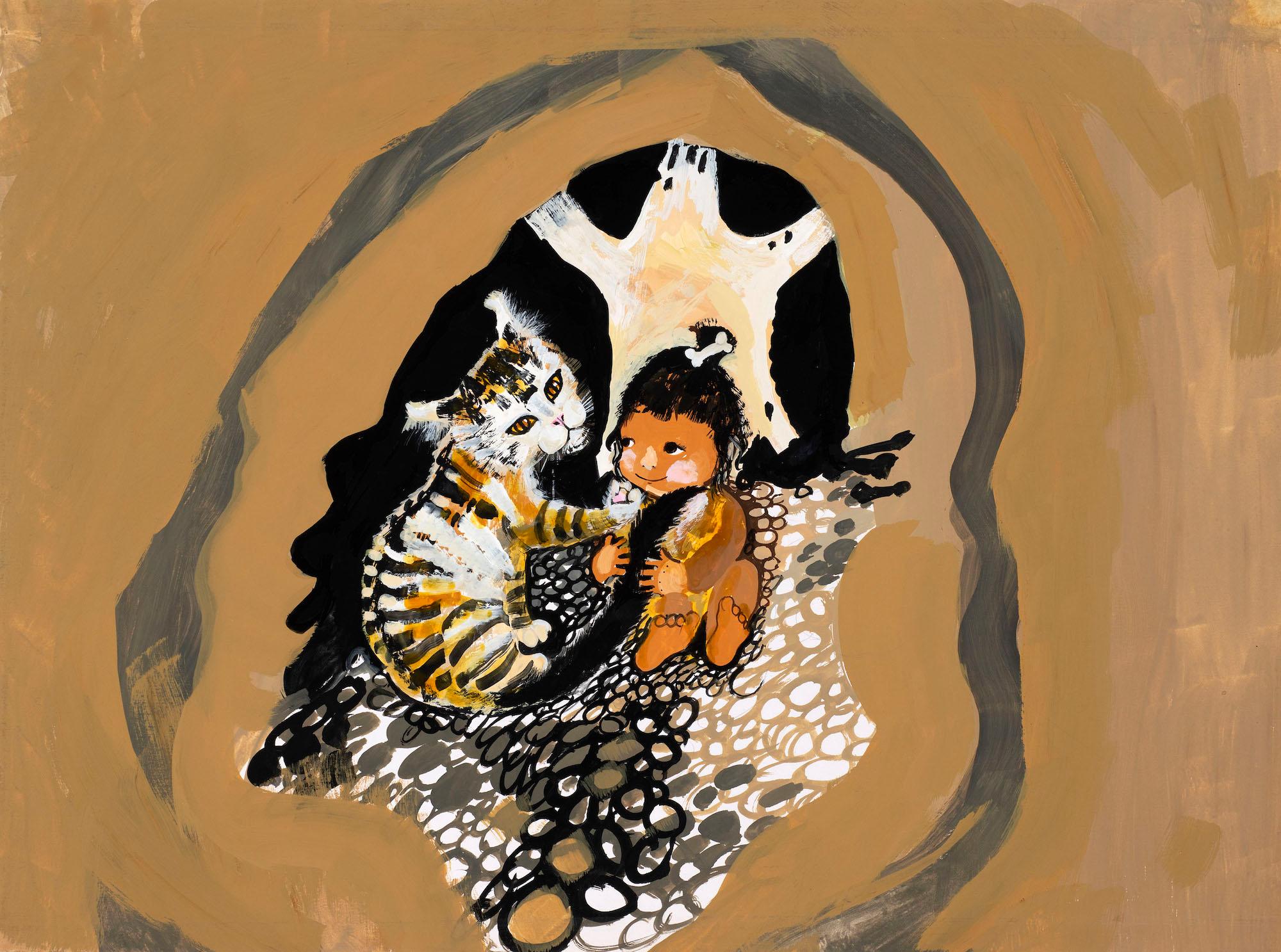
Untitled illustration for Jackanory (Just So Stories: The Cat who Walked by Himself), 1973
Janina Ede (1937-2018) created covers and illustrations for over 100 books in the 1960s, 70s and 80s. Many of her illustrations feature animals, which she drew from life. In the 1970s, Ede was commissioned to create large colourful illustrations for the BBC children’s television series, Jackanory. Each episode was dedicated to a story read by an actor, while specially commissioned illustrations were shown on screen during each programme. Some of these illustrations were for programmes featuring stories by author Rudyard Kipling. His ‘Just So’ stories were short tales that imagined how various animals attained their distinguishing features. Kipling set the stories in parts of India, West Asia and Africa. His descriptions of places and people included racist and exoticised stereotypes. Ede’s illustrations draw extensively on Kipling’s descriptions, and therefore reflect the racism in his work, as well as the prevailing stereotypical views that existed in 1970s Britain. Her own personal views are not documented. This storyboard illustration was produced by Janina Ede for Jackanory episode #1452, 'Just So Stories - The Cat that Walked by Himself'. It aired on 3 January 1973.
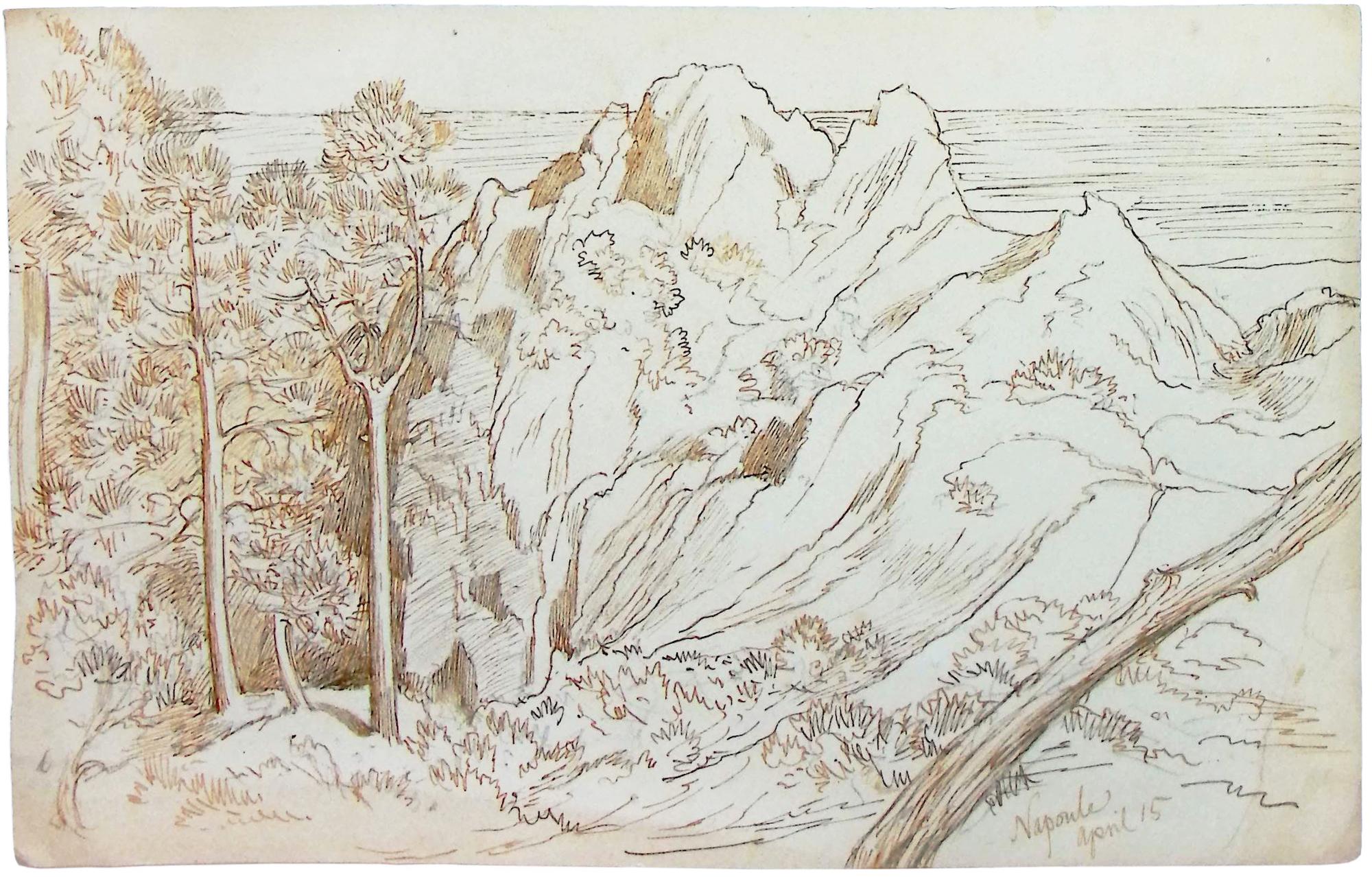
Untitled (Napoule), Date unknown
Eleanor Vere Boyle (1825 – 1916) illustrated poetry and prose by some of the most popular authors of her time. She regularly drew and painted using ink and watercolour, sketching landscapes, animals and her children from life. She also made drawings from her imagination, often reflecting spiritual themes.
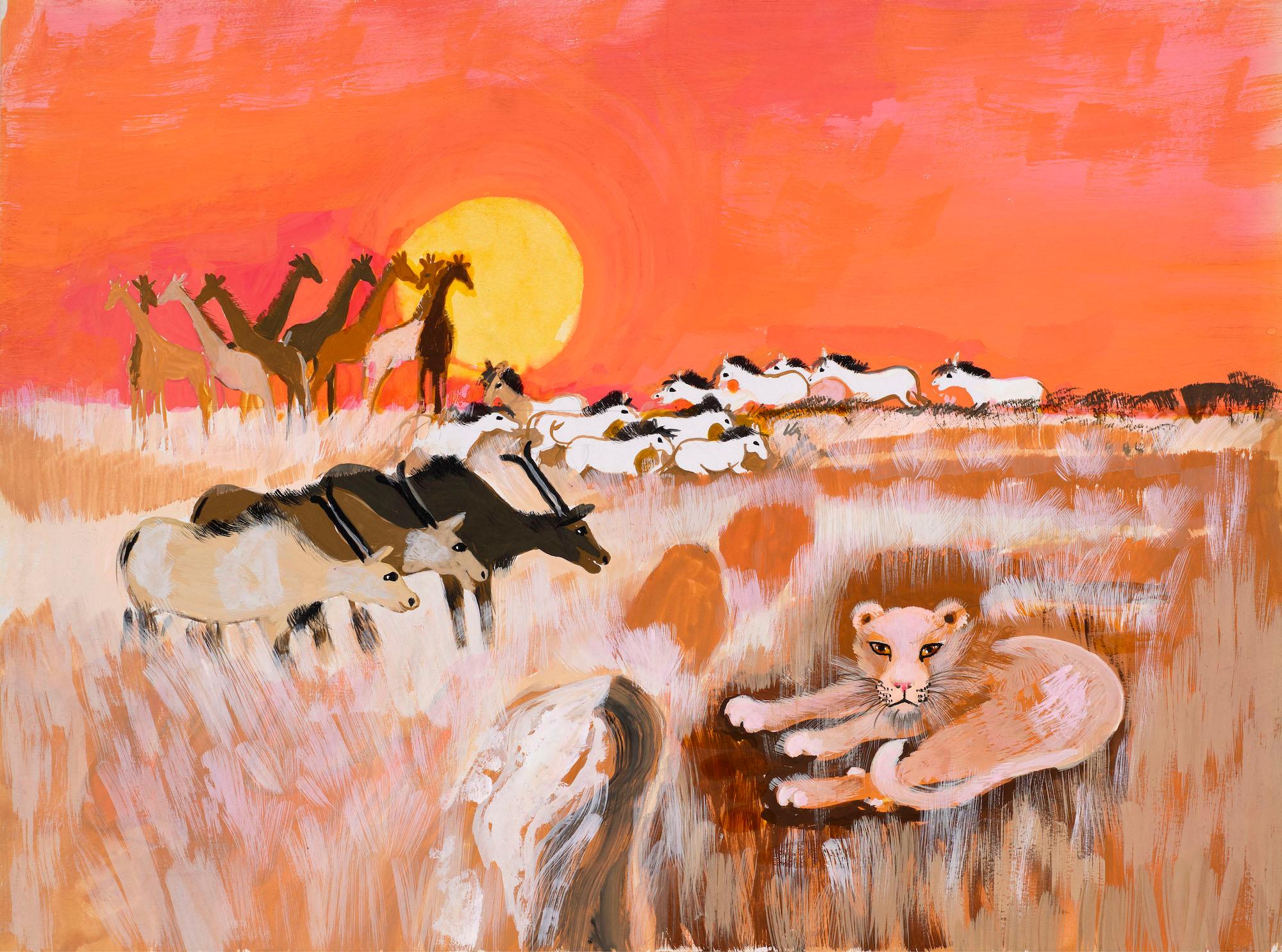
Untitled illustration for Jackanory (Just So Stories: How the Leopard Got His Spots), 1973
Janina Ede (1937-2018) created covers and illustrations for over 100 books in the 1960s, 70s and 80s. Many of her illustrations feature animals, which she drew from life. In the 1970s, Ede was commissioned to create large colourful illustrations for the BBC children’s television series, Jackanory. Each episode was dedicated to a story read by an actor, while specially commissioned illustrations were shown on screen during each programme. Some of these illustrations were for programmes featuring stories by author Rudyard Kipling. His ‘Just So’ stories were short tales that imagined how various animals attained their distinguishing features. Kipling set the stories in parts of India, West Asia and Africa. His descriptions of places and people included racist and exoticised stereotypes. Ede’s illustrations draw extensively on Kipling’s descriptions, and therefore reflect the racism in his work, as well as the prevailing stereotypical views that existed in 1970s Britain. Her own personal views are not documented. This storyboard illustration was produced by Janina Ede for Jackanory episode #1454, 'Just So Stories - How the Leopard Got His Spots'. It aired on 5 January 1973.
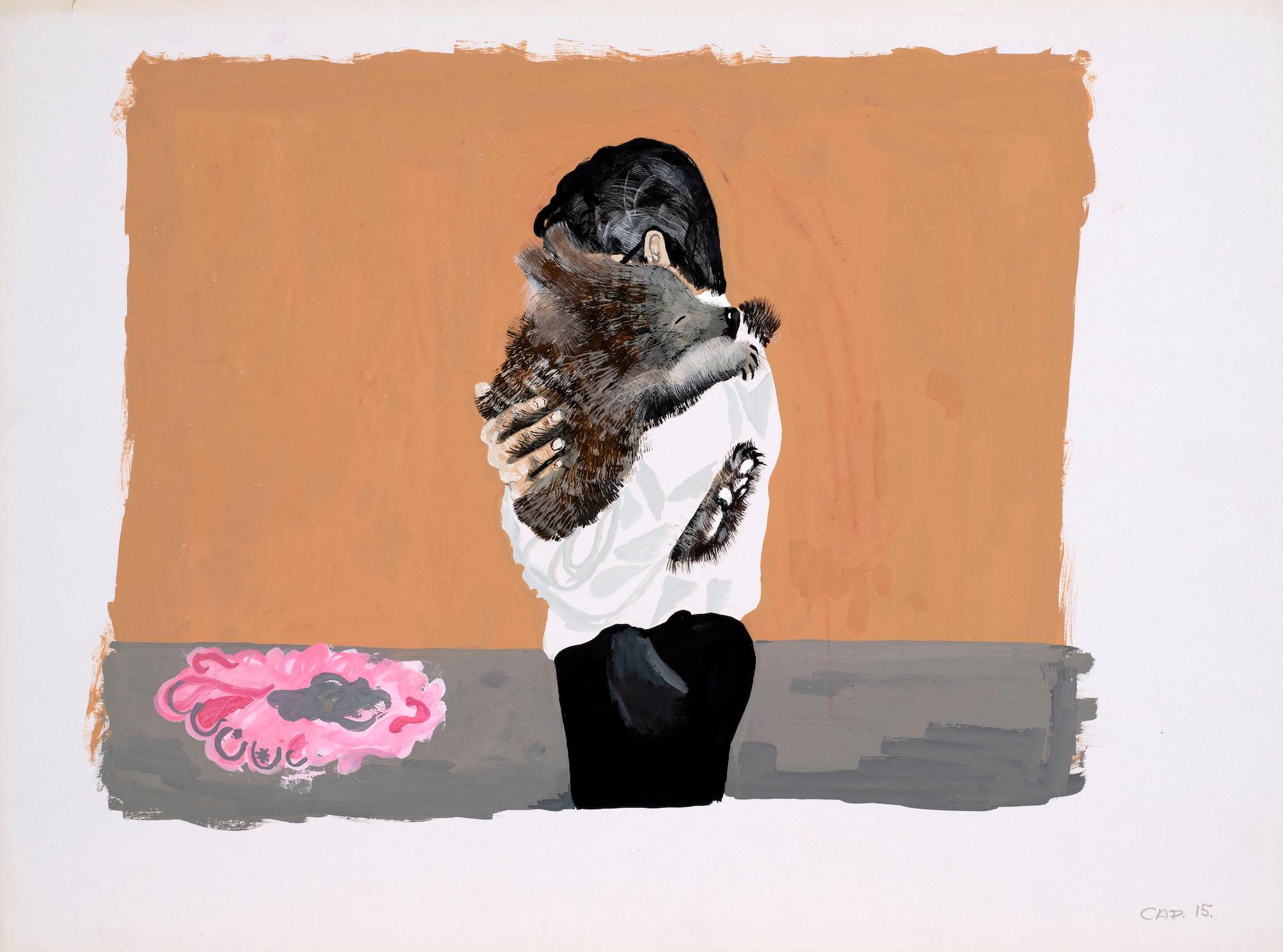
Untitled illustration for Jackanory (Mary Plain Goes to America) , 1972
British illustrator Janina Ede (1937-2018) created covers and illustrations for over 100 books from the 1950s to the 1980s. In the 1970s, she made illustrations for Jackanory, a BBC television programme. During each episode, an actor read a story, while specially-commissioned illustrations were shown on screen. For the televised version of Mary Plain Goes to America, Ede created paintings on large boards. These allowed the camera to pan across her image, showing a little at a time. BBC1 had only been in colour for three years, and so Ede used bold colours painted in gouache and reflective collaged foil to make the most of the new technology. This storyboard illustration was produced by Janina Ede for Jackanory episode #1426, 'Mary Plain Goes to America: Part 1 - An invitation'. It aired on 13 November 1972.
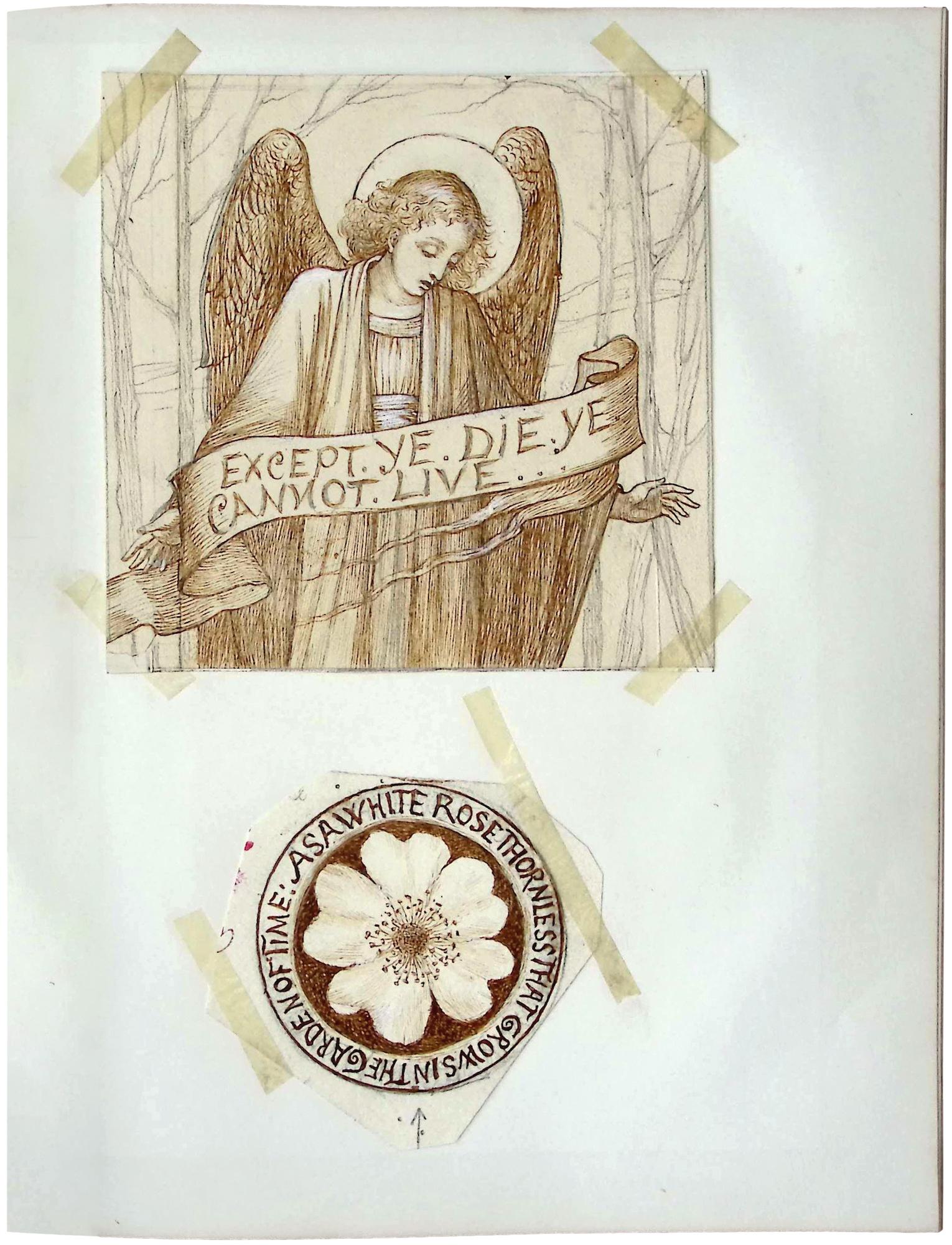
Untitled (illustrations for A Book of Heavenly Birthdays), c. 1893
Eleanor Vere Boyle (1825 – 1916) illustrated poetry and prose by some of the most popular authors of her time. She regularly drew and painted using ink and watercolour, sketching landscapes, animals and her children from life. She also made drawings from her imagination, often reflecting spiritual themes. These drawings were used as some of the final illustrations printed in the artists' publication A Book of Heavenly Birthdays (1893, London Elliot Stock)
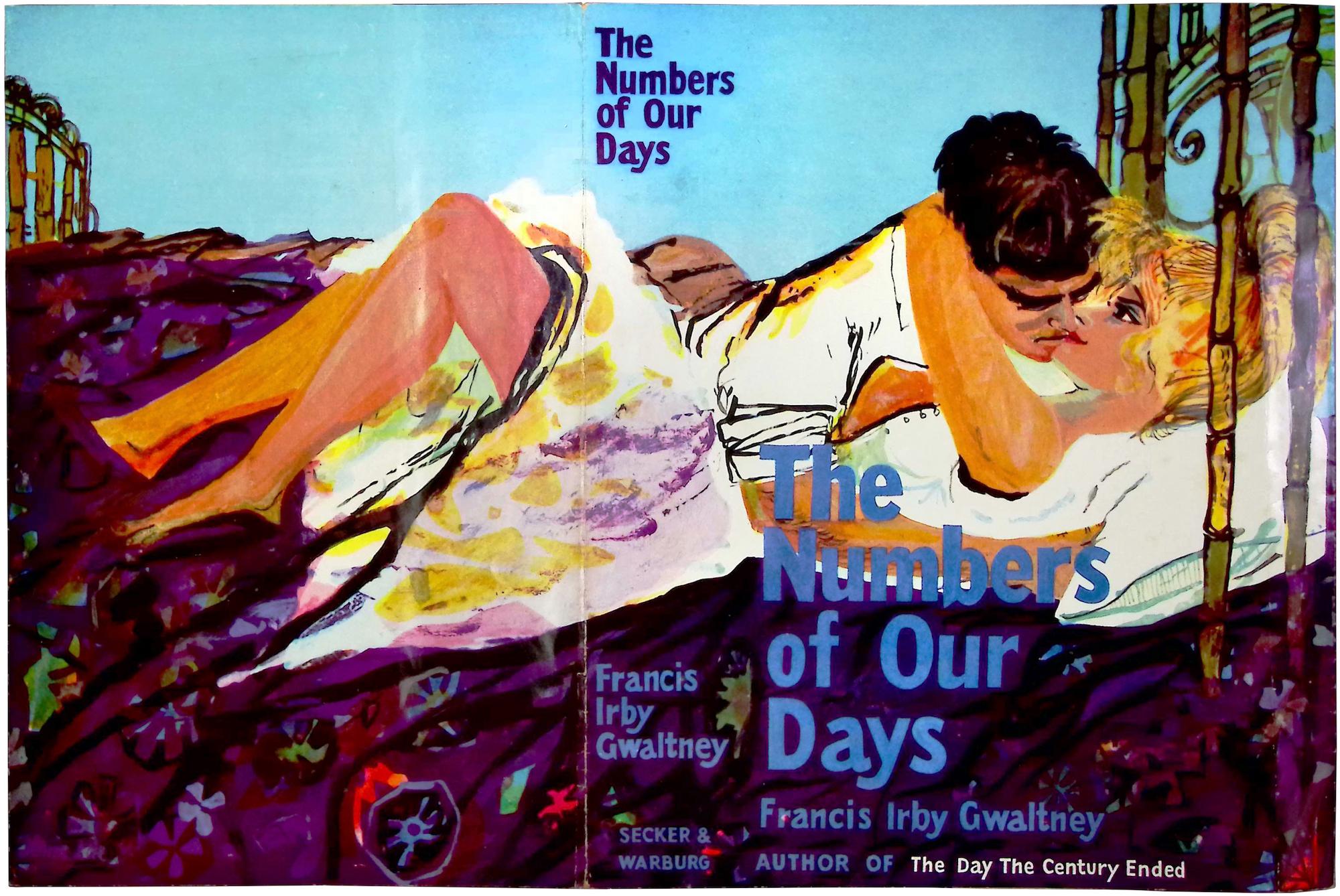
Cover jacket for "The Numbers of Our Days", 1959
British illustrator Janina Ede (1937-2018) created covers and illustrations for over 100 books from the 1950s to the 1980s.
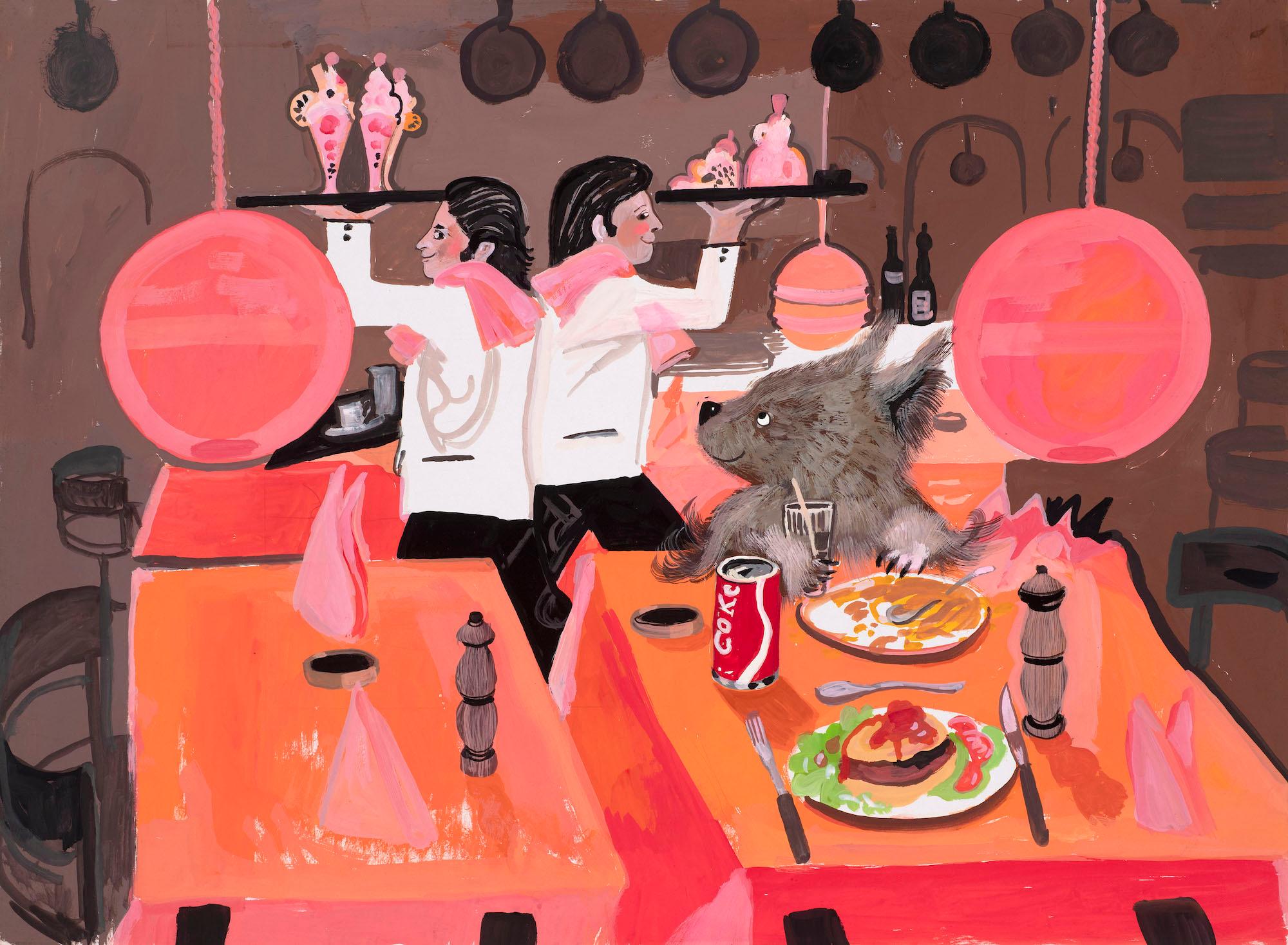
Untitled illustration for Jackanory (Mary Plain Goes to America) , 1972
British illustrator Janina Ede (1937-2018) created covers and illustrations for over 100 books from the 1950s to the 1980s. In the 1970s, she made illustrations for Jackanory, a BBC television programme. During each episode, an actor read a story, while specially-commissioned illustrations were shown on screen. For the televised version of Mary Plain Goes to America, Ede created paintings on large boards. These allowed the camera to pan across her image, showing a little at a time. BBC1 had only been in colour for three years, and so Ede used bold colours painted in gouache and reflective collaged foil to make the most of the new technology. This storyboard illustration was produced by Janina Ede for Jackanory episode #1427, 'Mary Plain Goes to America: Part 2 - The Most Popular Person on Board'. It aired on 14 November 1972.
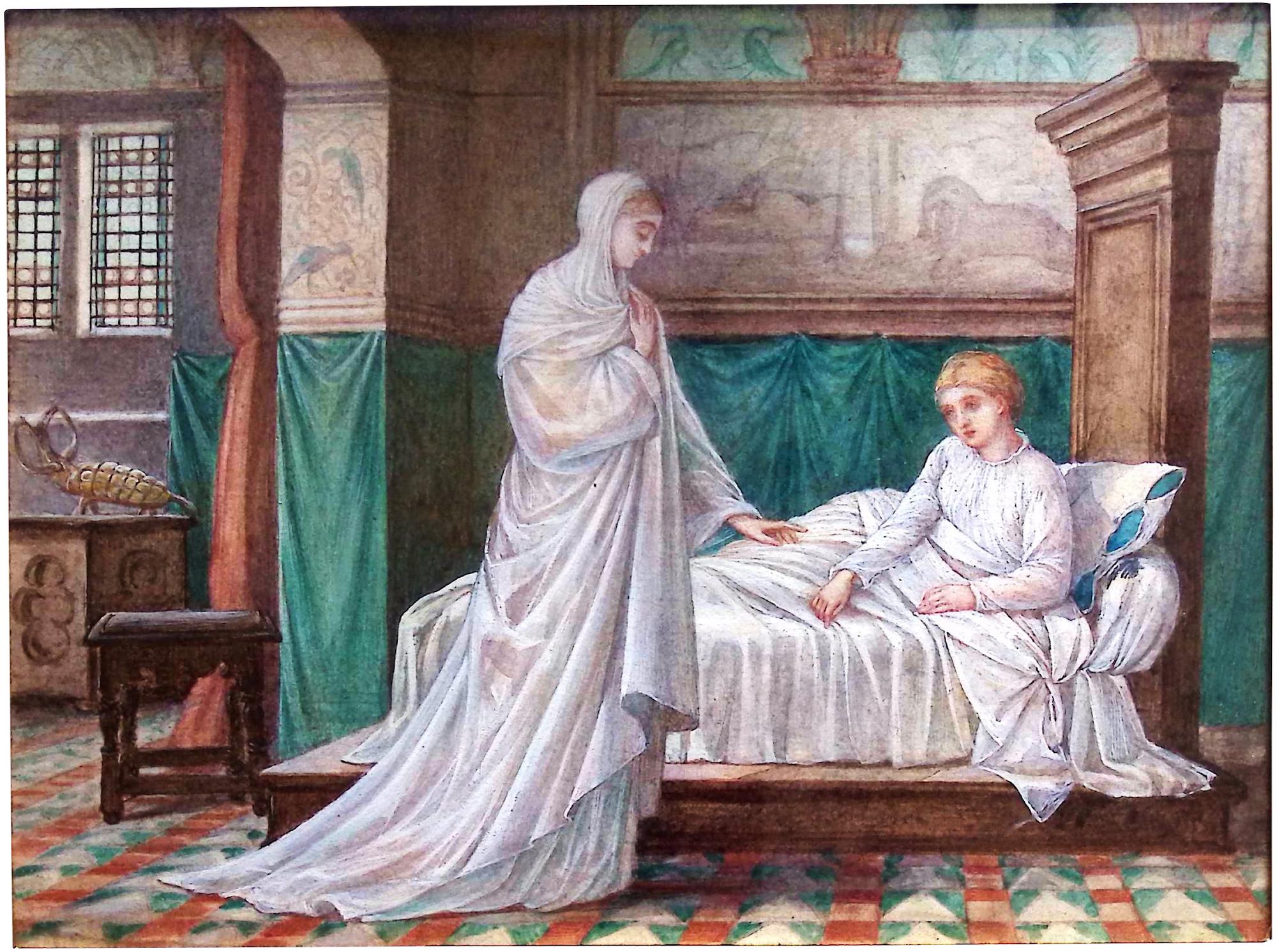
Illustration for Beauty and the Beast (a lady comforting Beauty), c. 1875
Eleanor Vere Boyle (1825 – 1916) illustrated poetry and prose by some of the most popular authors of her time. She regularly drew and painted using ink and watercolour, sketching landscapes, animals and her children from life. She also made drawings from her imagination, often reflecting spiritual themes. This illustration is from Boyle’s 1875 retelling of Beauty and the Beast, a fairy tale where a woman is imprisoned by a monster and falls in love with him. Unlike other illustrated versions before or since, Boyle gave her beast walrus-like tusks and flippers. In several of her illustrations, Boyle used shell gold – a mixture of finely ground gold powder and gum arabic (tree sap) that would have been stored in a shallow seashell. In the final publication, the caption for this illustration reads, "The room where Beauty slept. At dawn, a lady came to comfort her"

Untitled illustration for Jackanory (Just So Stories: How the Leopard Got His Spots), 1973
Janina Ede (1937-2018) created covers and illustrations for over 100 books in the 1960s, 70s and 80s. Many of her illustrations feature animals, which she drew from life. In the 1970s, Ede was commissioned to create large colourful illustrations for the BBC children’s television series, Jackanory. Each episode was dedicated to a story read by an actor, while specially commissioned illustrations were shown on screen during each programme. Some of these illustrations were for programmes featuring stories by author Rudyard Kipling. His ‘Just So’ stories were short tales that imagined how various animals attained their distinguishing features. Kipling set the stories in parts of India, West Asia and Africa. His descriptions of places and people included racist and exoticised stereotypes. Ede’s illustrations draw extensively on Kipling’s descriptions, and therefore reflect the racism in his work, as well as the prevailing stereotypical views that existed in 1970s Britain. Her own personal views are not documented. This storyboard illustration was produced by Janina Ede for Jackanory episode #1454, 'Just So Stories - How the Leopard Got His Spots'. It aired on 5 January 1973.
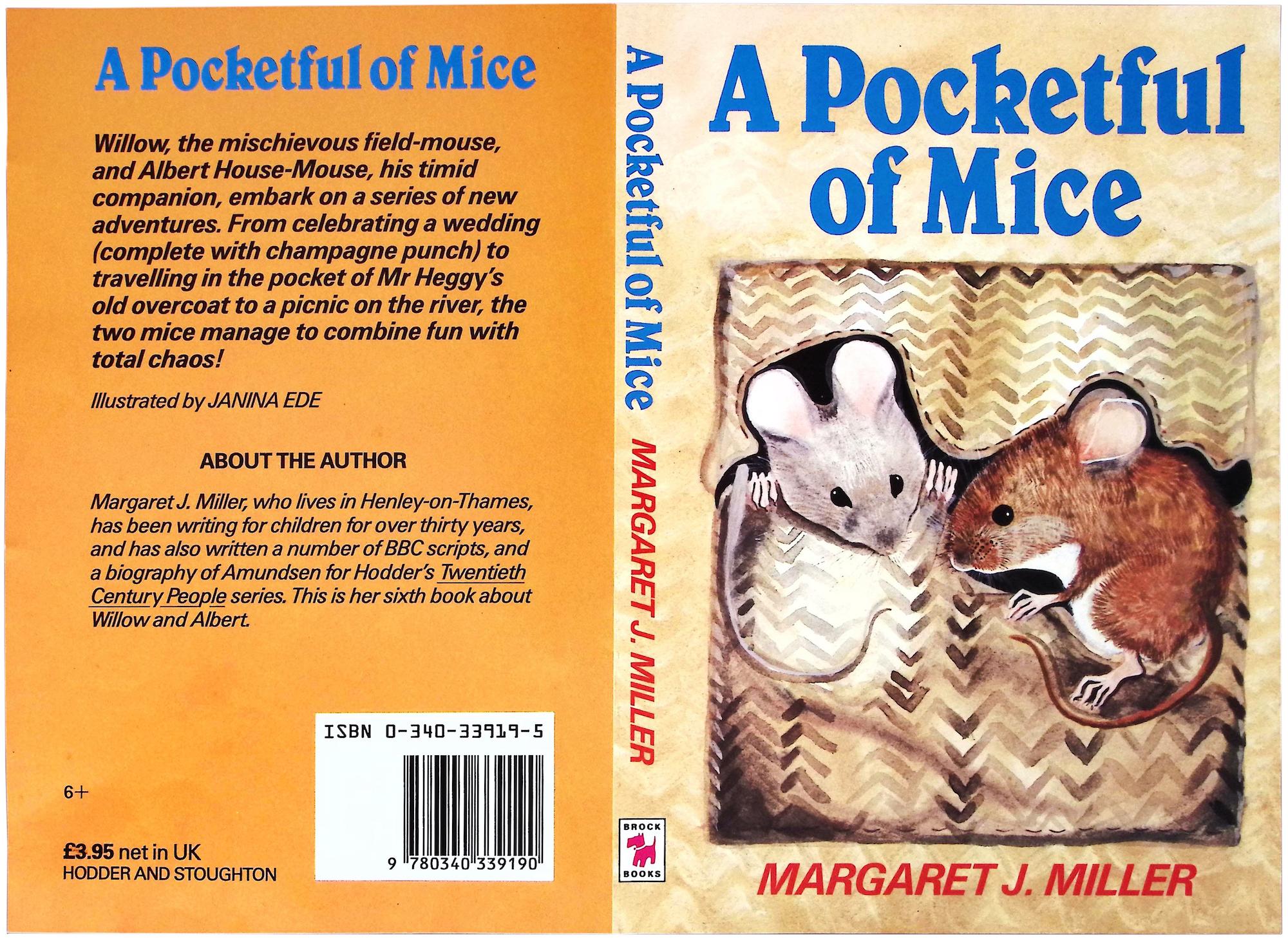
Printed book cover proof for A Pocket Full of Mice , c. 1984
British illustrator Janina Ede (1937-2018) created covers and illustrations for over 100 books from the 1950s to the 1980s. Many of her illustrations feature animals, which she drew from life.
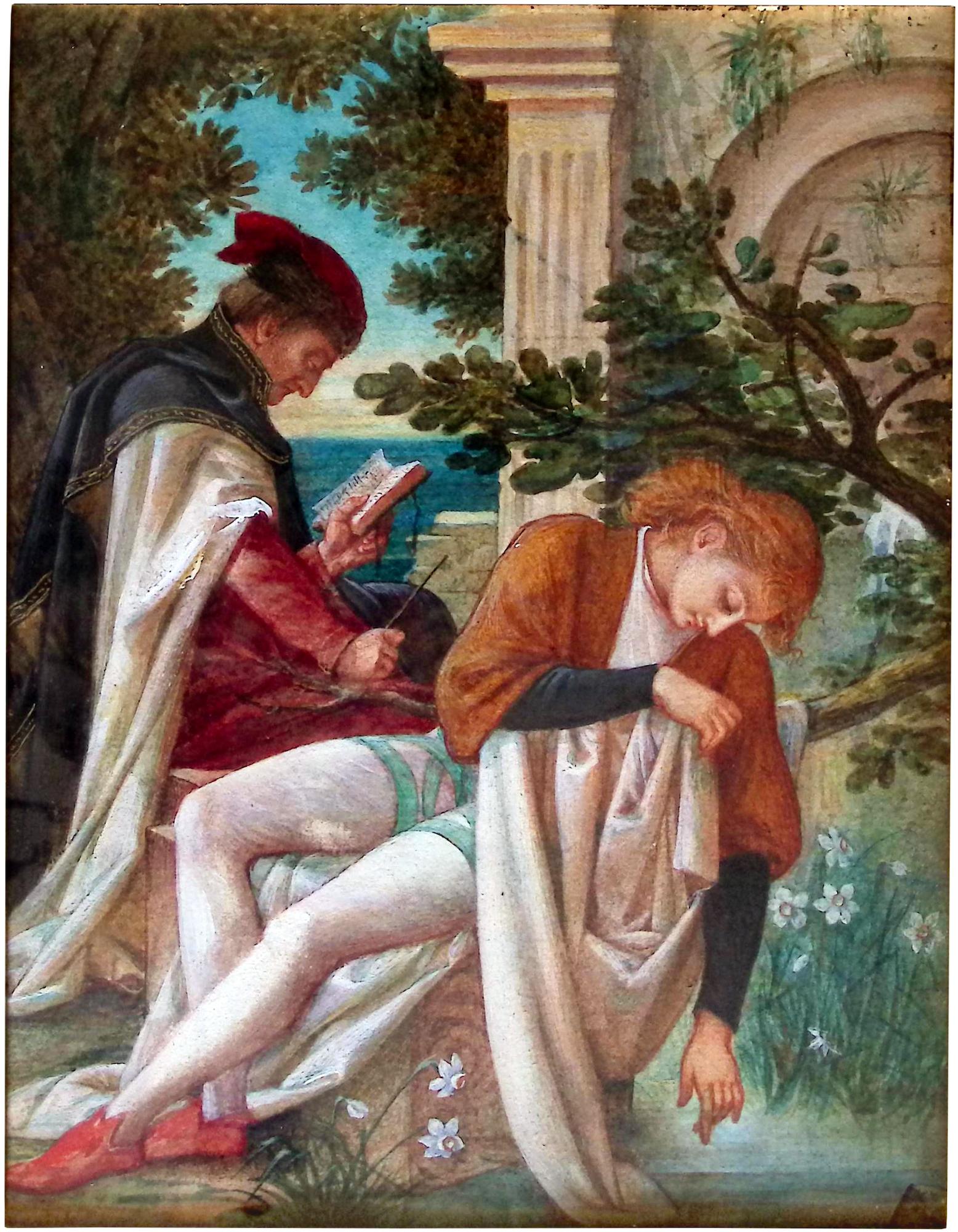
Illustration for Beauty and the Beast (the sisters' husbands), c. 1875
Eleanor Vere Boyle (1825 – 1916) illustrated poetry and prose by some of the most popular authors of her time. She regularly drew and painted using ink and watercolour, sketching landscapes, animals and her children from life. She also made drawings from her imagination, often reflecting spiritual themes. This illustration is from Boyle’s 1875 retelling of Beauty and the Beast, a fairy tale where a woman is imprisoned by a monster and falls in love with him. Unlike other illustrated versions before or since, Boyle gave her beast walrus-like tusks and flippers. In several of her illustrations, Boyle used shell gold – a mixture of finely ground gold powder and gum arabic (tree sap) that would have been stored in a shallow seashell. In the final publication, the caption for this illustration reads, "One sister's husband, like Narcissus of old, worshipped his own beauty. But the other was full of learning."

HIROSHIMA - DAY OF WORLD SOLIDARITY WITH THE STRUGGLE OF THE JAPANESE PEOPLE (August 6), 1972
Between the 1960s and 1990s, more than fifty designers worked at OSPAAAL (the Organisation of Solidarity with the People of Africa, Asia and Latin America). Based in Cuba, they made magazines and posters that were sent around the world. Their aim was to promote radical political ideas. Many of their posters celebrate socialist revolutions and liberation movements from the Global South. OSPAAAL marked the date of the atomic bombing of the city of Hiroshima by the U.S.A. as a day of solidarity with Japanese citizens.
![Teremok [The cabin]](https://cdn.sanity.io/images/n83t80i6/production/f9ec00295d1de824a94cc9766b91be8edf5b57ff-1624x2000.jpg?auto=format&fit=max&q=75&w=1624)
Evgenii Charushin , Teremok [The cabin], 1931
Evgenii Charushin (1901-1965) was an illustrator and author, known for his children’s books on nature and animals. He said, “More than anything else, I love to depict young animals, touching in their helplessness and interesting, because within them one can already see signs of the full-grown beast.” This book is a cumulative story about a hole in an oak tree that is inhabited by a series of different animals as it gets bigger. It was published in Leningrad (Saint Petersburg), Russia at a time when children’s books became a mass media phenomenon. Over a ten-year period, almost 10,000 titles were published in several editions of up to 200,000. Many of these books took experimental approaches to storytelling, design and layout.
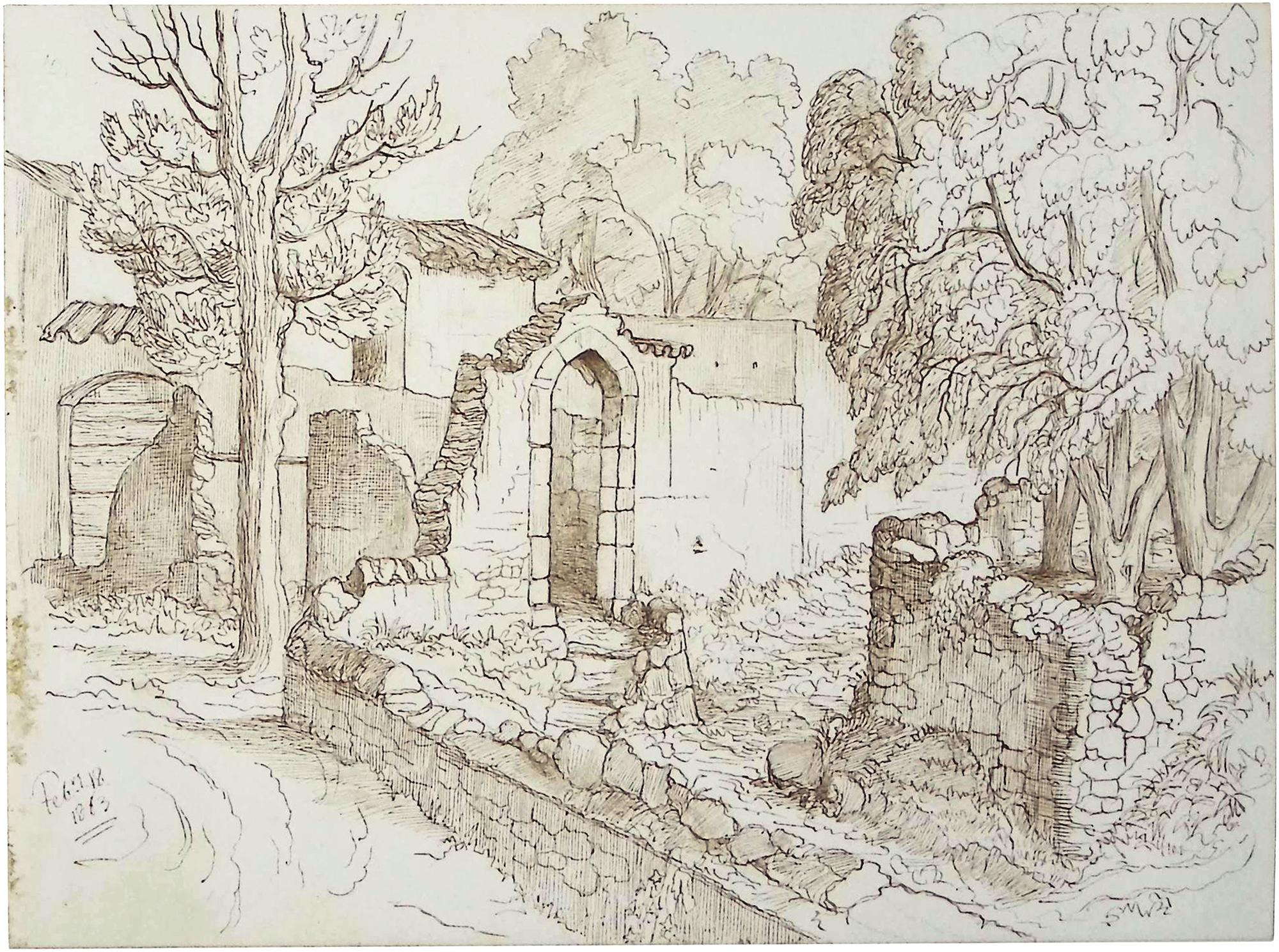
Untitled (Ruined Farm), 1863
Eleanor Vere Boyle (1825 – 1916) illustrated poetry and prose by some of the most popular authors of her time. She regularly drew and painted using ink and watercolour, sketching landscapes, animals and her children from life. She also made drawings from her imagination, often reflecting spiritual themes.
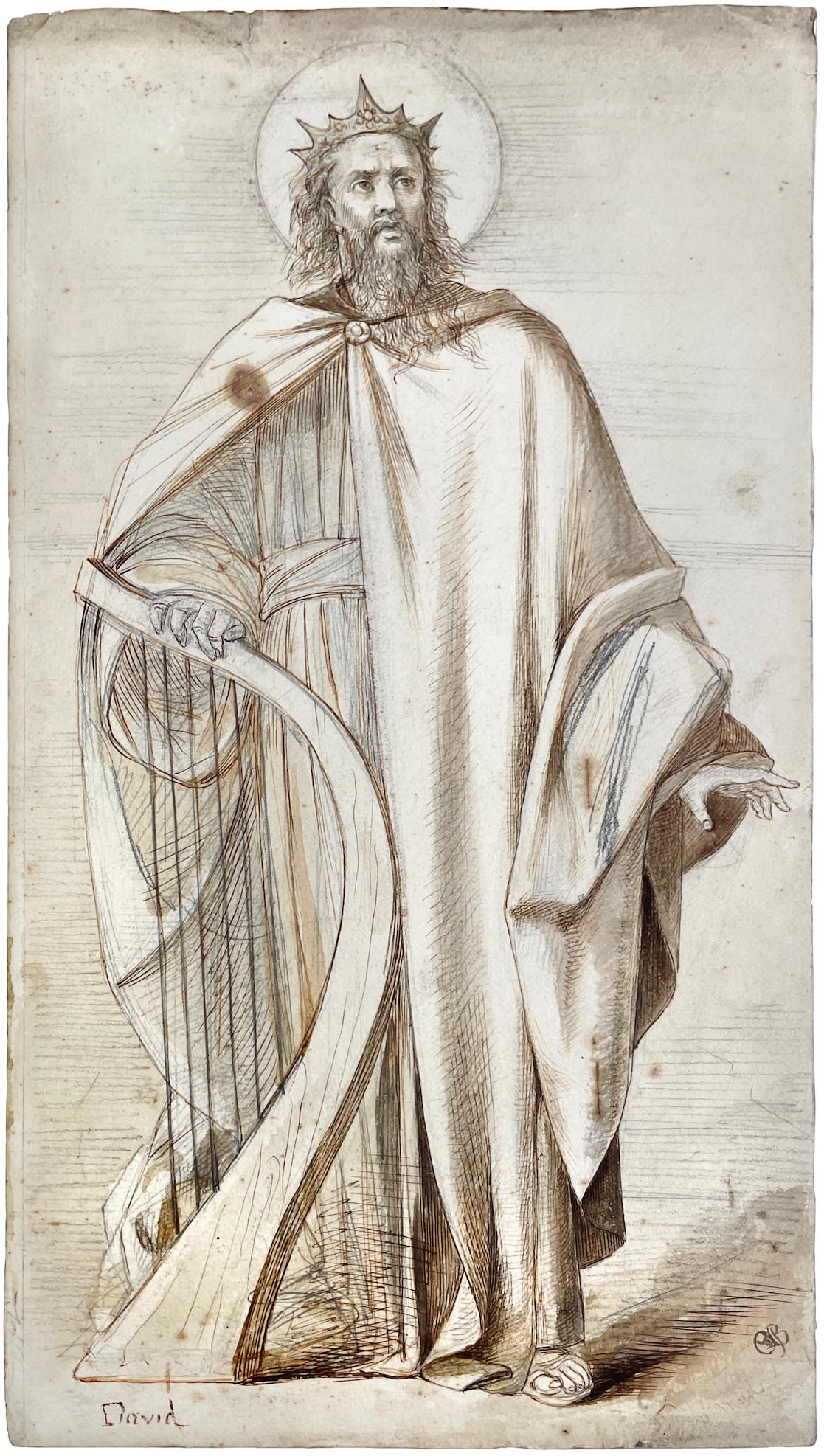
Untitled (David), Date unknown
Eleanor Vere Boyle (1825 – 1916) illustrated poetry and prose by some of the most popular authors of her time. She regularly drew and painted using ink and watercolour, sketching landscapes, animals and her children from life. She also made drawings from her imagination, often reflecting spiritual themes.

Untitled, 1969
Between the 1960s and 1990s, more than fifty designers worked at OSPAAAL (the Organisation of Solidarity with the People of Africa, Asia and Latin America). Based in Cuba, they made magazines and posters that were sent around the world. Their aim was to promote radical political ideas. Many of their posters celebrate socialist revolutions and liberation movements from the Global South. Alfredo Rostgaard’s poster depicts Jesus Christ carrying a rifle on his back. On the reverse of the poster is a quote from Camilo Torres, a Roman Catholic priest and guerrilla who fought with the revolutionary Colombian National Liberation Army. Torres combined his religious faith with Marxist politics and believed that “If Jesus were alive today, he would be a guerrillero”.
Content warning: weaponry
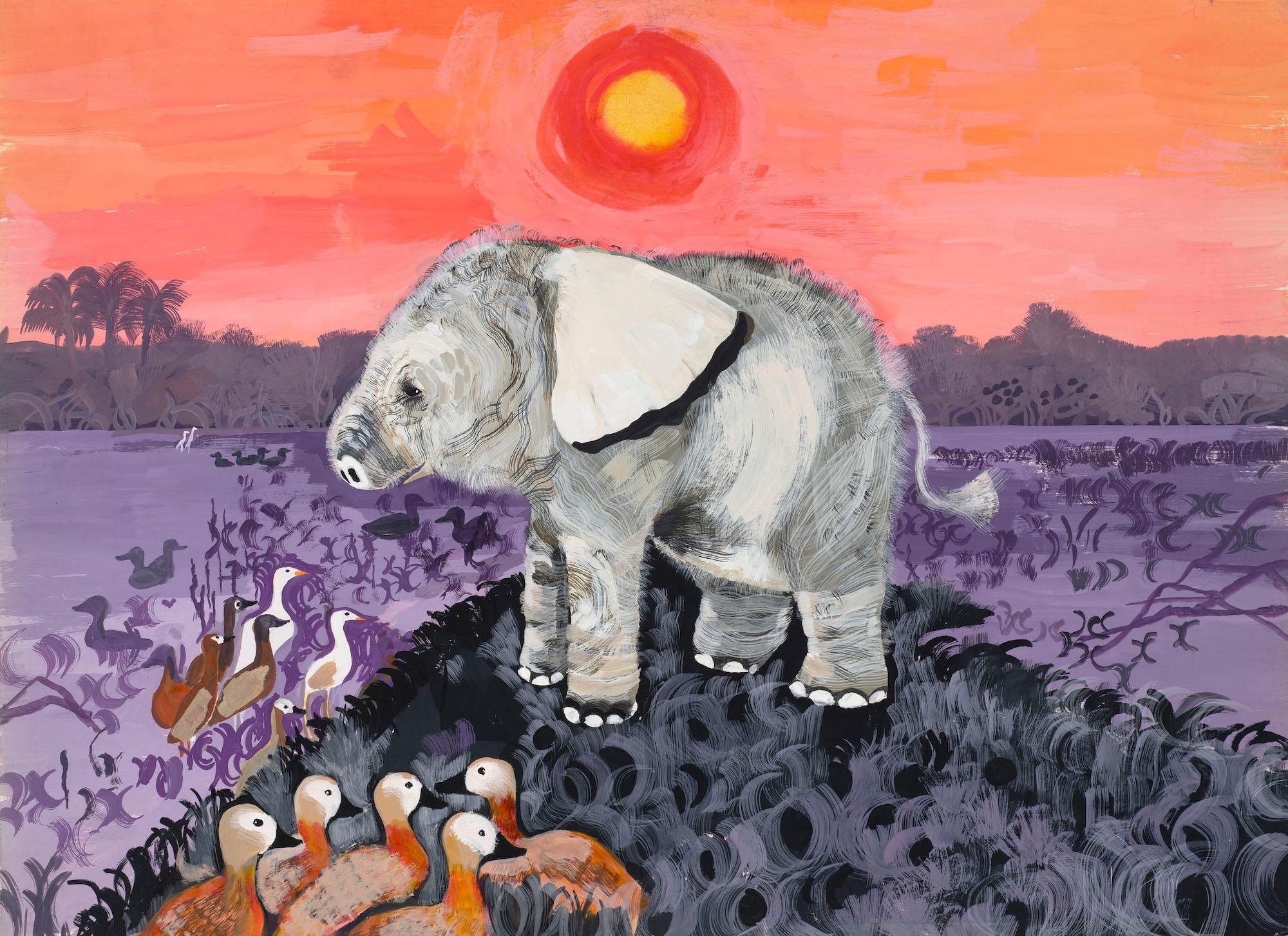
Untitled illustration for Jackanory (Just So Stories: The Elephant's Child), 1973
Janina Ede (1937-2018) created covers and illustrations for over 100 books in the 1960s, 70s and 80s. Many of her illustrations feature animals, which she drew from life. In the 1970s, Ede was commissioned to create large colourful illustrations for the BBC children’s television series, Jackanory. Each episode was dedicated to a story read by an actor, while specially commissioned illustrations were shown on screen during each programme. Some of these illustrations were for programmes featuring stories by author Rudyard Kipling. His ‘Just So’ stories were short tales that imagined how various animals attained their distinguishing features. Kipling set the stories in parts of India, West Asia and Africa. His descriptions of places and people included racist and exoticised stereotypes. Ede’s illustrations draw extensively on Kipling’s descriptions, and therefore reflect the racism in his work, as well as the prevailing stereotypical views that existed in 1970s Britain. Her own personal views are not documented. This storyboard illustration was produced by Janina Ede for Jackanory episode #1450, 'Just So Stories - The Elephant's Child'. It aired on 1 January 1973.
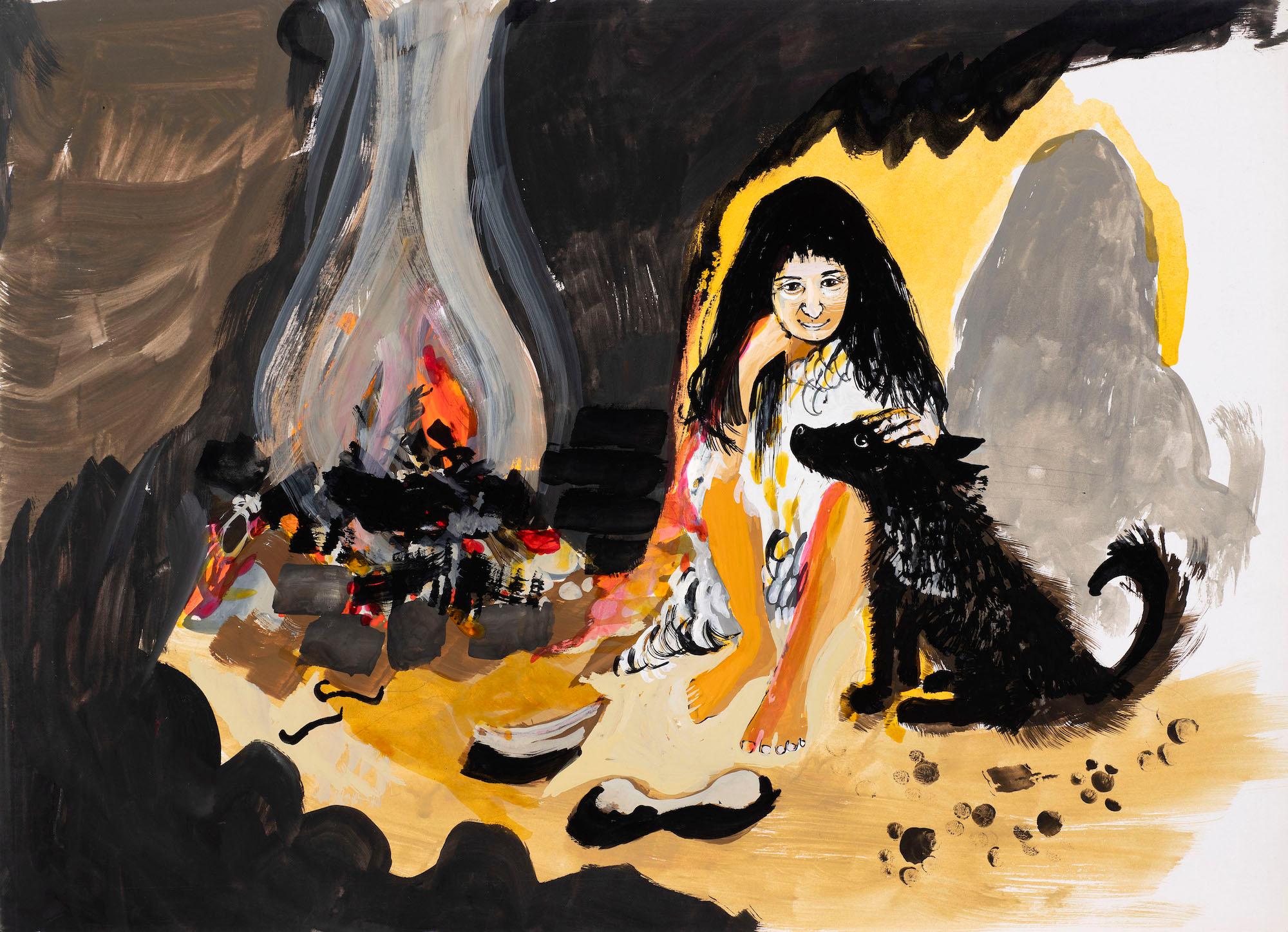
Untitled illustration for Jackanory (Just So Stories: The Cat who Walked by Himself), 1973
Janina Ede (1937-2018) created covers and illustrations for over 100 books in the 1960s, 70s and 80s. Many of her illustrations feature animals, which she drew from life. In the 1970s, Ede was commissioned to create large colourful illustrations for the BBC children’s television series, Jackanory. Each episode was dedicated to a story read by an actor, while specially commissioned illustrations were shown on screen during each programme. Some of these illustrations were for programmes featuring stories by author Rudyard Kipling. His ‘Just So’ stories were short tales that imagined how various animals attained their distinguishing features. Kipling set the stories in parts of India, West Asia and Africa. His descriptions of places and people included racist and exoticised stereotypes. Ede’s illustrations draw extensively on Kipling’s descriptions, and therefore reflect the racism in his work, as well as the prevailing stereotypical views that existed in 1970s Britain. Her own personal views are not documented. This storyboard illustration was produced by Janina Ede for Jackanory episode #1452, 'Just So Stories - The Cat that Walked by Himself'. It aired on 3 January 1973.
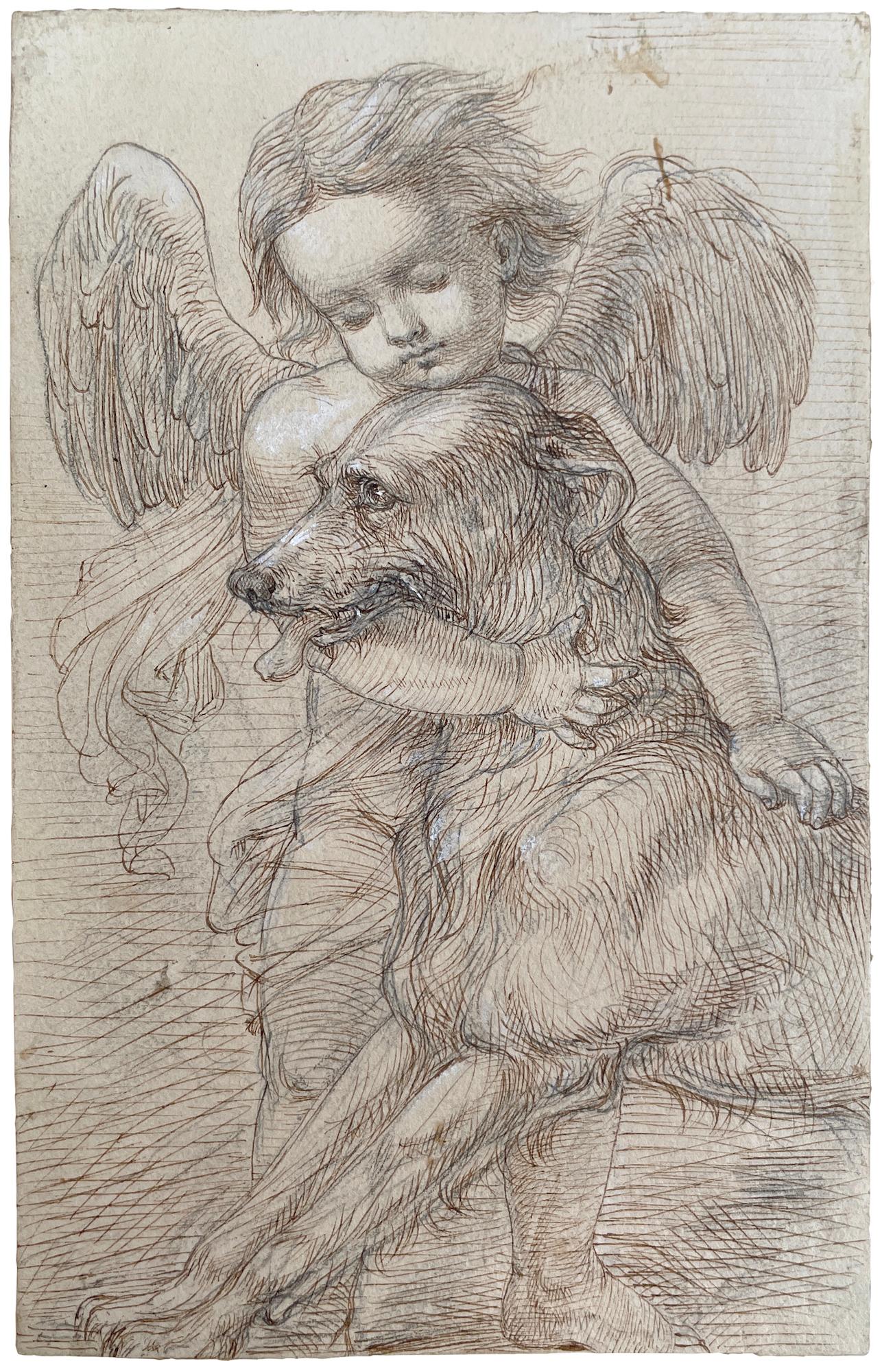
Untitled, 1855
Eleanor Vere Boyle (1825 – 1916) illustrated poetry and prose by some of the most popular authors of her time. She regularly drew and painted using ink and watercolour, sketching landscapes, animals and her children from life. She also made drawings from her imagination, often reflecting spiritual themes.
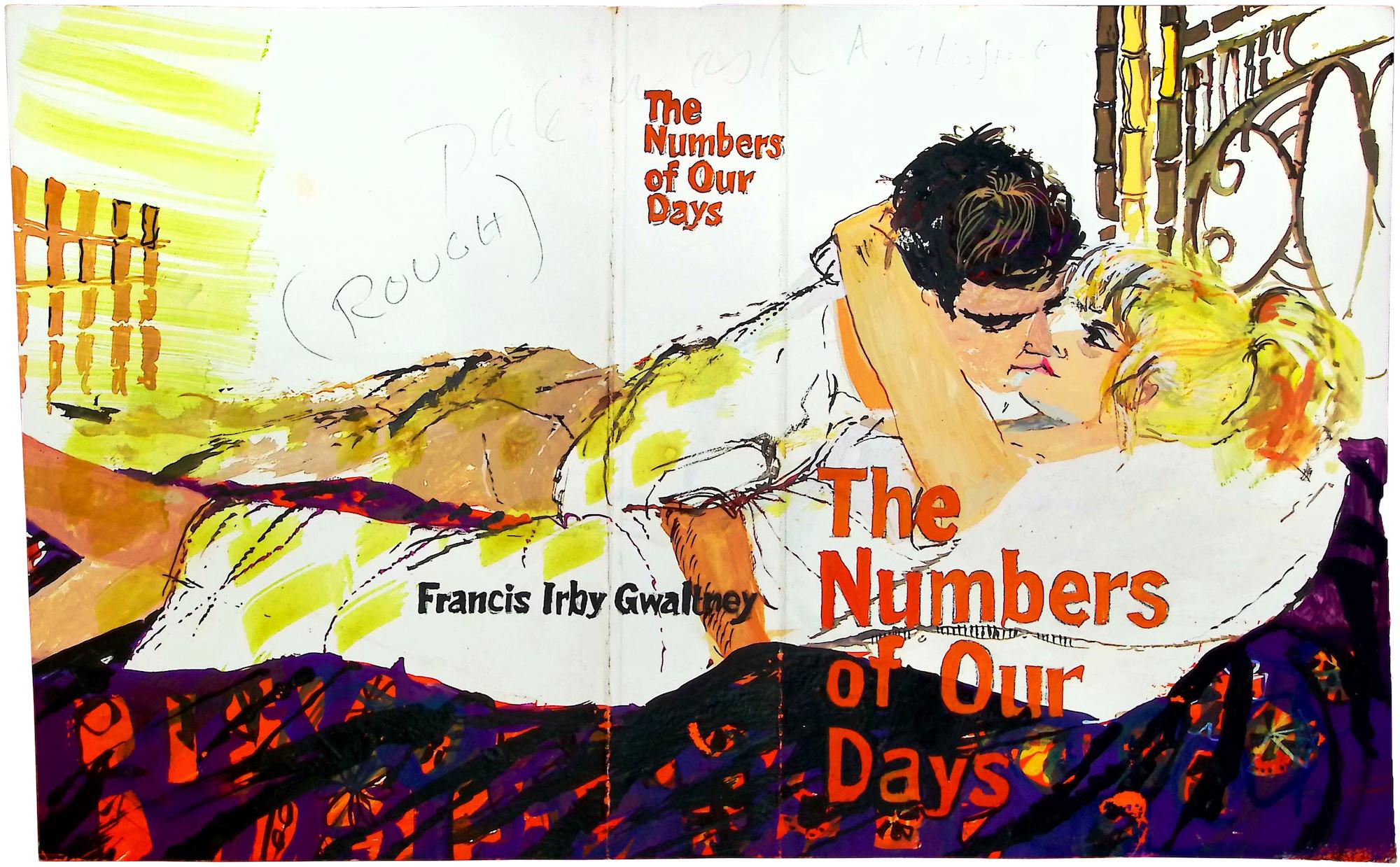
Untitled (rough cover illustration for "The Numbers of Our Days"), c. 1959
British illustrator Janina Ede (1937-2018) created covers and illustrations for over 100 books from the 1950s to the 1980s.
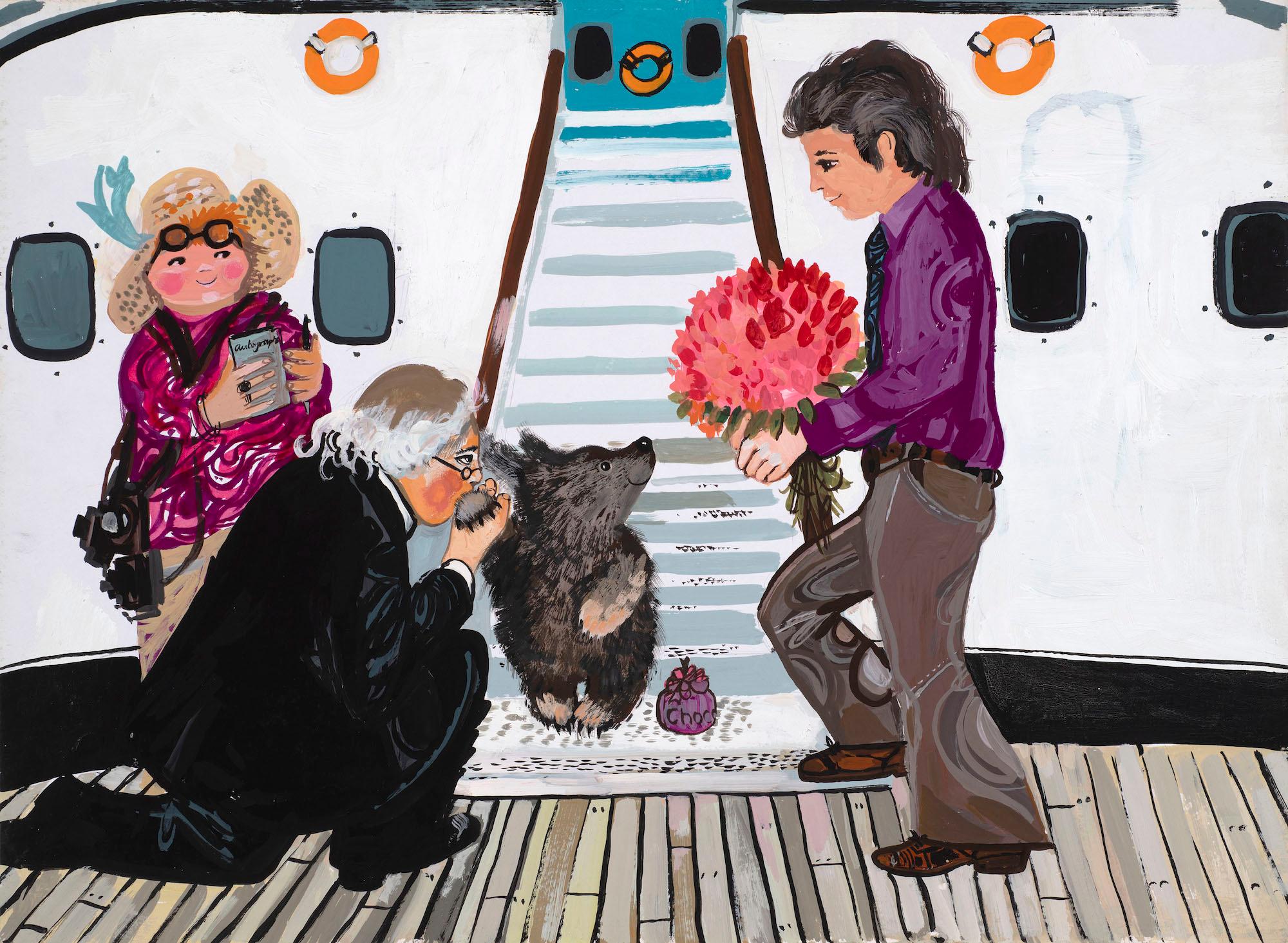
Untitled illustration for Jackanory (Mary Plain Goes to America) , 1972
British illustrator Janina Ede (1937-2018) created covers and illustrations for over 100 books from the 1950s to the 1980s. In the 1970s, she made illustrations for Jackanory, a BBC television programme. During each episode, an actor read a story, while specially-commissioned illustrations were shown on screen. For the televised version of Mary Plain Goes to America, Ede created paintings on large boards. These allowed the camera to pan across her image, showing a little at a time. BBC1 had only been in colour for three years, and so Ede used bold colours painted in gouache and reflective collaged foil to make the most of the new technology. This storyboard illustration was produced by Janina Ede for Jackanory episode #1427, 'Mary Plain Goes to America: Part 2 - The Most Popular Person on Board'. It aired on 14 November 1972.
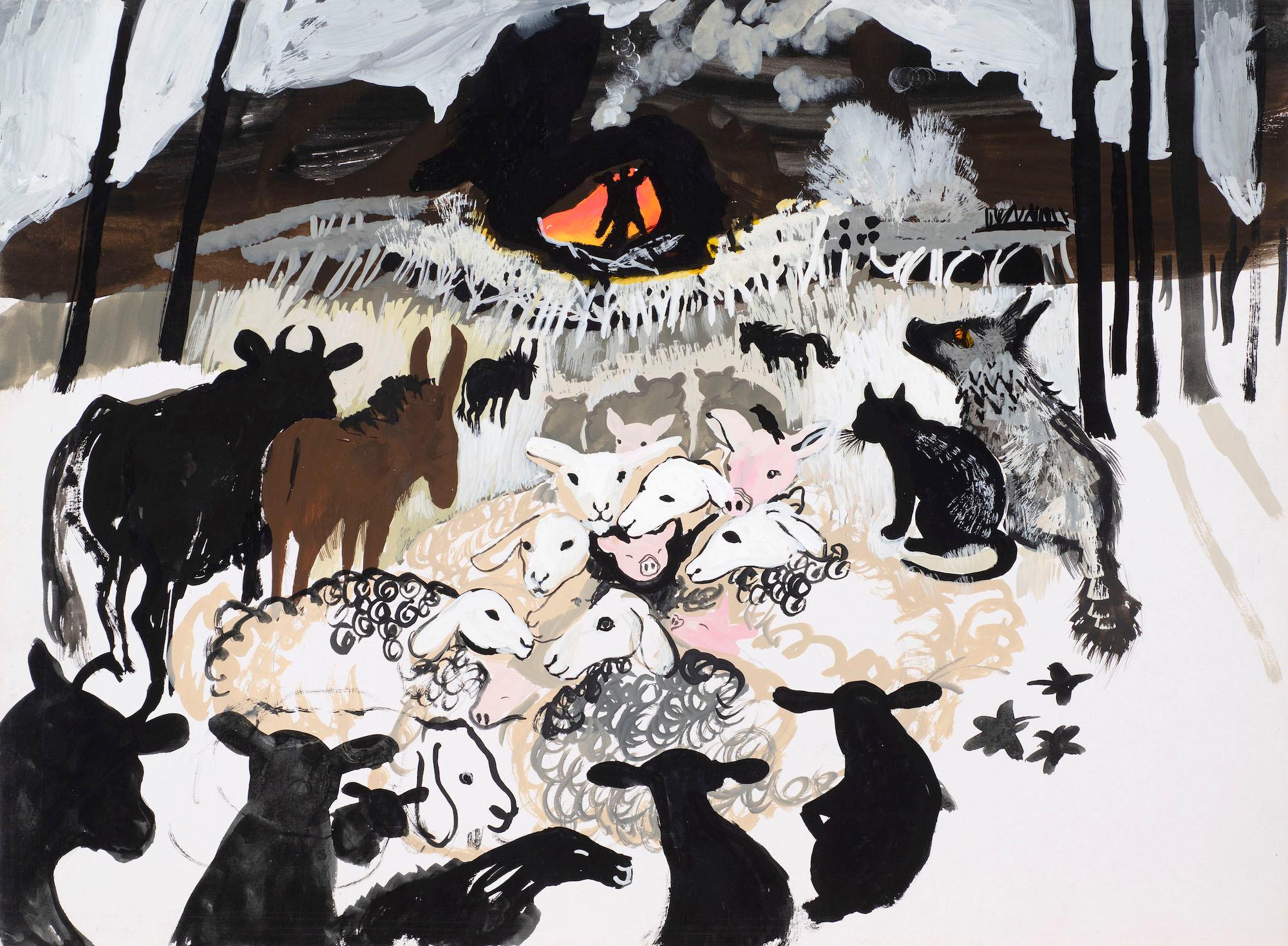
Untitled illustration for Jackanory (Just So Stories: The Cat who Walked by Himself), 1973
Janina Ede (1937-2018) created covers and illustrations for over 100 books in the 1960s, 70s and 80s. Many of her illustrations feature animals, which she drew from life. In the 1970s, Ede was commissioned to create large colourful illustrations for the BBC children’s television series, Jackanory. Each episode was dedicated to a story read by an actor, while specially commissioned illustrations were shown on screen during each programme. Some of these illustrations were for programmes featuring stories by author Rudyard Kipling. His ‘Just So’ stories were short tales that imagined how various animals attained their distinguishing features. Kipling set the stories in parts of India, West Asia and Africa. His descriptions of places and people included racist and exoticised stereotypes. Ede’s illustrations draw extensively on Kipling’s descriptions, and therefore reflect the racism in his work, as well as the prevailing stereotypical views that existed in 1970s Britain. Her own personal views are not documented. This storyboard illustration was produced by Janina Ede for Jackanory episode #1452, 'Just So Stories - The Cat that Walked by Himself'. It aired on 3 January 1973.
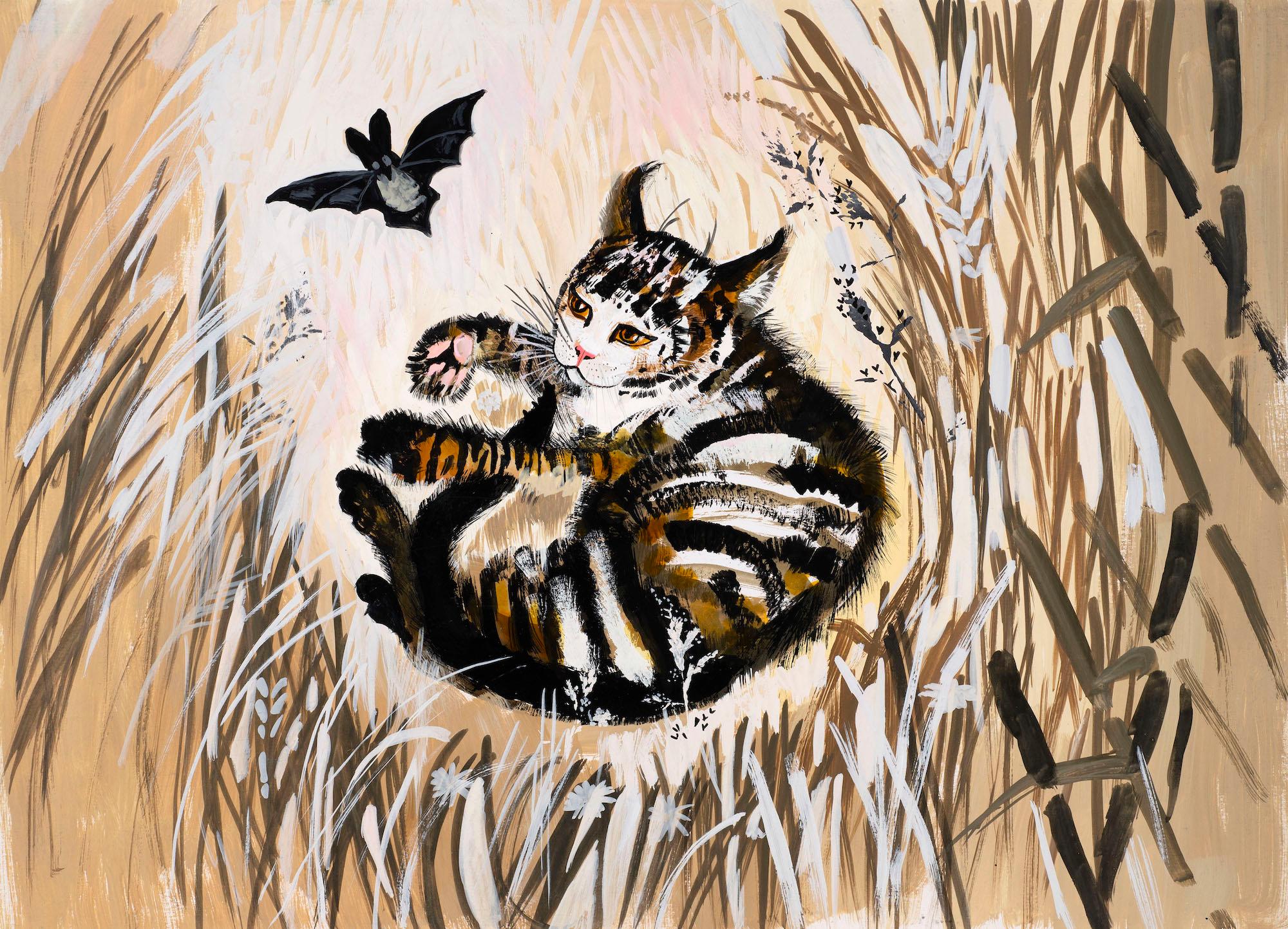
Untitled illustration for Jackanory (Just So Stories: The Cat who Walked by Himself), 1973
Janina Ede (1937-2018) created covers and illustrations for over 100 books in the 1960s, 70s and 80s. Many of her illustrations feature animals, which she drew from life. In the 1970s, Ede was commissioned to create large colourful illustrations for the BBC children’s television series, Jackanory. Each episode was dedicated to a story read by an actor, while specially commissioned illustrations were shown on screen during each programme. Some of these illustrations were for programmes featuring stories by author Rudyard Kipling. His ‘Just So’ stories were short tales that imagined how various animals attained their distinguishing features. Kipling set the stories in parts of India, West Asia and Africa. His descriptions of places and people included racist and exoticised stereotypes. Ede’s illustrations draw extensively on Kipling’s descriptions, and therefore reflect the racism in his work, as well as the prevailing stereotypical views that existed in 1970s Britain. Her own personal views are not documented. This storyboard illustration was produced by Janina Ede for Jackanory episode #1452, 'Just So Stories - The Cat that Walked by Himself'. It aired on 3 January 1973.
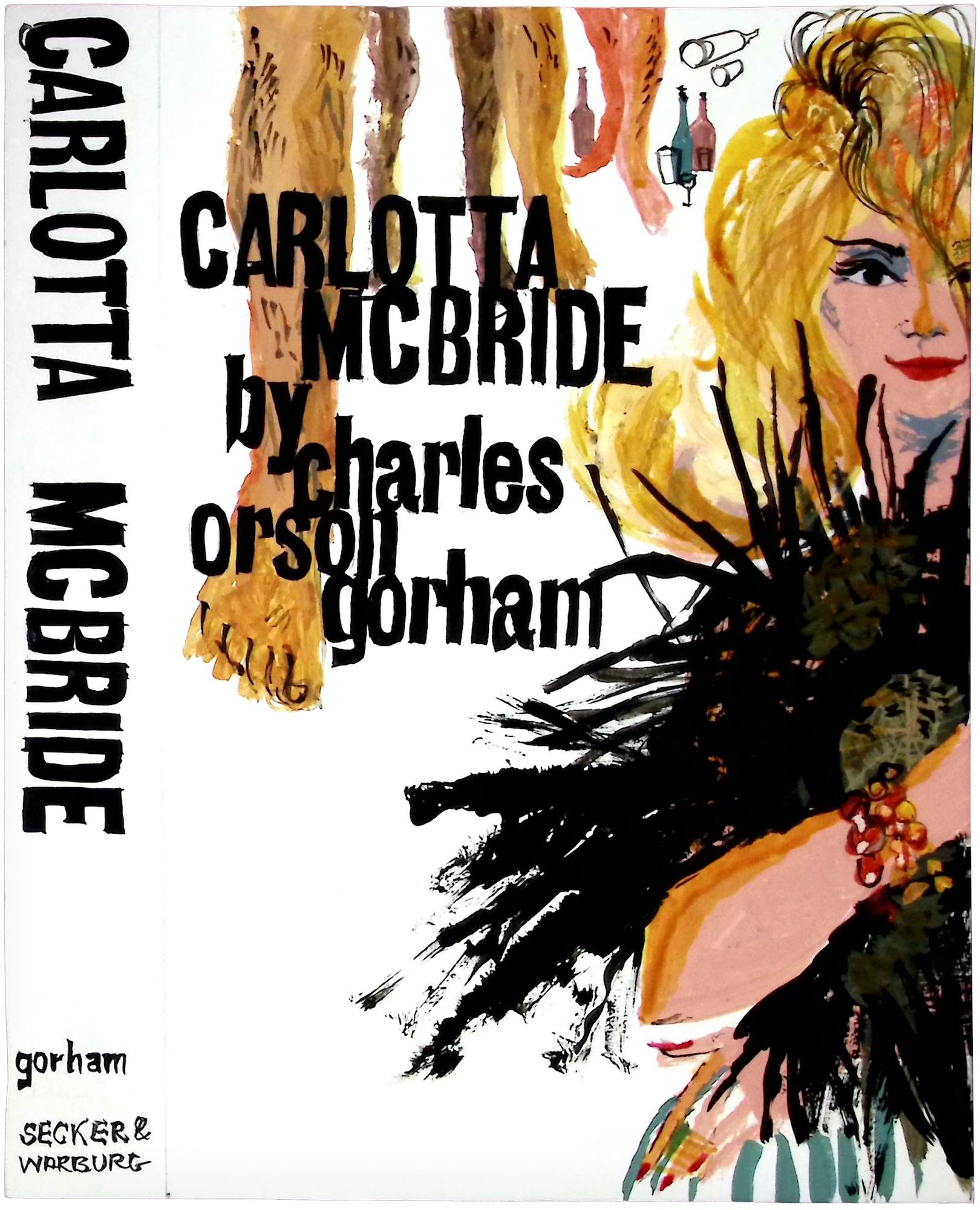
Rough cover illustration for "Carlotta Mc Bride", c. 1959
Janina Ede (1937-2018) created covers and illustrations for over 100 books from the 1950s to the 1980s. One of her earliest cover designs was for Carlotta McBride, a novel following the eponymous character in Paris, New York and Hollywood. It’s descriptions of sex and lesbian relationships led to the book being banned in Australia.
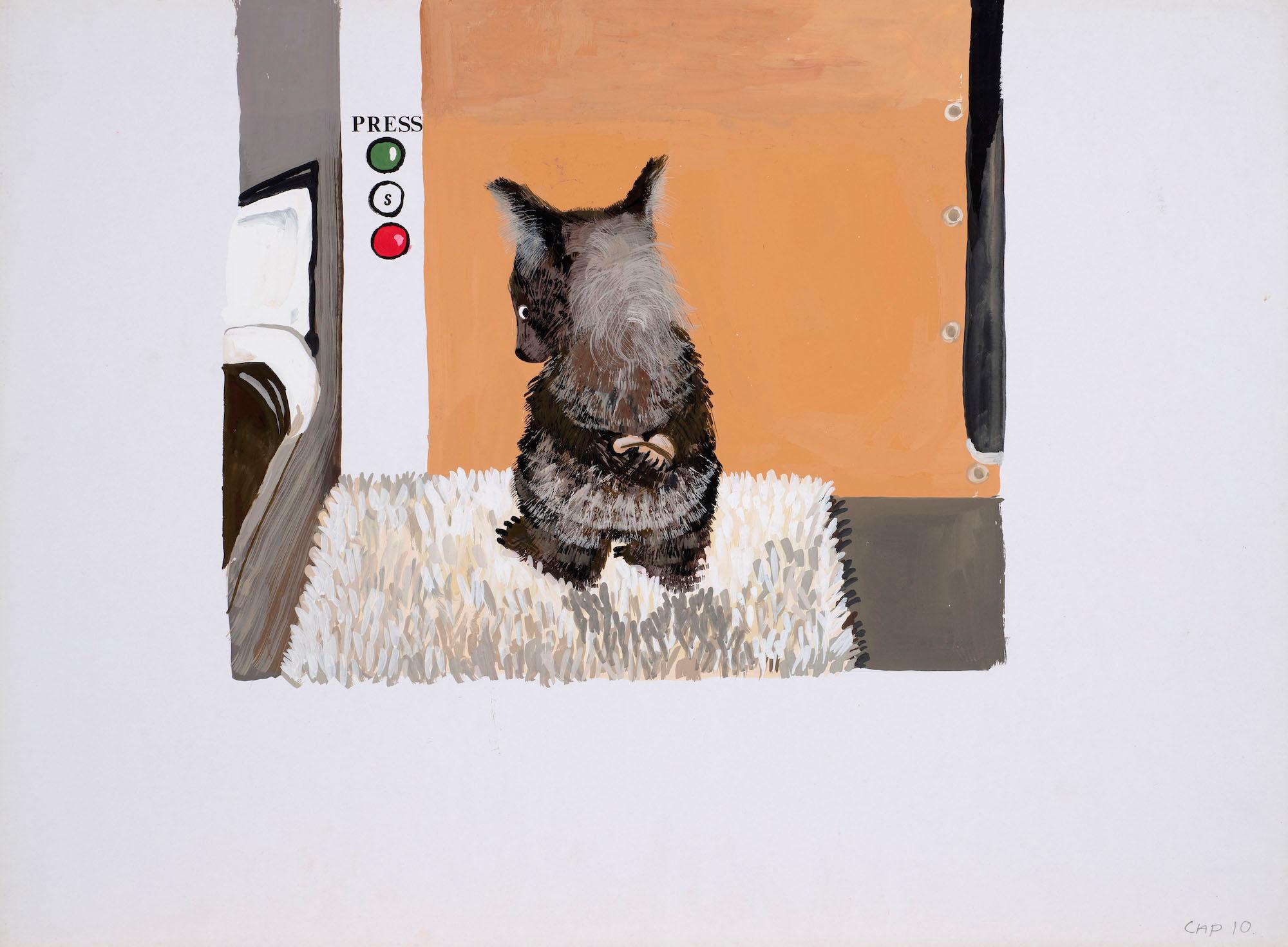
Untitled illustration for Jackanory (Mary Plain Goes to America) , 1972
British illustrator Janina Ede (1937-2018) created covers and illustrations for over 100 books from the 1950s to the 1980s. In the 1970s, she made illustrations for Jackanory, a BBC television programme. During each episode, an actor read a story, while specially-commissioned illustrations were shown on screen. For the televised version of Mary Plain Goes to America, Ede created paintings on large boards. These allowed the camera to pan across her image, showing a little at a time. BBC1 had only been in colour for three years, and so Ede used bold colours painted in gouache and reflective collaged foil to make the most of the new technology. This storyboard illustration was produced by Janina Ede for Jackanory episode #1426, 'Mary Plain Goes to America: Part 1 - An invitation'. It aired on 13 November 1972.
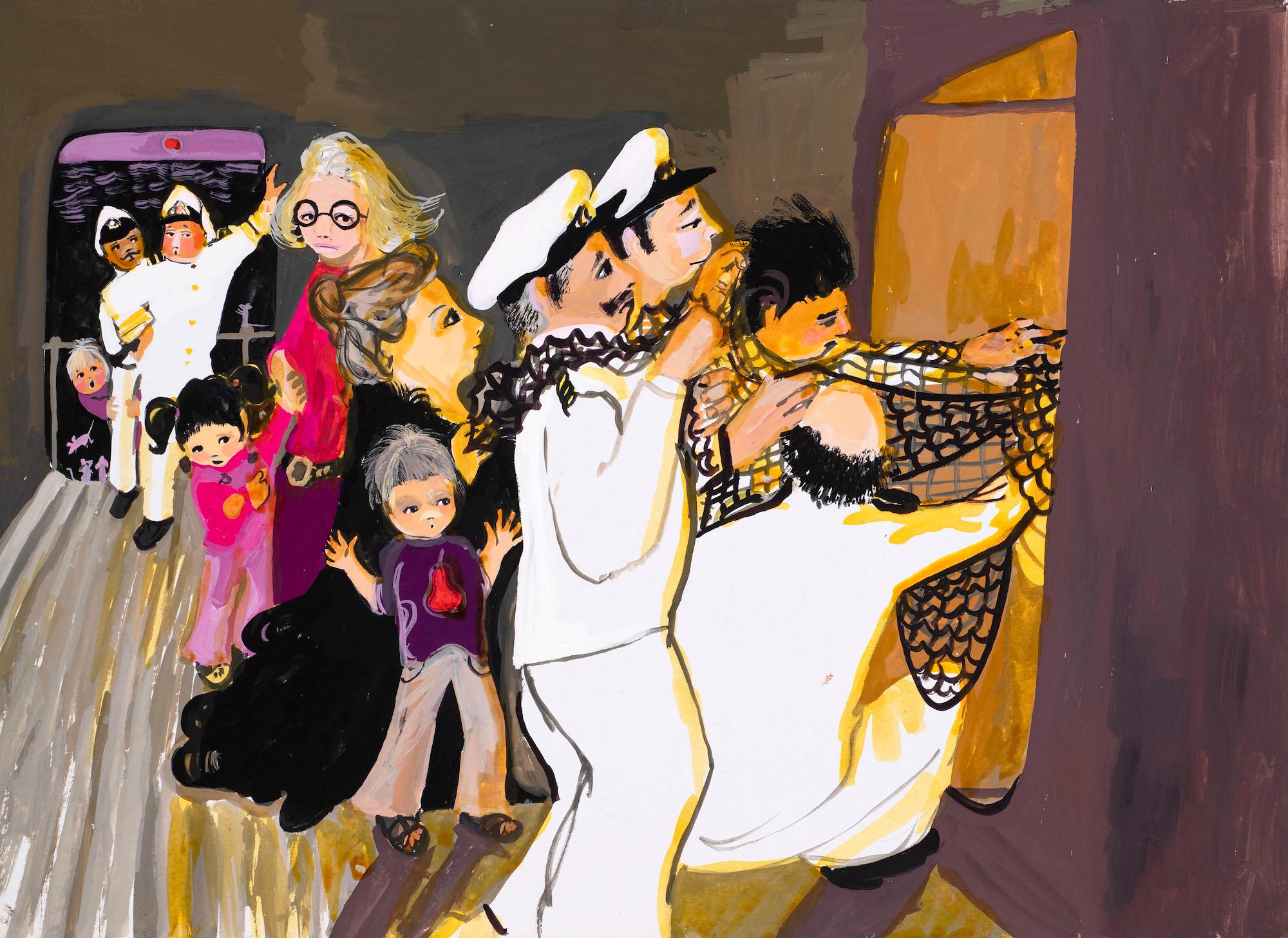
Untitled illustration for Jackanory (Mary Plain Goes to America) , 1972
British illustrator Janina Ede (1937-2018) created covers and illustrations for over 100 books from the 1950s to the 1980s. In the 1970s, she made illustrations for Jackanory, a BBC television programme. During each episode, an actor read a story, while specially-commissioned illustrations were shown on screen. For the televised version of Mary Plain Goes to America, Ede created paintings on large boards. These allowed the camera to pan across her image, showing a little at a time. BBC1 had only been in colour for three years, and so Ede used bold colours painted in gouache and reflective collaged foil to make the most of the new technology. This storyboard illustration was produced by Janina Ede for Jackanory episode #1426, 'Mary Plain Goes to America: Part 1 - An invitation'. It aired on 13 November 1972.
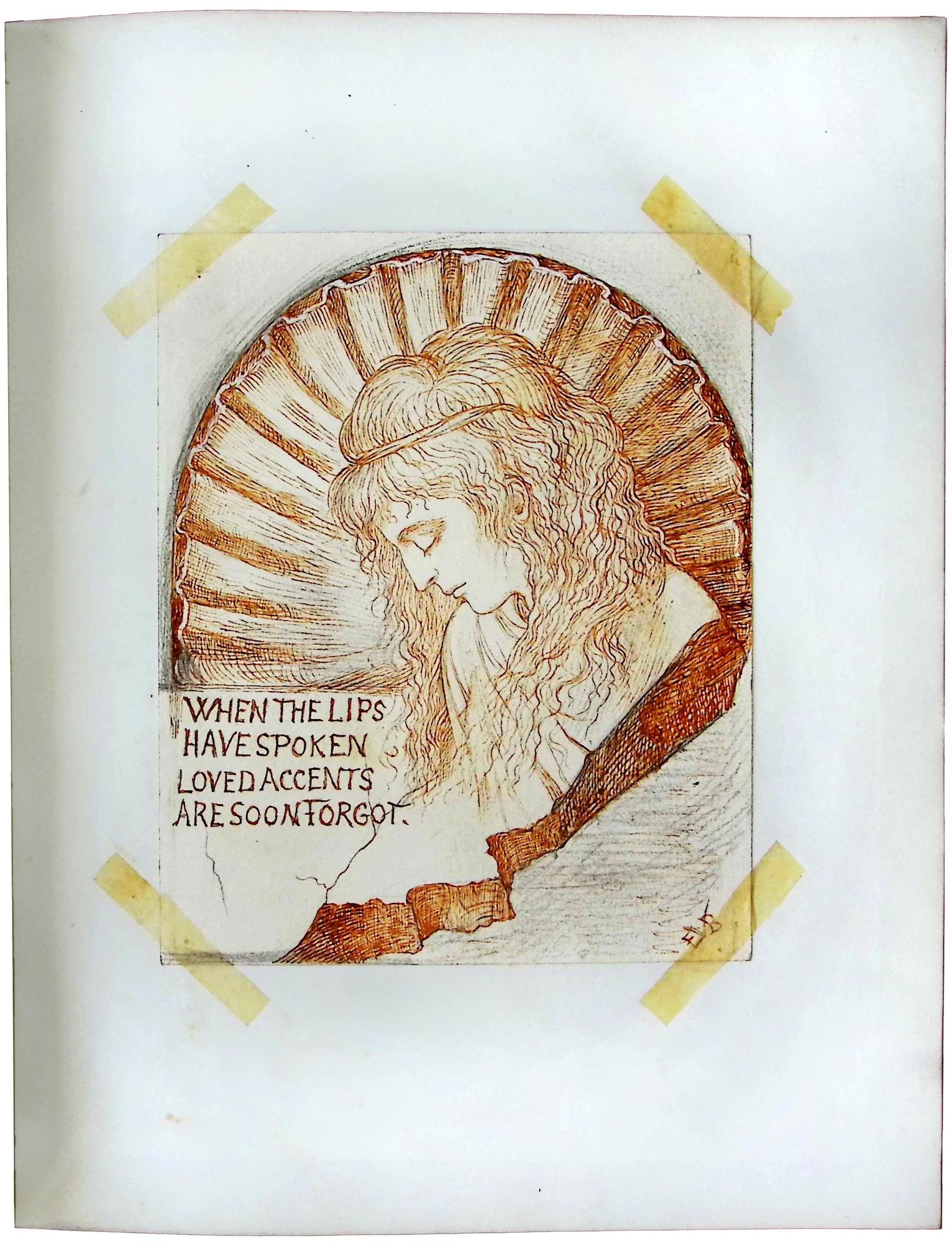
Untitled (illustration for A Book of Heavenly Birthdays), c. 1893
Eleanor Vere Boyle (1825 – 1916) illustrated poetry and prose by some of the most popular authors of her time. She regularly drew and painted using ink and watercolour, sketching landscapes, animals and her children from life. She also made drawings from her imagination, often reflecting spiritual themes. This drawing was used as some of the final illustrations printed in the artists' publication A Book of Heavenly Birthdays (1893, London Elliot Stock)
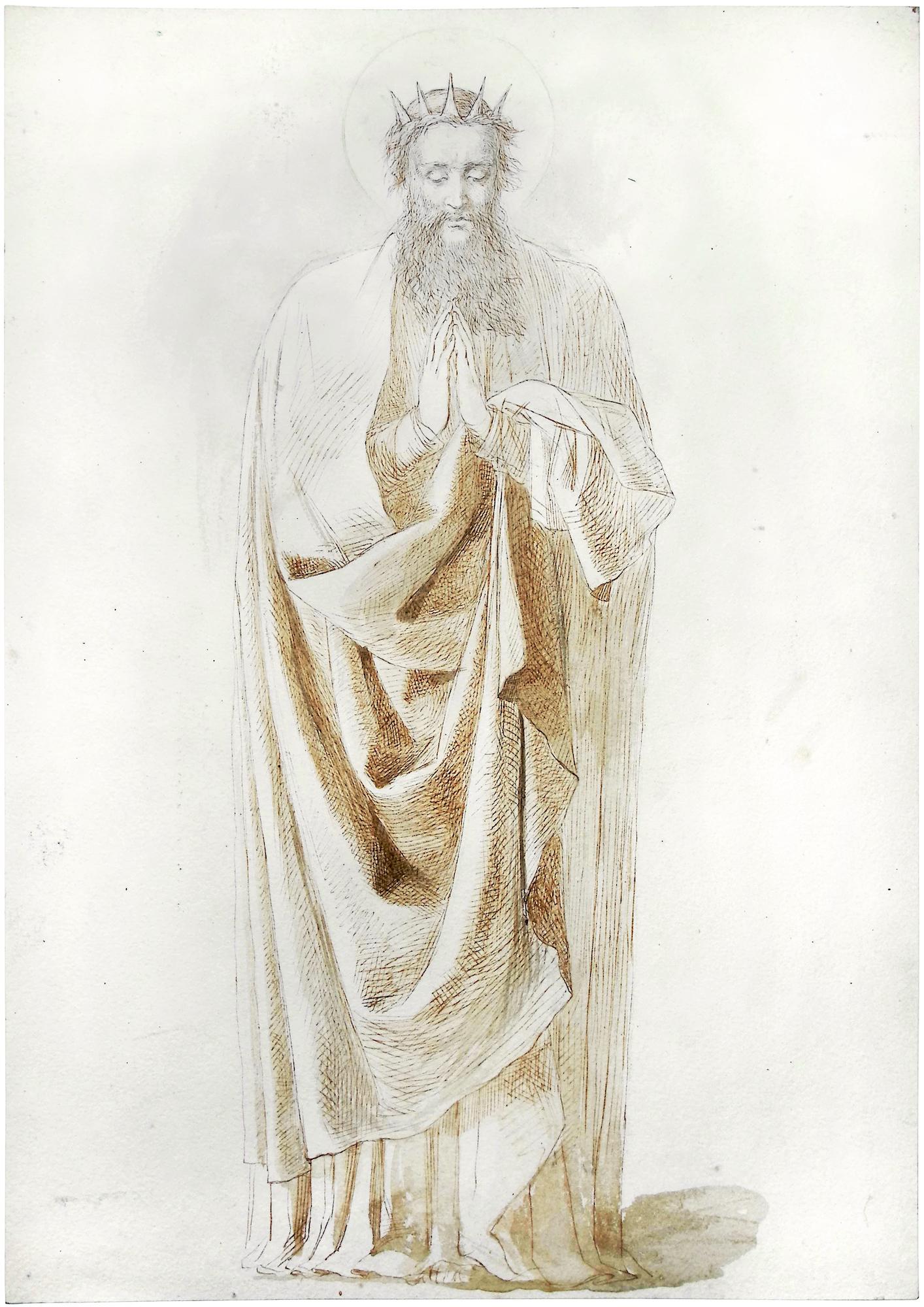
Untitled, Date unknown
Eleanor Vere Boyle (1825 – 1916) illustrated poetry and prose by some of the most popular authors of her time. She regularly drew and painted using ink and watercolour, sketching landscapes, animals and her children from life. She also made drawings from her imagination, often reflecting spiritual themes.
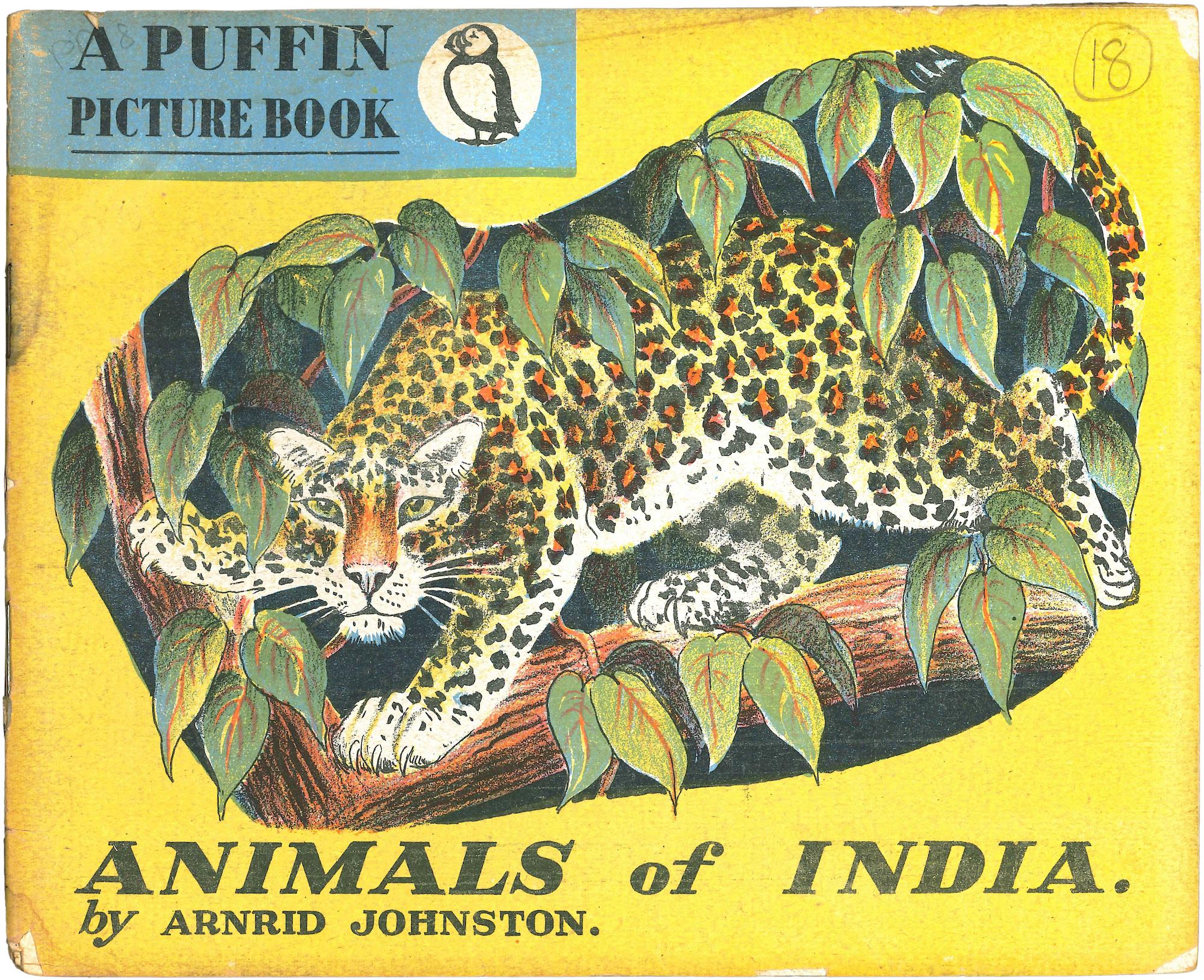
Animals of India, 1942
The Puffin Picture Books series was established by designer and editor Noel Carrington (1895-1989). In 1933, artist Pearl Binder (1904-1990) sent Carrington a package of Soviet children’s books. “They were produced by the million on very cheap paper, but the drawings were vigorous and the colour delightful” he later remembered. These books inspired Carrington to edit a series of affordable books that would encourage “the child’s awakening interest in its surroundings... I felt that colour was essential, and that artists could... be more successful in books of this nature than the camera”. Many artists and illustrators worked on the series, adapting their ways of working to lithographic printing and the Puffin Picture Book format. Most of the 120 books in the series were printed on one large sheet of paper: one side in colour and one in black-and-white. Each sheet was cut, folded and stapled to create a softcover book.
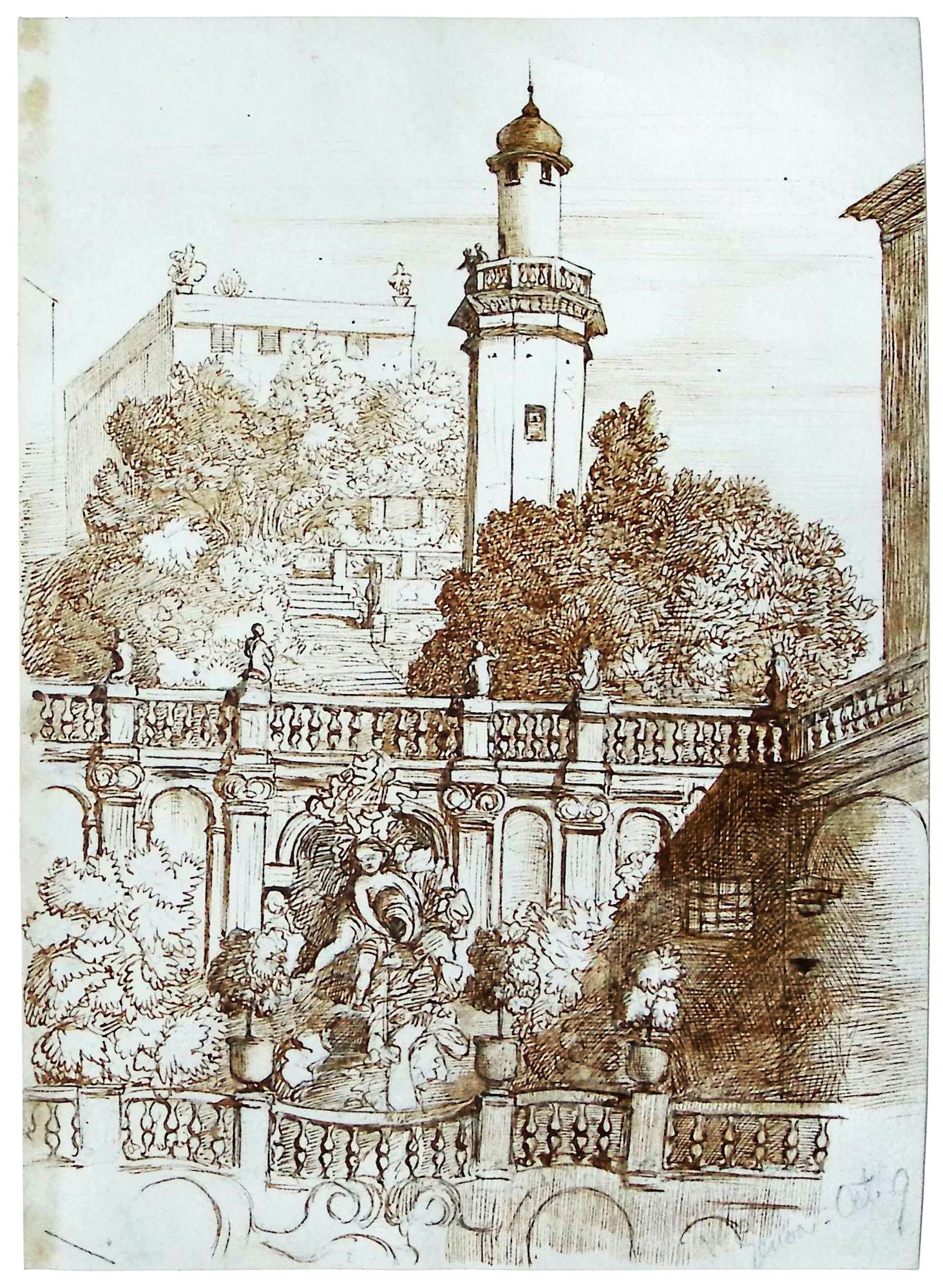
Untitled, Date unknown
Eleanor Vere Boyle (1825 – 1916) illustrated poetry and prose by some of the most popular authors of her time. She regularly drew and painted using ink and watercolour, sketching landscapes, animals and her children from life. She also made drawings from her imagination, often reflecting spiritual themes.
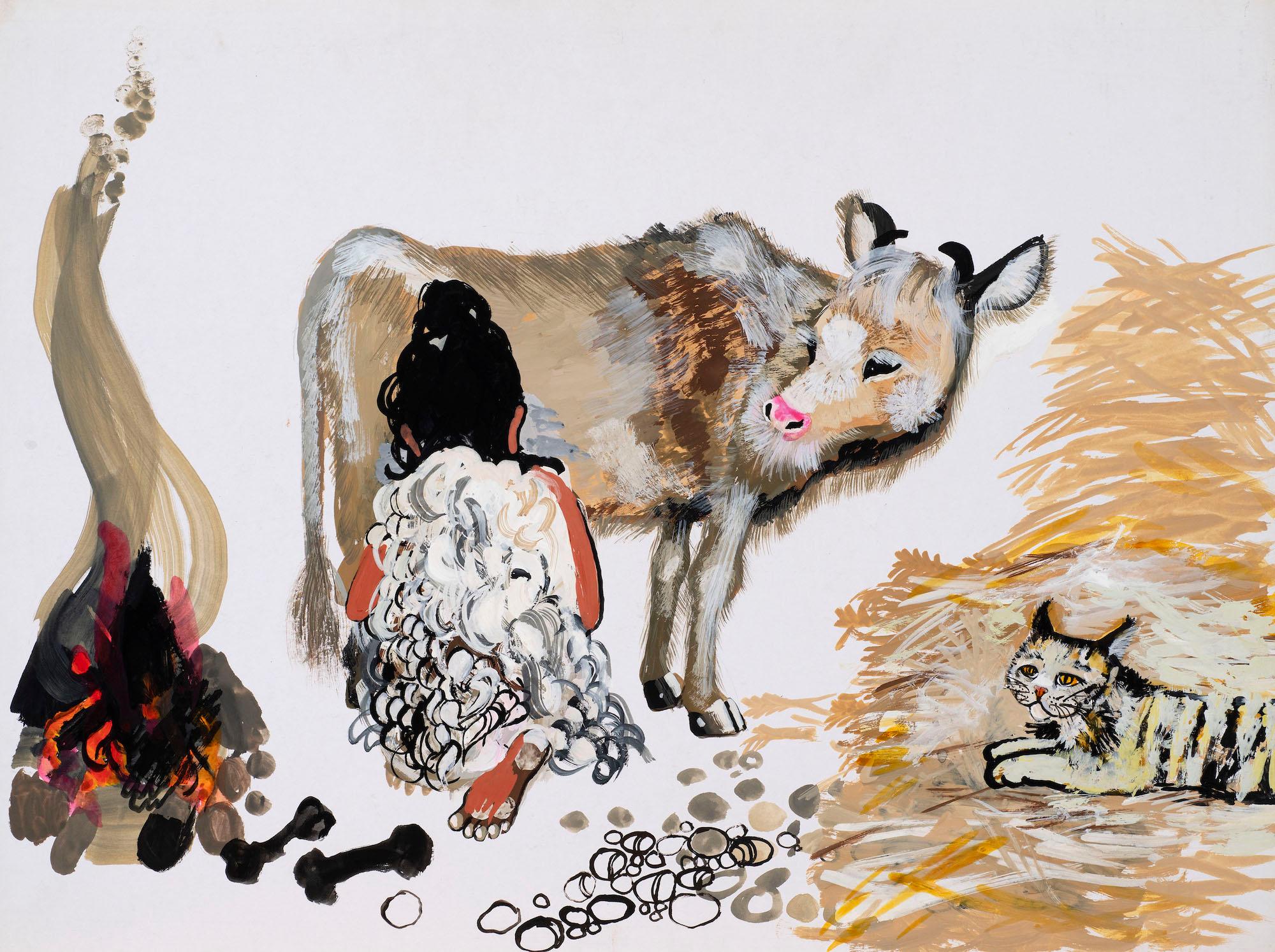
Untitled illustration for Jackanory (Just So Stories: The Cat who Walked by Himself), 1973
Janina Ede (1937-2018) created covers and illustrations for over 100 books in the 1960s, 70s and 80s. Many of her illustrations feature animals, which she drew from life. In the 1970s, Ede was commissioned to create large colourful illustrations for the BBC children’s television series, Jackanory. Each episode was dedicated to a story read by an actor, while specially commissioned illustrations were shown on screen during each programme. Some of these illustrations were for programmes featuring stories by author Rudyard Kipling. His ‘Just So’ stories were short tales that imagined how various animals attained their distinguishing features. Kipling set the stories in parts of India, West Asia and Africa. His descriptions of places and people included racist and exoticised stereotypes. Ede’s illustrations draw extensively on Kipling’s descriptions, and therefore reflect the racism in his work, as well as the prevailing stereotypical views that existed in 1970s Britain. Her own personal views are not documented. This storyboard illustration was produced by Janina Ede for Jackanory episode #1452, 'Just So Stories - The Cat that Walked by Himself'. It aired on 3 January 1973.
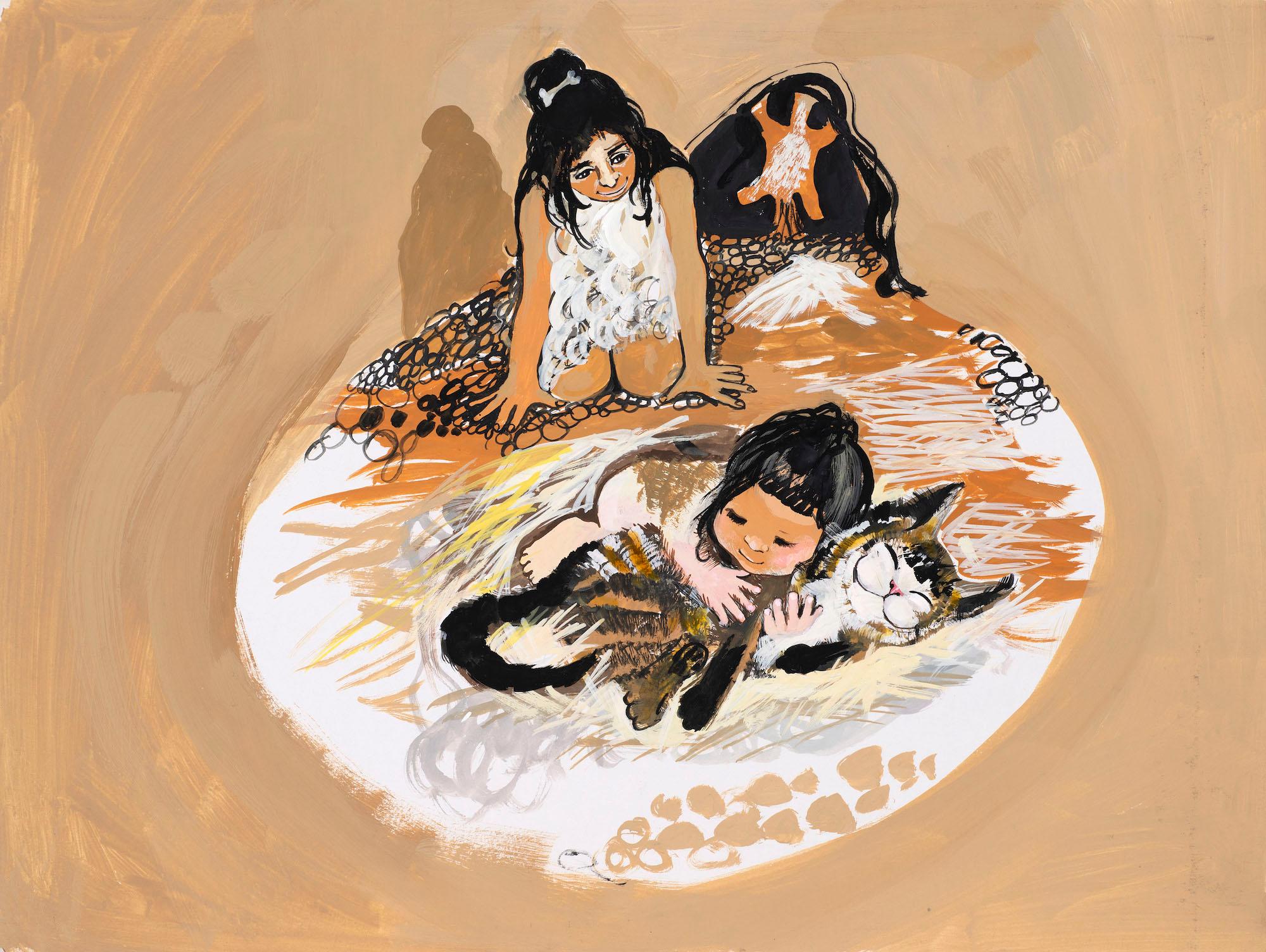
Untitled illustration for Jackanory (Just So Stories: The Cat who Walked by Himself), 1973
Janina Ede (1937-2018) created covers and illustrations for over 100 books in the 1960s, 70s and 80s. Many of her illustrations feature animals, which she drew from life. In the 1970s, Ede was commissioned to create large colourful illustrations for the BBC children’s television series, Jackanory. Each episode was dedicated to a story read by an actor, while specially commissioned illustrations were shown on screen during each programme. Some of these illustrations were for programmes featuring stories by author Rudyard Kipling. His ‘Just So’ stories were short tales that imagined how various animals attained their distinguishing features. Kipling set the stories in parts of India, West Asia and Africa. His descriptions of places and people included racist and exoticised stereotypes. Ede’s illustrations draw extensively on Kipling’s descriptions, and therefore reflect the racism in his work, as well as the prevailing stereotypical views that existed in 1970s Britain. Her own personal views are not documented. This storyboard illustration was produced by Janina Ede for Jackanory episode #1452, 'Just So Stories - The Cat that Walked by Himself'. It aired on 3 January 1973.
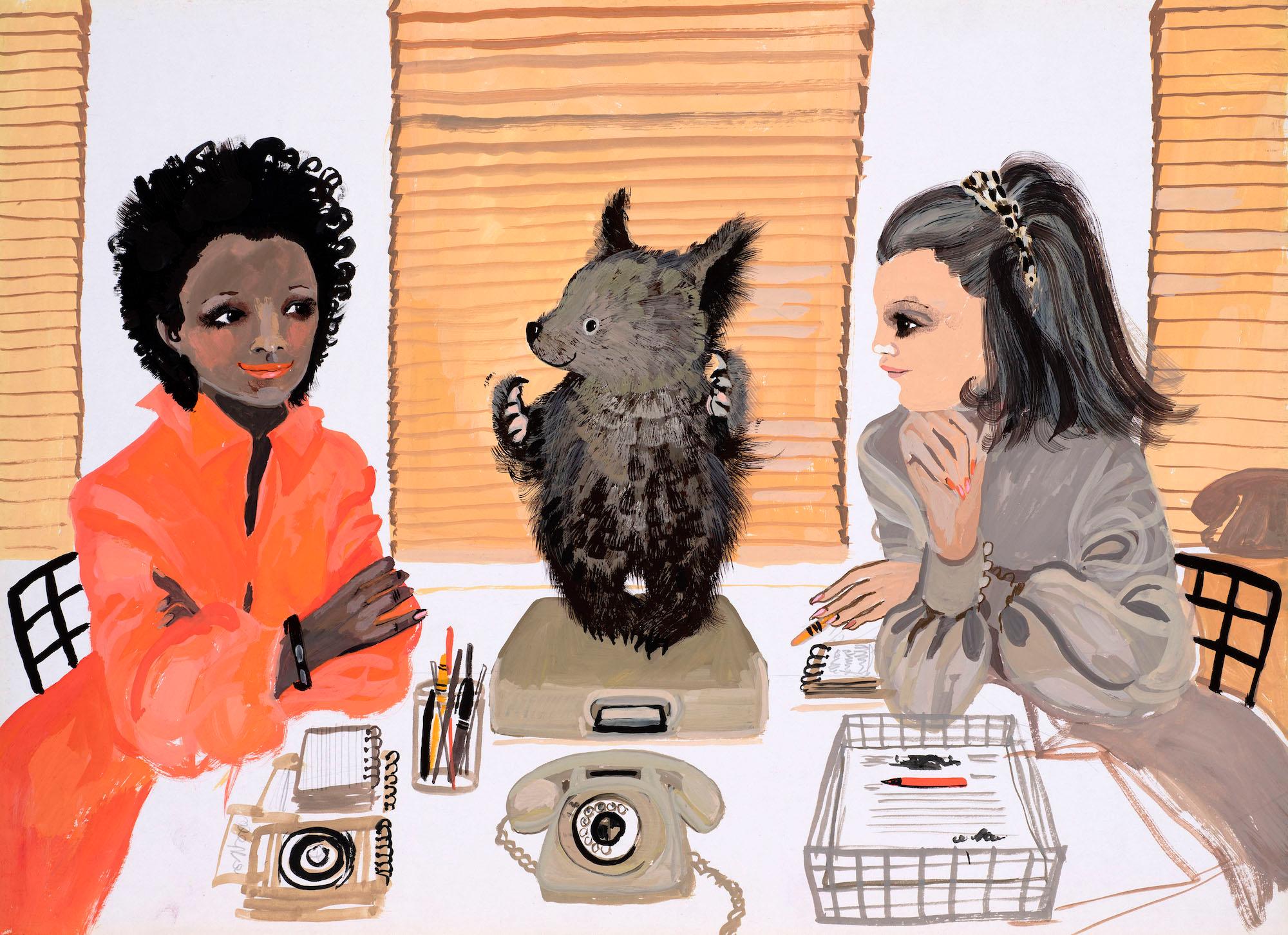
Untitled illustration for Jackanory (Mary Plain Goes to America) , 1972
British illustrator Janina Ede (1937-2018) created covers and illustrations for over 100 books from the 1950s to the 1980s. In the 1970s, she made illustrations for Jackanory, a BBC television programme. During each episode, an actor read a story, while specially-commissioned illustrations were shown on screen. For the televised version of Mary Plain Goes to America, Ede created paintings on large boards. These allowed the camera to pan across her image, showing a little at a time. BBC1 had only been in colour for three years, and so Ede used bold colours painted in gouache and reflective collaged foil to make the most of the new technology. This storyboard illustration was produced by Janina Ede for Jackanory episode #1427, 'Mary Plain Goes to America: Part 2 - The Most Popular Person on Board'. It aired on 14 November 1972.
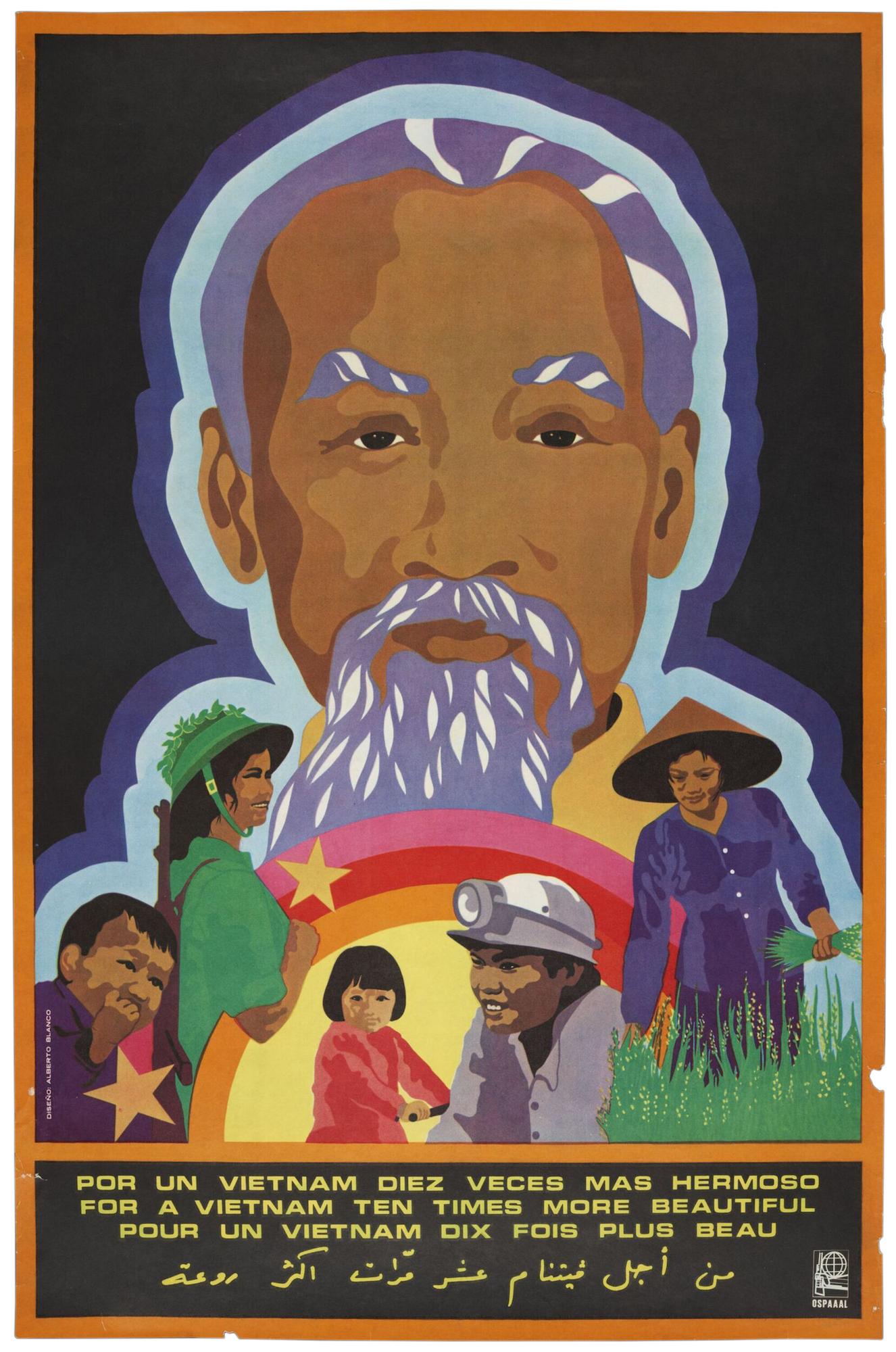
FOR A VIETNAM TEN TIMES MORE BEAUTIFUL, 1980
Between the 1960s and 1990s, more than fifty designers worked at OSPAAAL (the Organisation of Solidarity with the People of Africa, Asia and Latin America). Based in Cuba, they made magazines and posters that were sent around the world. Their aim was to promote radical political ideas. Many of their posters celebrate socialist revolutions and liberation movements from the Global South. President Hồ Chí Minh promised that a country “ten times more beautiful” would be rebuilt after the destruction caused by the war between North Vietnam and South Vietnam, allied with the U.S.A. (known as the ‘Vietnam War’ and ‘War Against the Americans to Save the Nation’).. This posthumous portrait of the leader pictures Vietnamese citizens in the socialist realist style used in propaganda posters from the Soviet Union and People’s Republic of China.
Content warning: weaponry
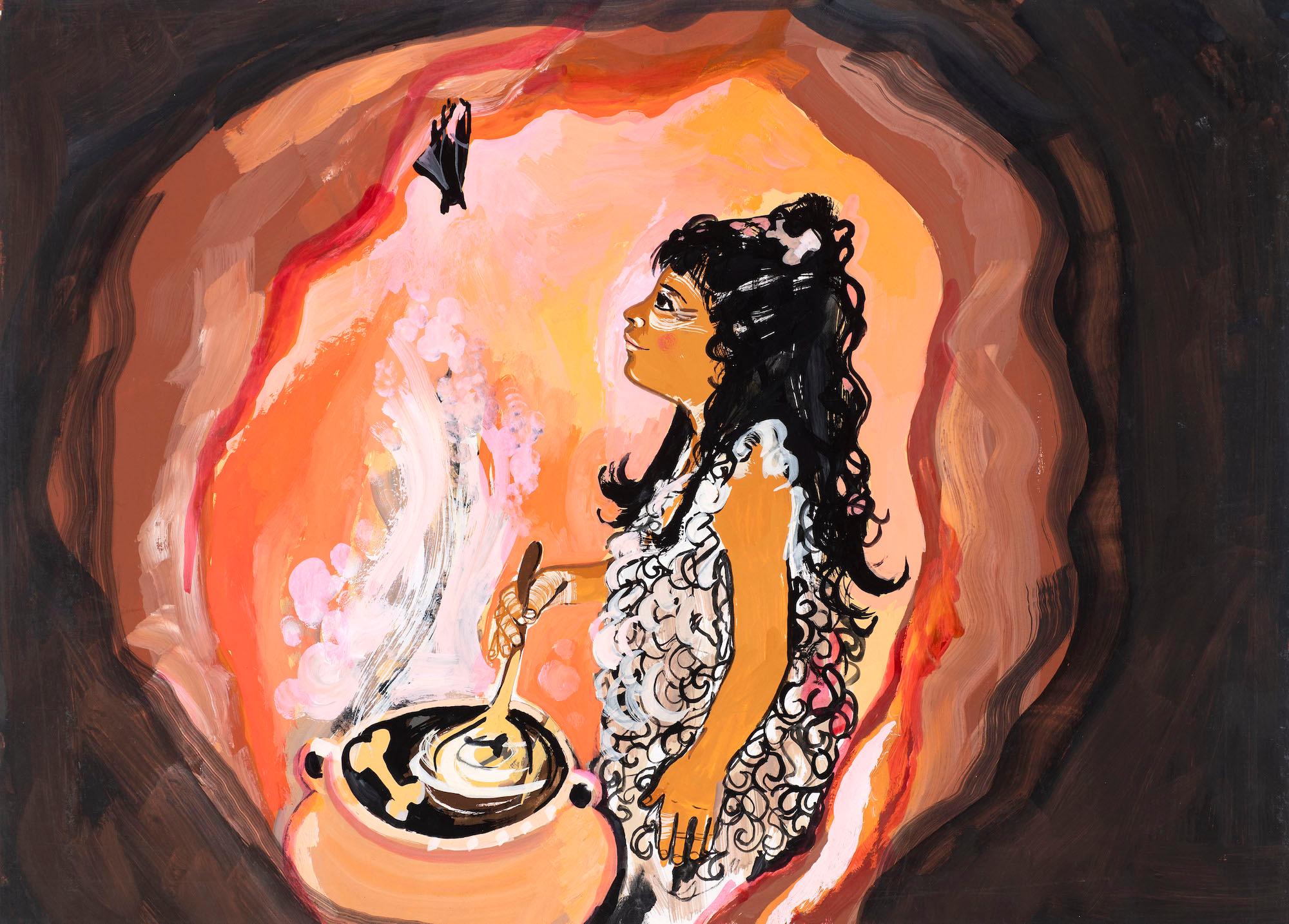
Untitled illustration for Jackanory (Just So Stories: The Cat who Walked by Himself), 1973
Janina Ede (1937-2018) created covers and illustrations for over 100 books in the 1960s, 70s and 80s. Many of her illustrations feature animals, which she drew from life. In the 1970s, Ede was commissioned to create large colourful illustrations for the BBC children’s television series, Jackanory. Each episode was dedicated to a story read by an actor, while specially commissioned illustrations were shown on screen during each programme. Some of these illustrations were for programmes featuring stories by author Rudyard Kipling. His ‘Just So’ stories were short tales that imagined how various animals attained their distinguishing features. Kipling set the stories in parts of India, West Asia and Africa. His descriptions of places and people included racist and exoticised stereotypes. Ede’s illustrations draw extensively on Kipling’s descriptions, and therefore reflect the racism in his work, as well as the prevailing stereotypical views that existed in 1970s Britain. Her own personal views are not documented. This storyboard illustration was produced by Janina Ede for Jackanory episode #1452, 'Just So Stories - The Cat that Walked by Himself'. It aired on 3 January 1973.
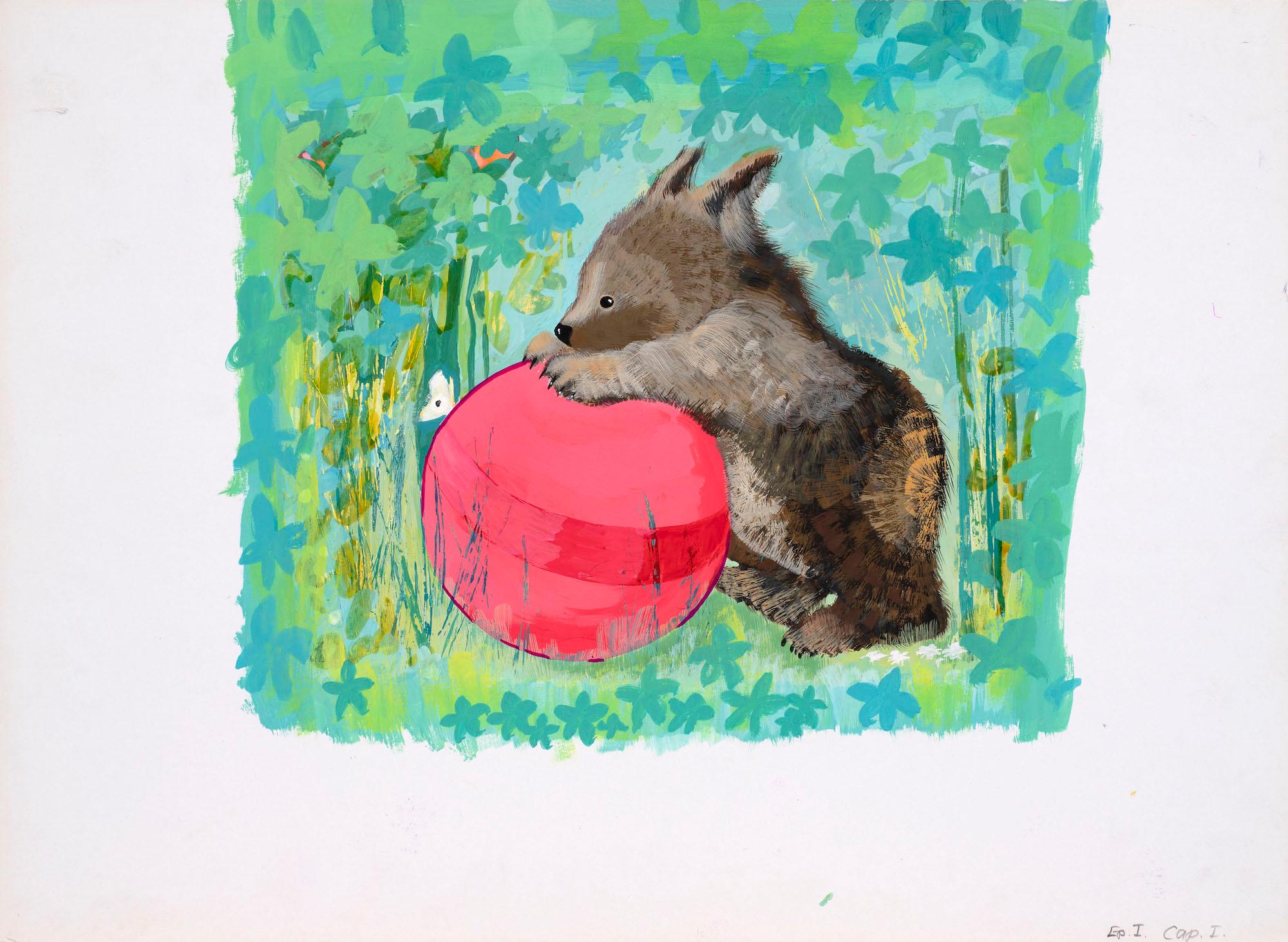
Untitled illustration for Jackanory (Mary Plain Goes to America) , 1972
British illustrator Janina Ede (1937-2018) created covers and illustrations for over 100 books from the 1950s to the 1980s. In the 1970s, she made illustrations for Jackanory, a BBC television programme. During each episode, an actor read a story, while specially-commissioned illustrations were shown on screen. For the televised version of Mary Plain Goes to America, Ede created paintings on large boards. These allowed the camera to pan across her image, showing a little at a time. BBC1 had only been in colour for three years, and so Ede used bold colours painted in gouache and reflective collaged foil to make the most of the new technology. This storyboard illustration was produced by Janina Ede for Jackanory episode #1426, 'Mary Plain Goes to America: Part 1 - An invitation'. It aired on 13 November 1972.
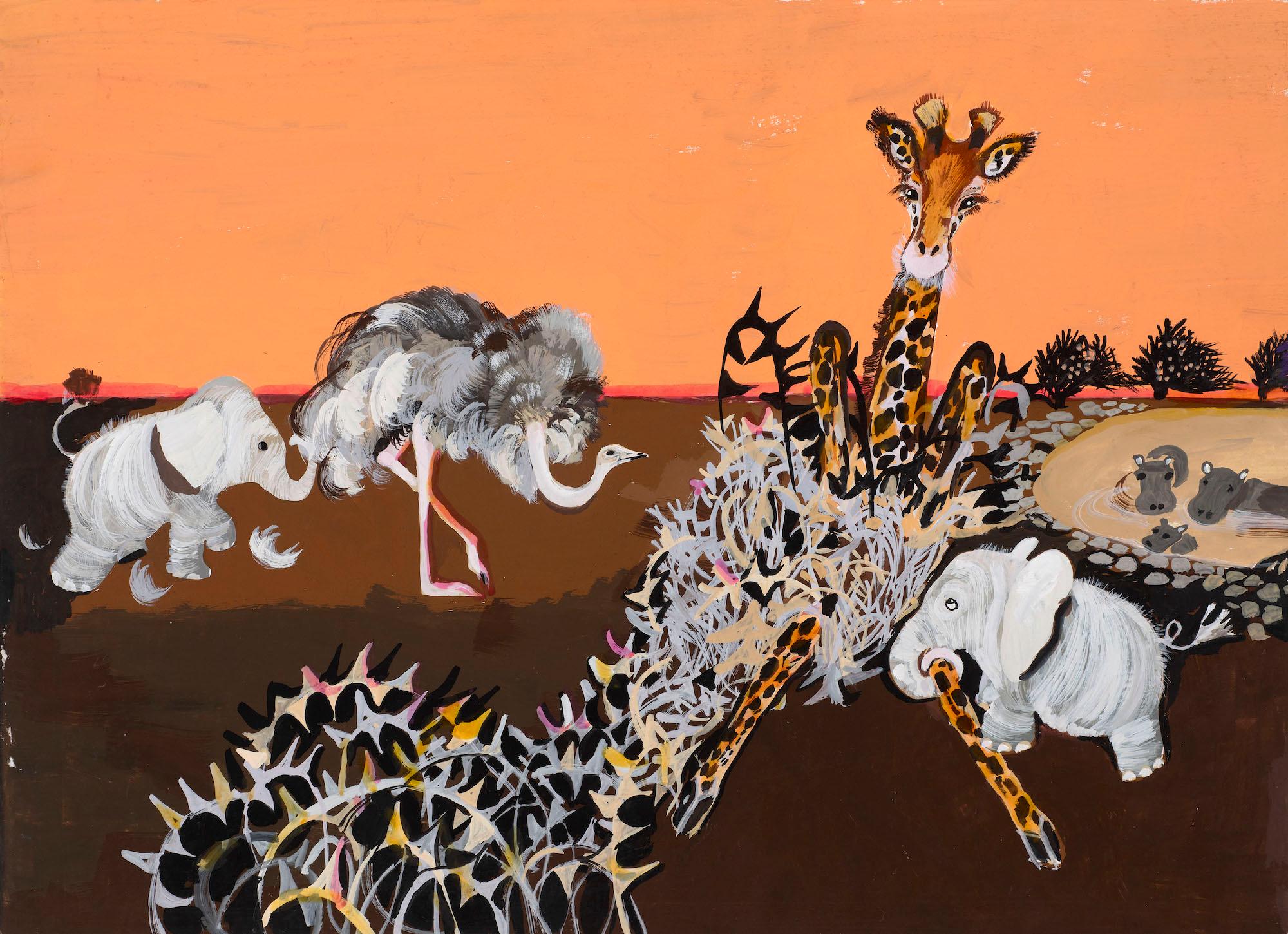
Untitled illustration for Jackanory (Just So Stories: The Elephant's Child), 1973
Janina Ede (1937-2018) created covers and illustrations for over 100 books in the 1960s, 70s and 80s. Many of her illustrations feature animals, which she drew from life. In the 1970s, Ede was commissioned to create large colourful illustrations for the BBC children’s television series, Jackanory. Each episode was dedicated to a story read by an actor, while specially commissioned illustrations were shown on screen during each programme. Some of these illustrations were for programmes featuring stories by author Rudyard Kipling. His ‘Just So’ stories were short tales that imagined how various animals attained their distinguishing features. Kipling set the stories in parts of India, West Asia and Africa. His descriptions of places and people included racist and exoticised stereotypes. Ede’s illustrations draw extensively on Kipling’s descriptions, and therefore reflect the racism in his work, as well as the prevailing stereotypical views that existed in 1970s Britain. Her own personal views are not documented. This storyboard illustration was produced by Janina Ede for Jackanory episode #1450, 'Just So Stories - The Elephant's Child'. It aired on 1 January 1973.
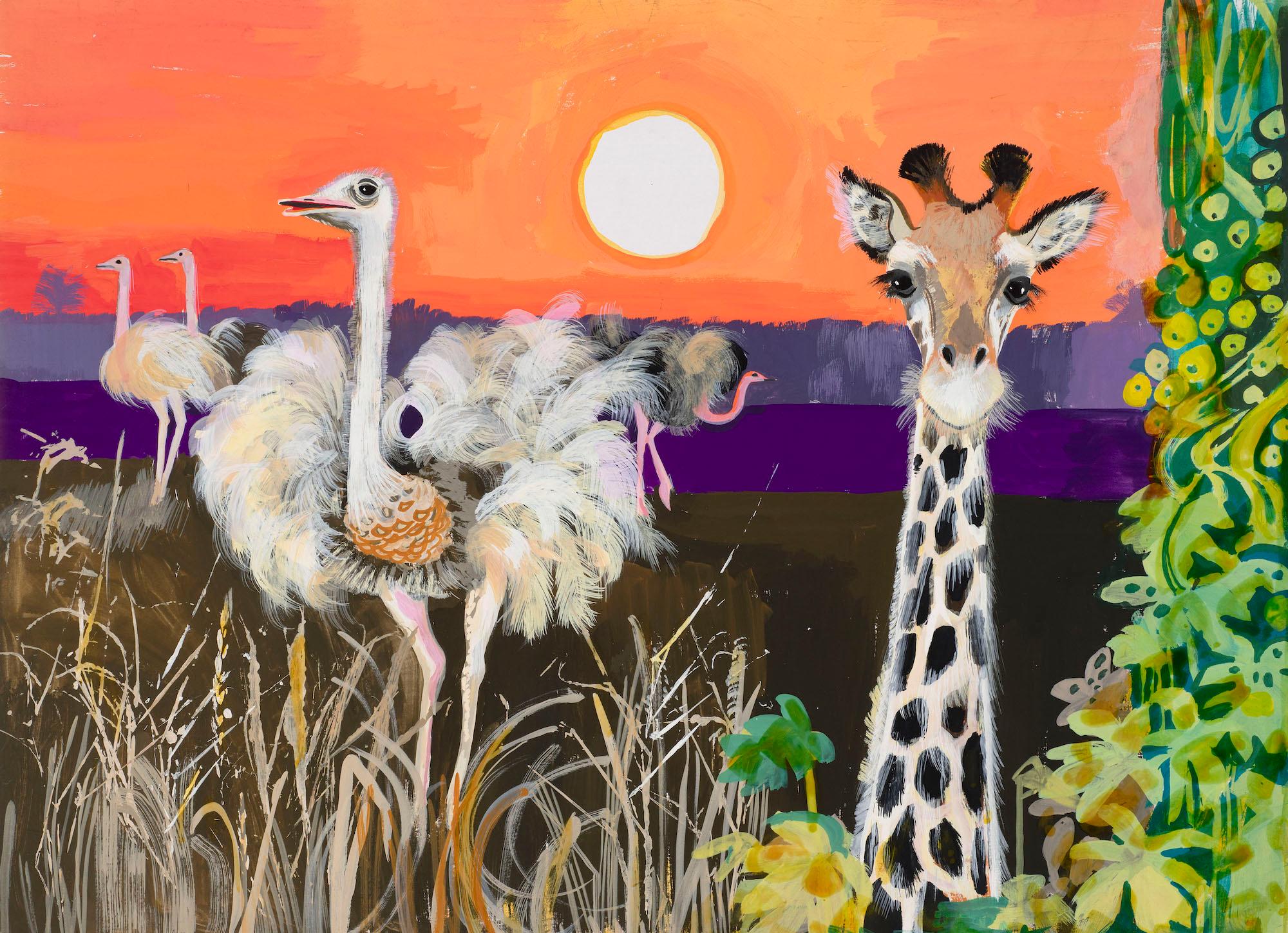
Untitled illustration for Jackanory (Just So Stories: The Elephant's Child), 1973
Janina Ede (1937-2018) created covers and illustrations for over 100 books in the 1960s, 70s and 80s. Many of her illustrations feature animals, which she drew from life. In the 1970s, Ede was commissioned to create large colourful illustrations for the BBC children’s television series, Jackanory. Each episode was dedicated to a story read by an actor, while specially commissioned illustrations were shown on screen during each programme. Some of these illustrations were for programmes featuring stories by author Rudyard Kipling. His ‘Just So’ stories were short tales that imagined how various animals attained their distinguishing features. Kipling set the stories in parts of India, West Asia and Africa. His descriptions of places and people included racist and exoticised stereotypes. Ede’s illustrations draw extensively on Kipling’s descriptions, and therefore reflect the racism in his work, as well as the prevailing stereotypical views that existed in 1970s Britain. Her own personal views are not documented. This storyboard illustration was produced by Janina Ede for Jackanory episode #1450, 'Just So Stories - The Elephant's Child'. It aired on 1 January 1973.
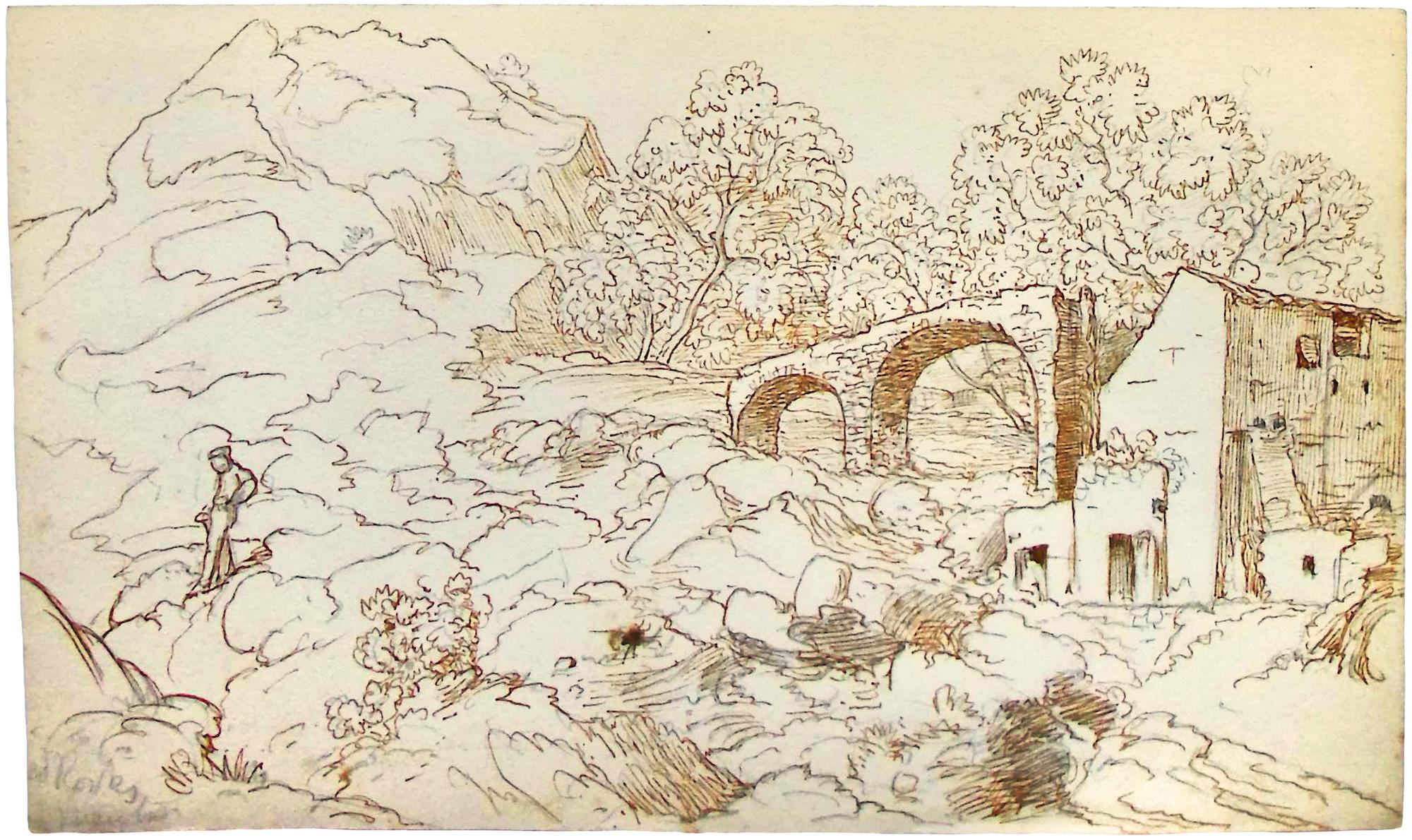
Untitled, Date unknown
Eleanor Vere Boyle (1825 – 1916) illustrated poetry and prose by some of the most popular authors of her time. She regularly drew and painted using ink and watercolour, sketching landscapes, animals and her children from life. She also made drawings from her imagination, often reflecting spiritual themes.
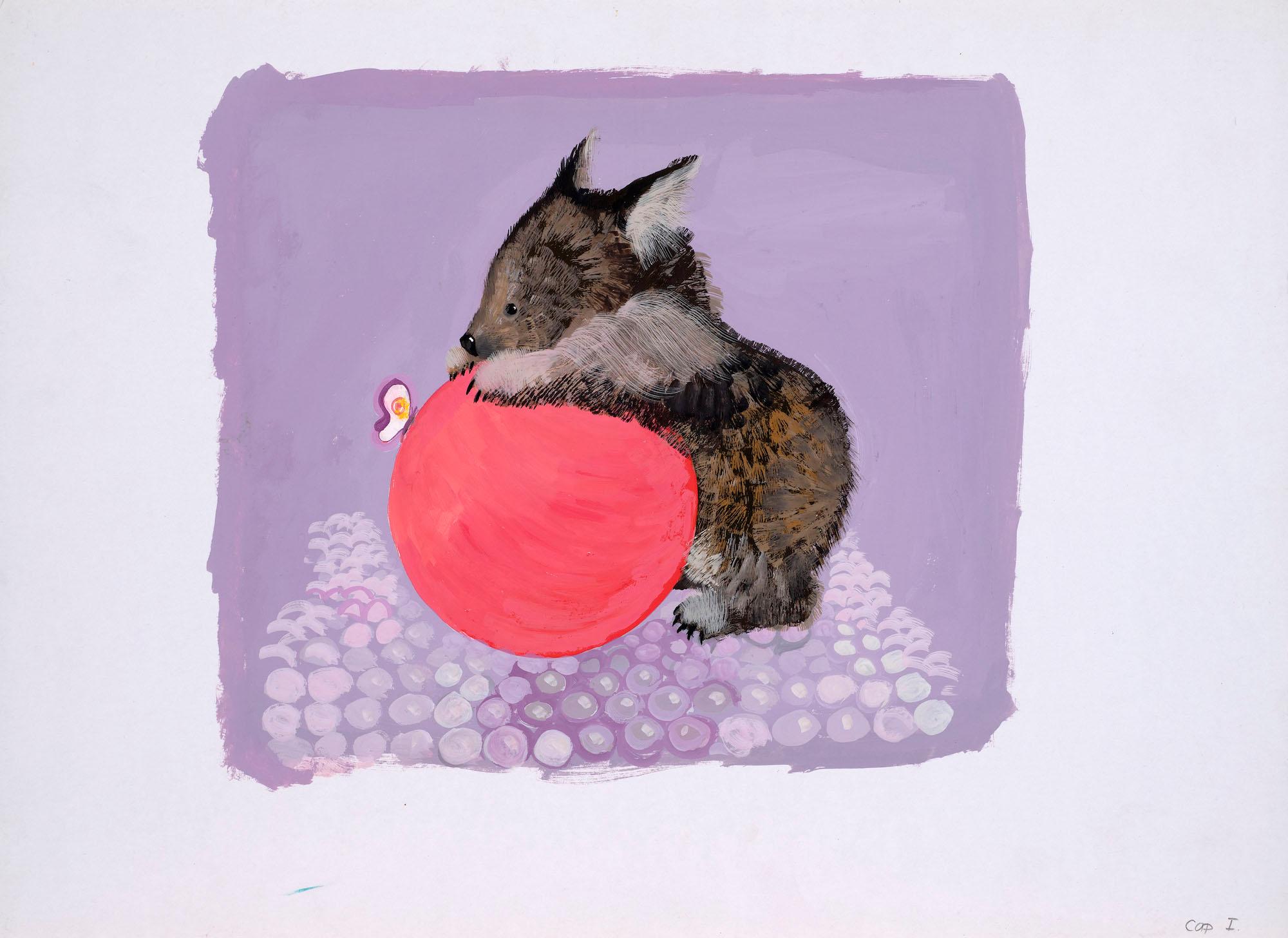
Untitled illustration for Jackanory (Mary Plain Goes to America) , 1972
British illustrator Janina Ede (1937-2018) created covers and illustrations for over 100 books from the 1950s to the 1980s. In the 1970s, she made illustrations for Jackanory, a BBC television programme. During each episode, an actor read a story, while specially-commissioned illustrations were shown on screen. For the televised version of Mary Plain Goes to America, Ede created paintings on large boards. These allowed the camera to pan across her image, showing a little at a time. BBC1 had only been in colour for three years, and so Ede used bold colours painted in gouache and reflective collaged foil to make the most of the new technology. This storyboard illustration was produced by Janina Ede for Jackanory episode #1427, 'Mary Plain Goes to America: Part 2 - The Most Popular Person on Board'. It aired on 14 November 1972.
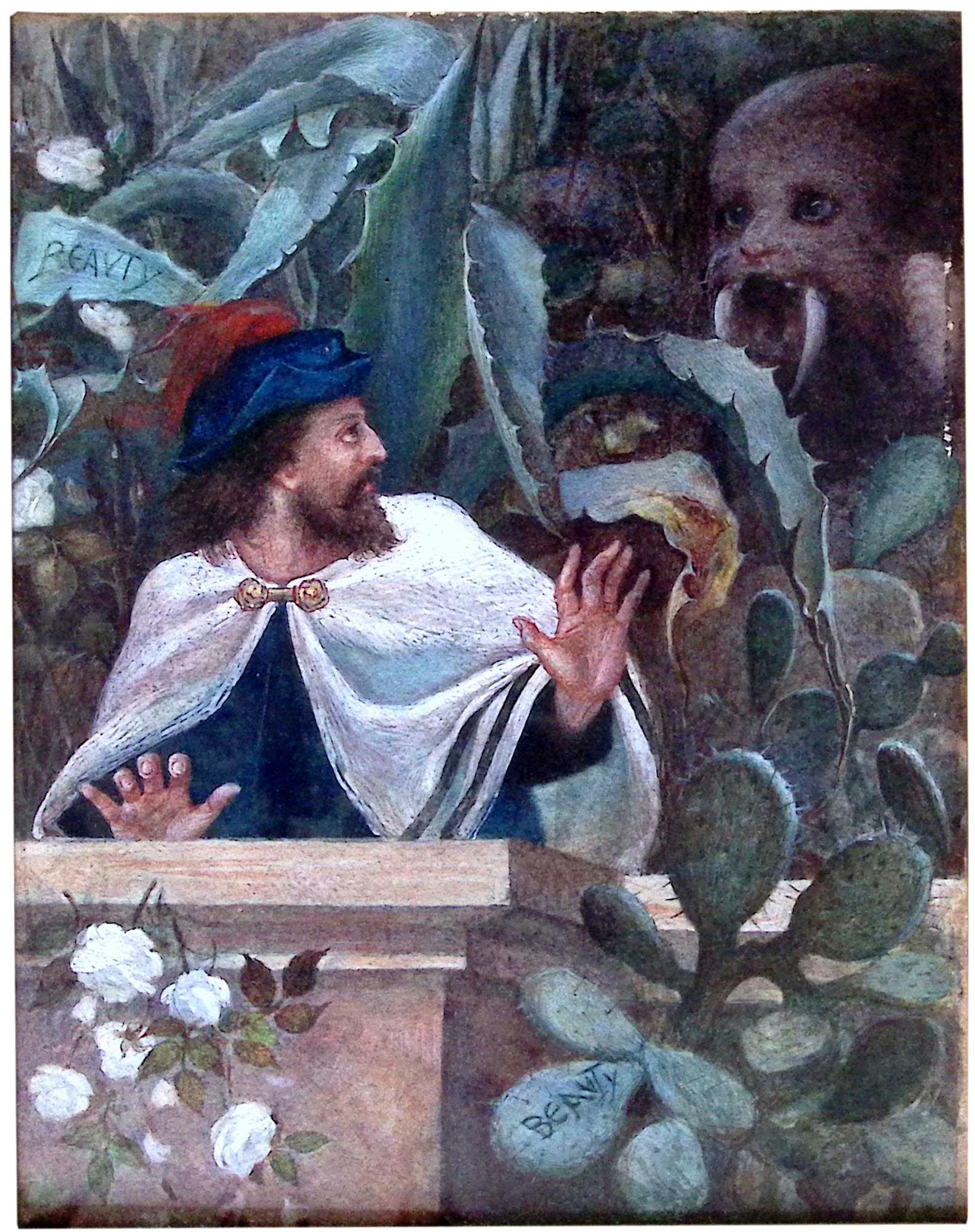
Illustration for Beauty and the Beast (the Merchant and the Beast), c. 1875
Eleanor Vere Boyle (1825 – 1916) illustrated poetry and prose by some of the most popular authors of her time. She regularly drew and painted using ink and watercolour, sketching landscapes, animals and her children from life. She also made drawings from her imagination, often reflecting spiritual themes. This illustration is from Boyle’s 1875 retelling of Beauty and the Beast, a fairy tale where a woman is imprisoned by a monster and falls in love with him. Unlike other illustrated versions before or since, Boyle gave her beast walrus-like tusks and flippers. In several of her illustrations, Boyle used shell gold – a mixture of finely ground gold powder and gum arabic (tree sap) that would have been stored in a shallow seashell. In the final publication, the caption for this illustration reads, "Upon the strange prickly leaves, some one had curiously carved Beauty's name ......... The Beast came near, and the roses fell from his grasp."
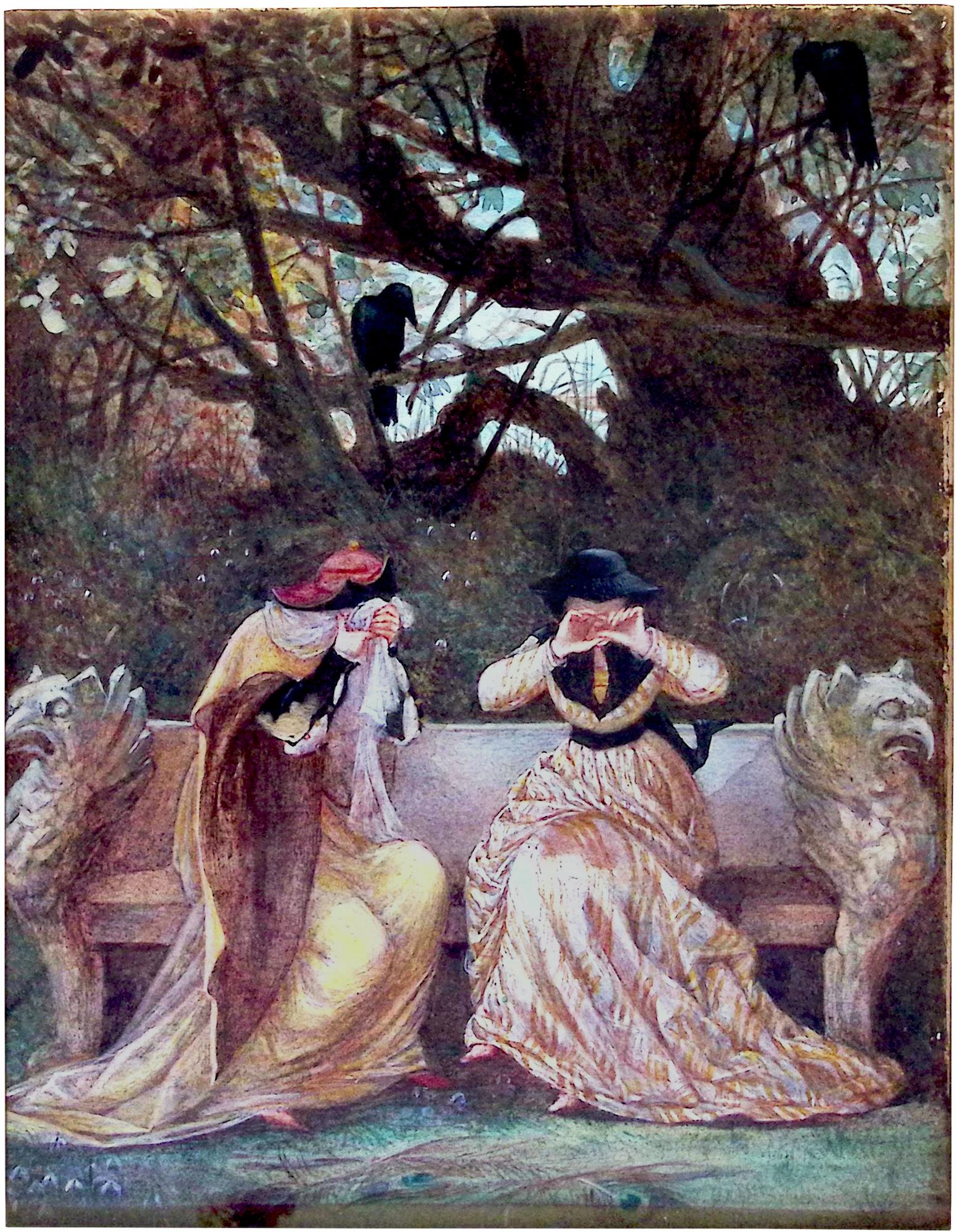
Illustration for Beauty and the Beast (two sisters weeping), c. 1875
Eleanor Vere Boyle (1825 – 1916) illustrated poetry and prose by some of the most popular authors of her time. She regularly drew and painted using ink and watercolour, sketching landscapes, animals and her children from life. She also made drawings from her imagination, often reflecting spiritual themes. This illustration is from Boyle’s 1875 retelling of Beauty and the Beast, a fairy tale where a woman is imprisoned by a monster and falls in love with him. Unlike other illustrated versions before or since, Boyle gave her beast walrus-like tusks and flippers. In several of her illustrations, Boyle used shell gold – a mixture of finely ground gold powder and gum arabic (tree sap) that would have been stored in a shallow seashell. In the final publication, the caption for this illustration reads, "Only the Raven in the brake, saw the sisters weep for rage, and heard them plot her death."
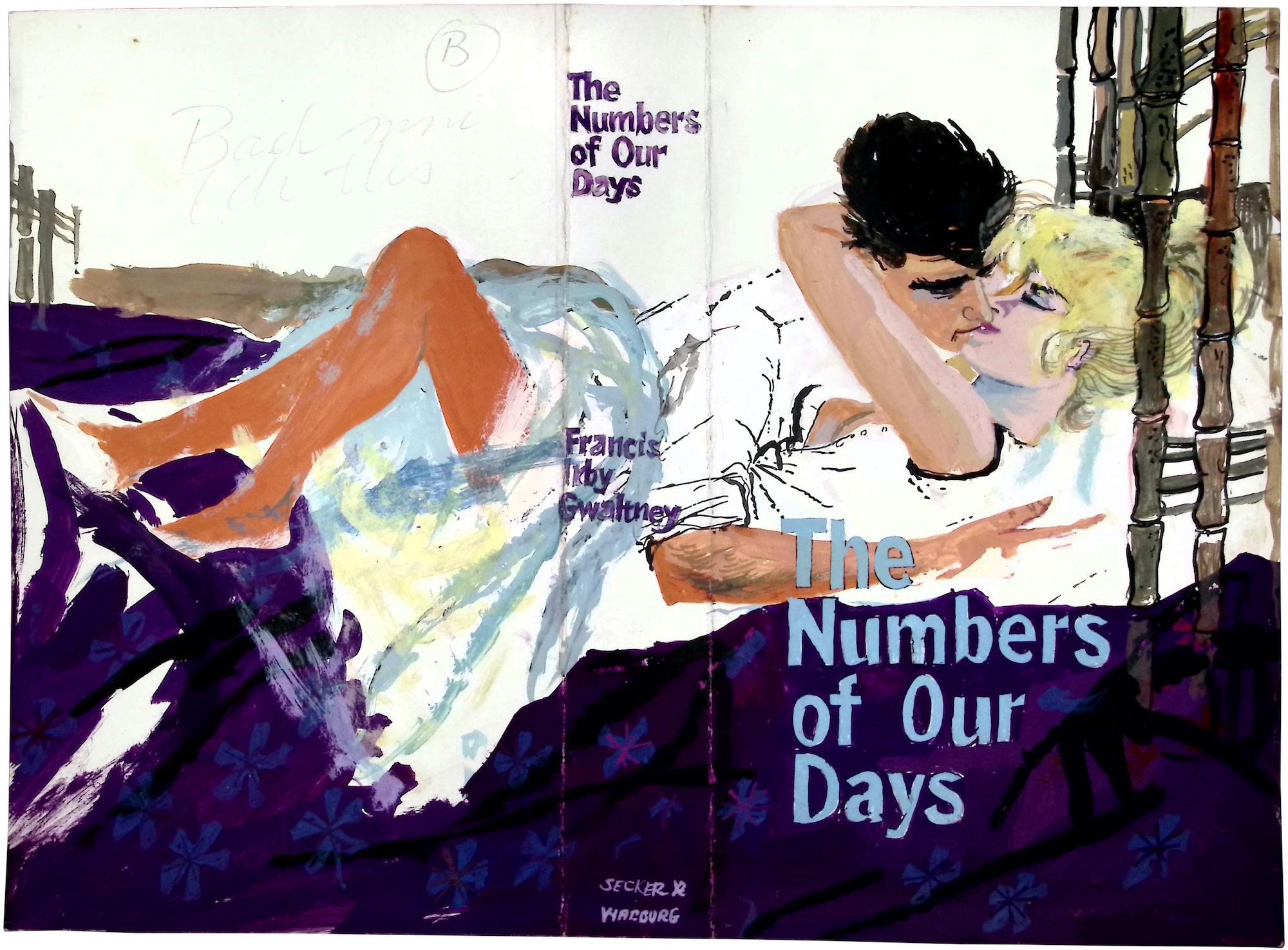
Untitled (rough cover illustration for "The Numbers of Our Days"), c. 1959
British illustrator Janina Ede (1937-2018) created covers and illustrations for over 100 books from the 1950s to the 1980s.
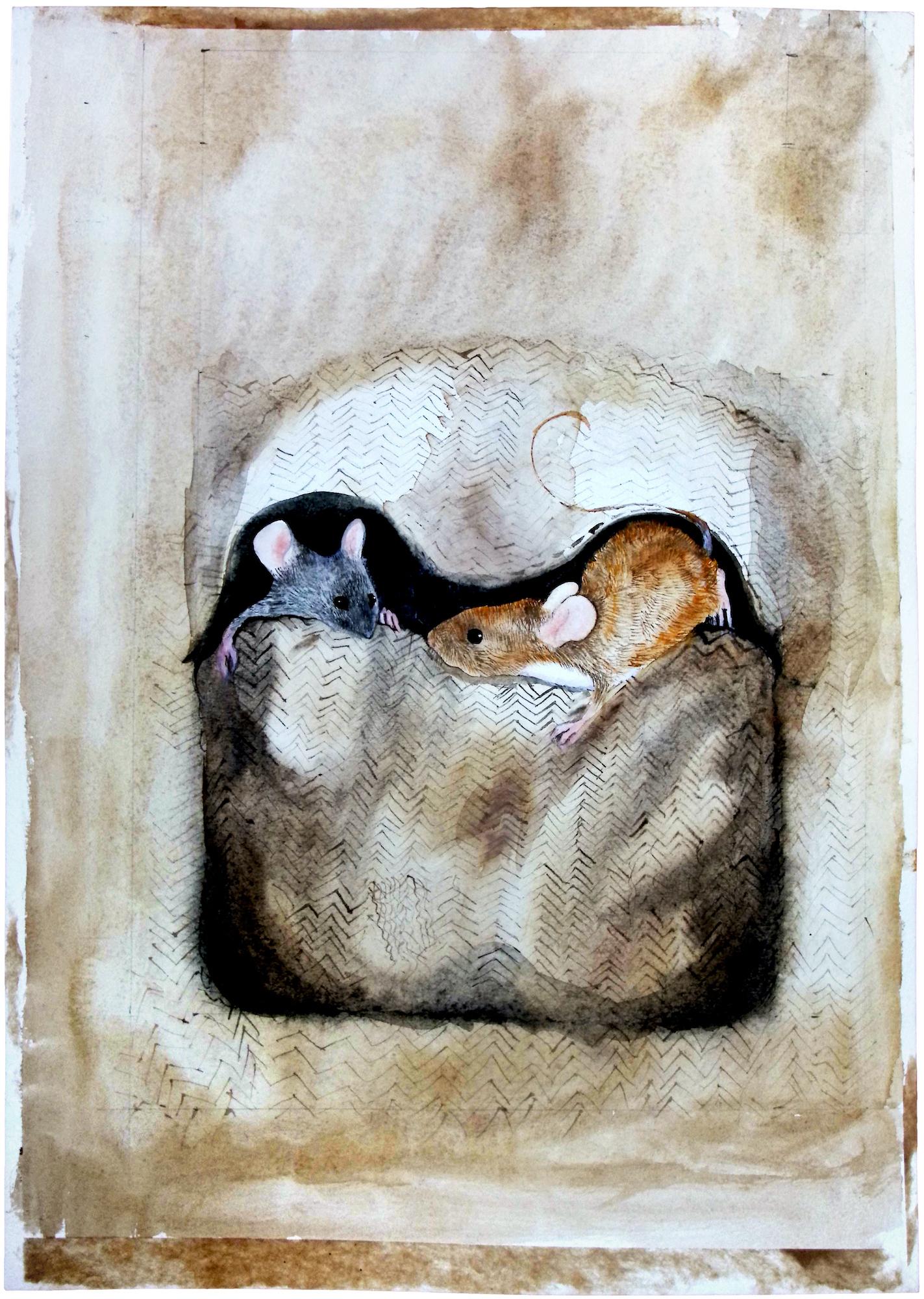
Draft cover illustration for A Pocket Full of Mice , c. 1984
British illustrator Janina Ede (1937-2018) created covers and illustrations for over 100 books from the 1950s to the 1980s. Many of her illustrations feature animals, which she drew from life.
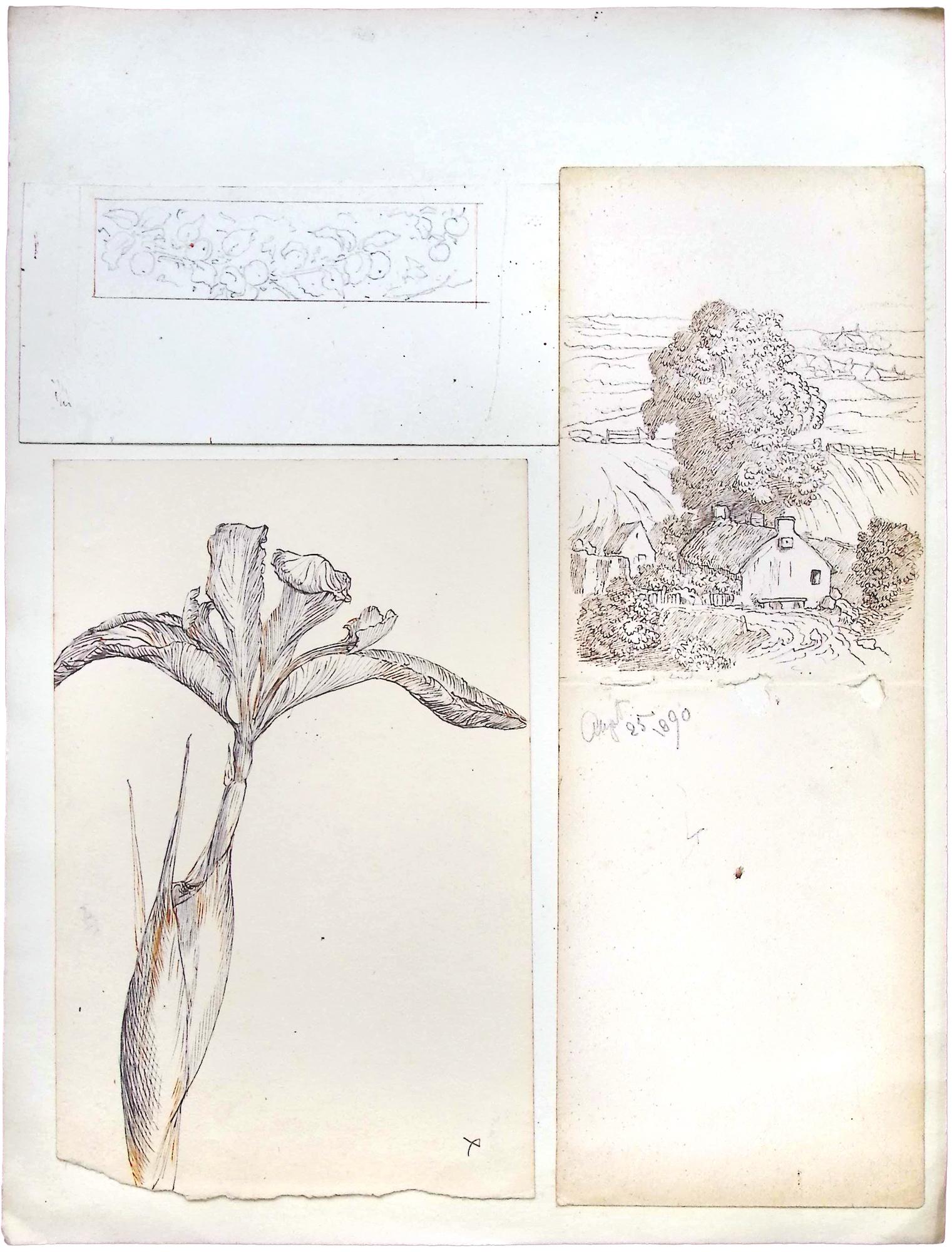
Untitled, Unknown date and 1890
Eleanor Vere Boyle (1825 – 1916) illustrated poetry and prose by some of the most popular authors of her time. She regularly drew and painted using ink and watercolour, sketching landscapes, animals and her children from life. She also made drawings from her imagination, often reflecting spiritual themes.
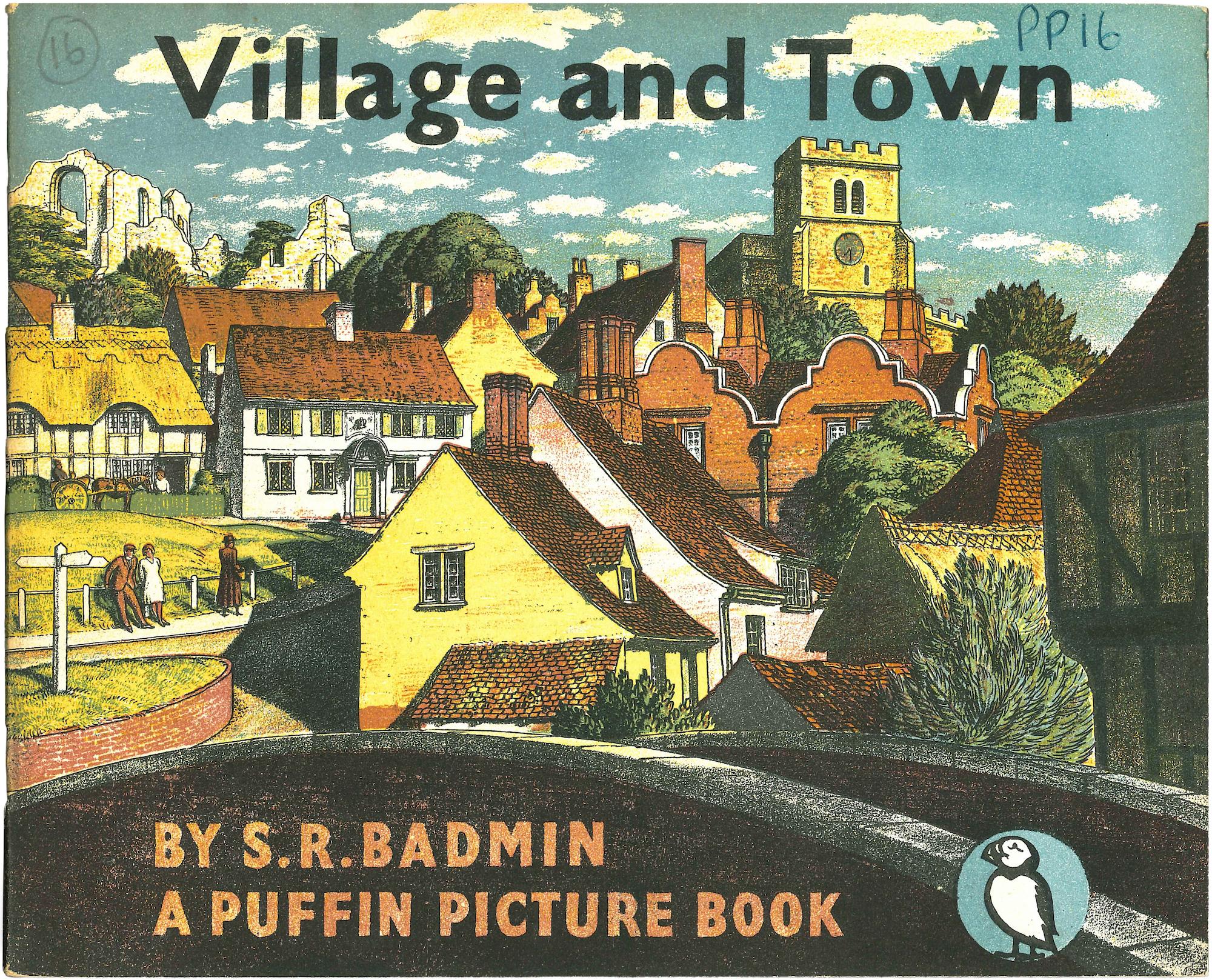
Village and Town, 1942
The Puffin Picture Books series was established by designer and editor Noel Carrington (1895-1989). In 1933, artist Pearl Binder (1904-1990) sent Carrington a package of Soviet children’s books. “They were produced by the million on very cheap paper, but the drawings were vigorous and the colour delightful” he later remembered. These books inspired Carrington to edit a series of affordable books that would encourage “the child’s awakening interest in its surroundings... I felt that colour was essential, and that artists could... be more successful in books of this nature than the camera”. Many artists and illustrators worked on the series, adapting their ways of working to lithographic printing and the Puffin Picture Book format. Most of the 120 books in the series were printed on one large sheet of paper: one side in colour and one in black-and-white. Each sheet was cut, folded and stapled to create a softcover book.
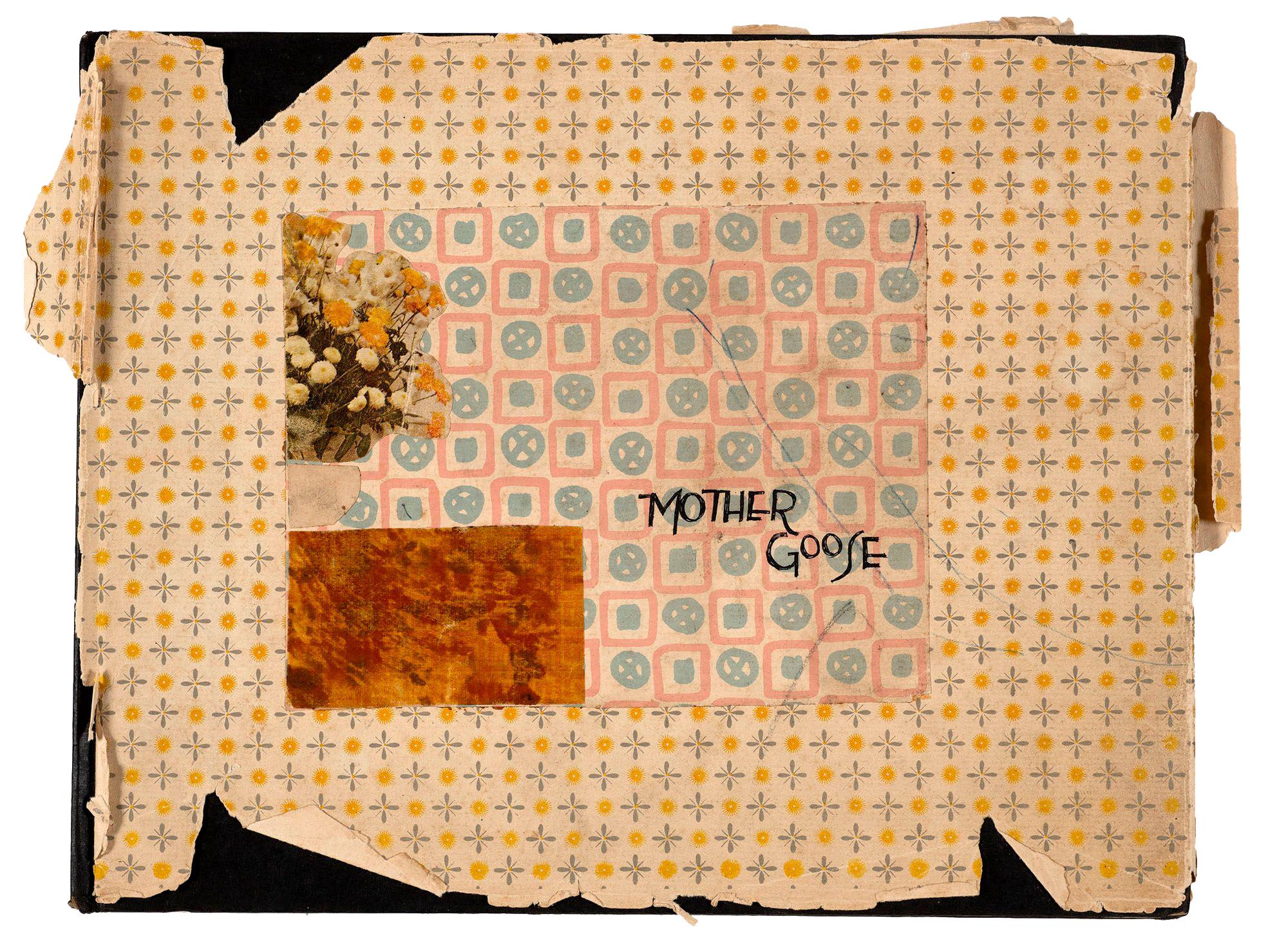
Jacqueline Ayer, Untitled (Handmade book for Margot), 1960
Jacqueline Ayer (1930–2012) had a career that spanned many creative fields. She began as a fashion illustrator, and later turned her hand to children’s books, textiles and garments, as she worked in New York, Paris, London, Bangkok, Hong Kong and across India. Jacqueline Ayer could not find children's books for her daughters when she first moved to Bangkok, Thailand, and so she made this nursery rhyme book out of magazines.
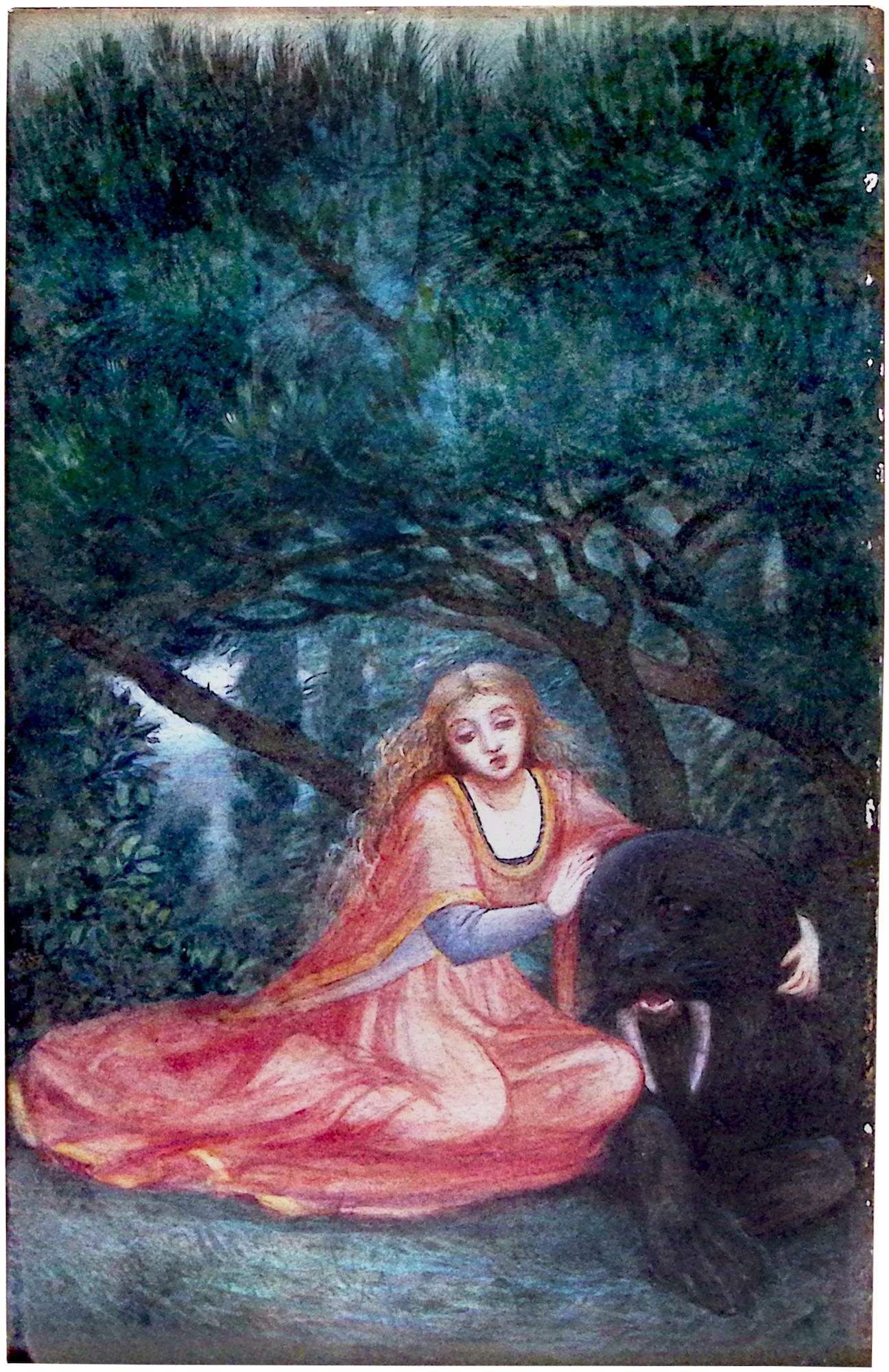
Illustration for Beauty and the Beast (Beauty embracing the dying Beast), c. 1875
Eleanor Vere Boyle (1825 – 1916) illustrated poetry and prose by some of the most popular authors of her time. She regularly drew and painted using ink and watercolour, sketching landscapes, animals and her children from life. She also made drawings from her imagination, often reflecting spiritual themes. This illustration is from Boyle’s 1875 retelling of Beauty and the Beast, a fairy tale where a woman is imprisoned by a monster and falls in love with him. Unlike other illustrated versions before or since, Boyle gave her beast walrus-like tusks and flippers. In several of her illustrations, Boyle used shell gold – a mixture of finely ground gold powder and gum arabic (tree sap) that would have been stored in a shallow seashell. In the final publication, the caption for this illustration reads, "Ah dear Beast, she said: Alas that my unkindness should thus slay thee."
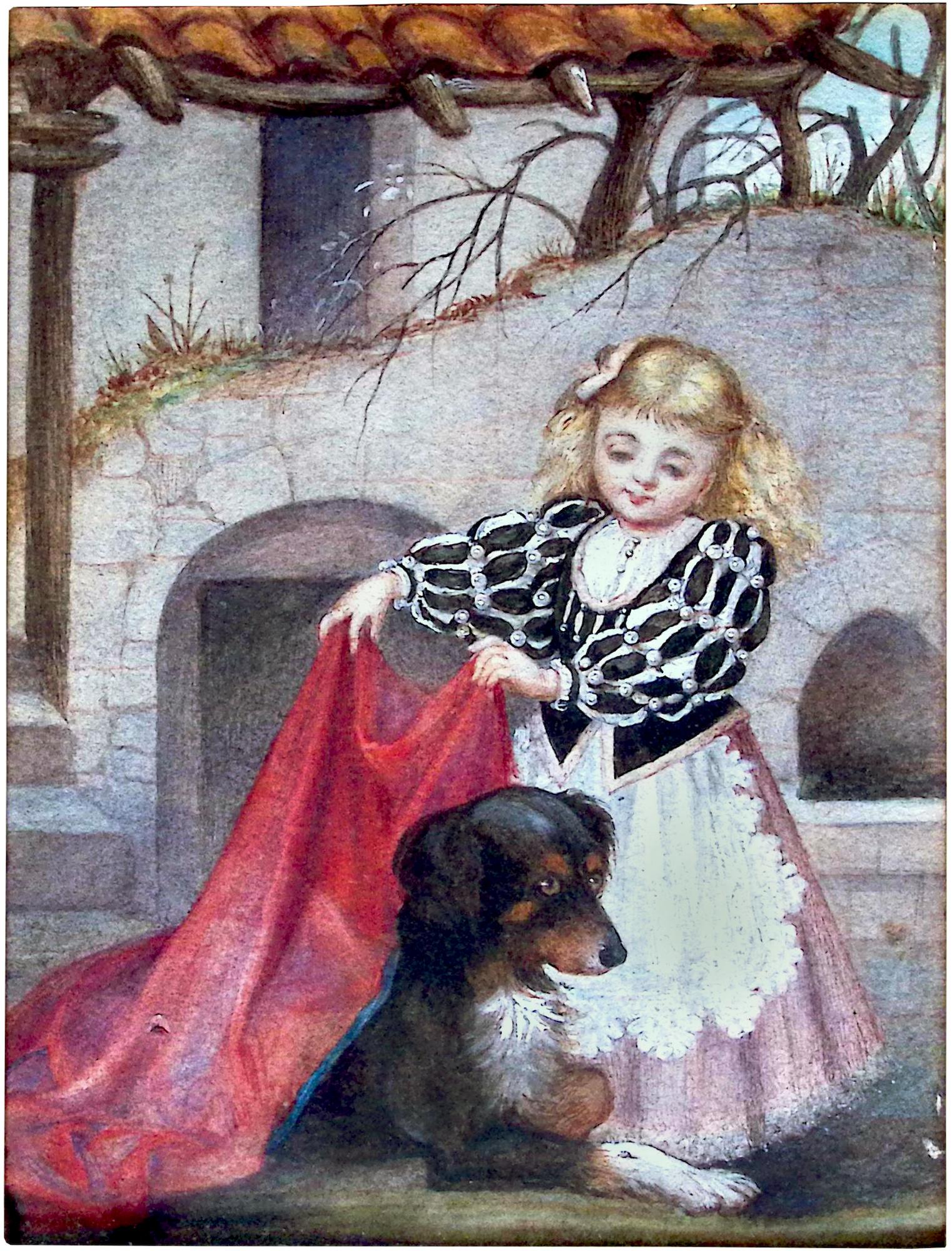
Illustration for Beauty and the Beast (Beauty with the watch dog), c. 1875
Eleanor Vere Boyle (1825 – 1916) illustrated poetry and prose by some of the most popular authors of her time. She regularly drew and painted using ink and watercolour, sketching landscapes, animals and her children from life. She also made drawings from her imagination, often reflecting spiritual themes. This illustration is from Boyle’s 1875 retelling of Beauty and the Beast, a fairy tale where a woman is imprisoned by a monster and falls in love with him. Unlike other illustrated versions before or since, Boyle gave her beast walrus-like tusks and flippers. In several of her illustrations, Boyle used shell gold – a mixture of finely ground gold powder and gum arabic (tree sap) that would have been stored in a shallow seashell. In the final publication, the caption for this illustration reads, "One cold March day, the little maid ran down to the outer court, with her new scarlet cloak, to wrap her friend the old watch dog in!"
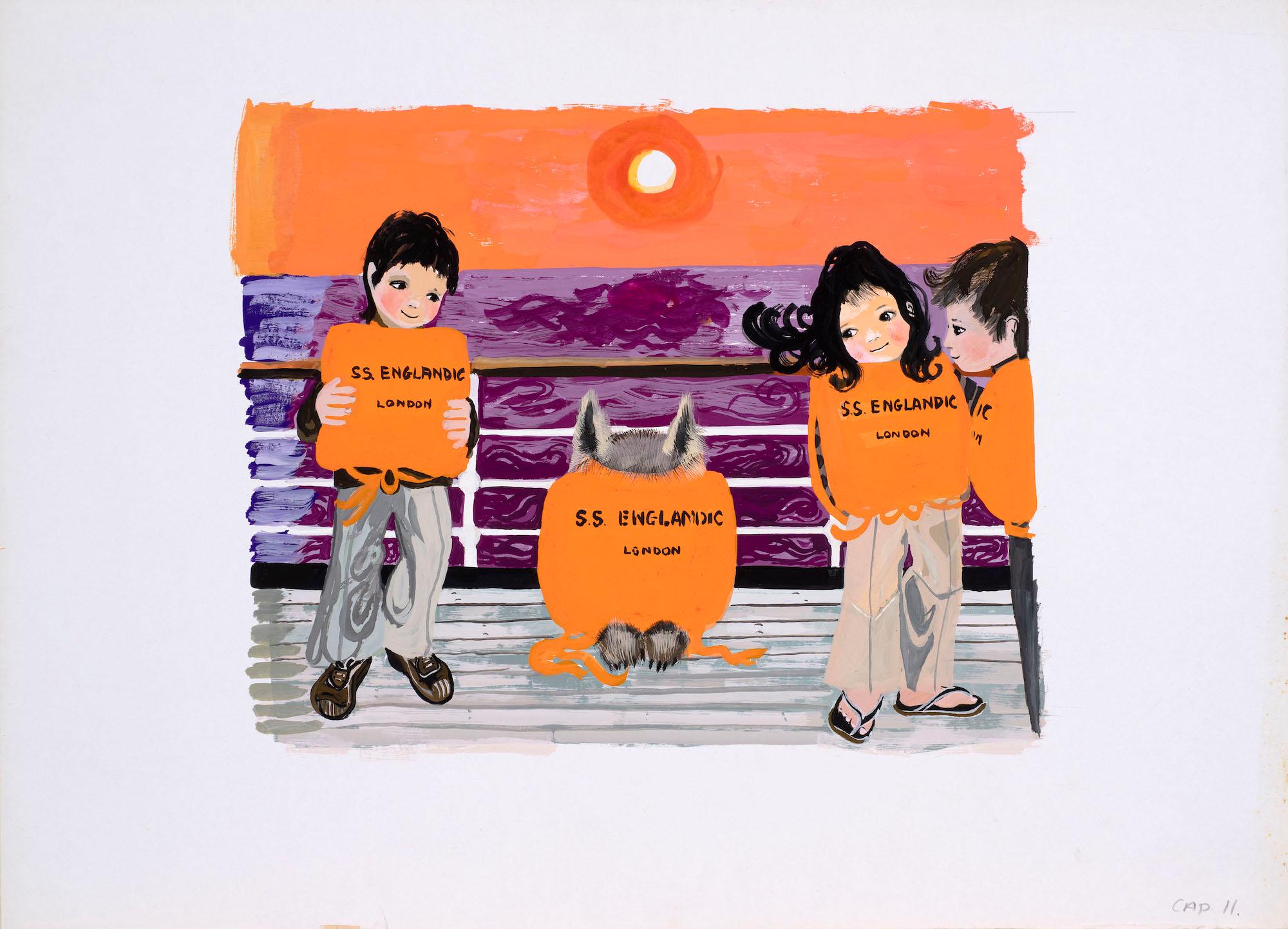
Untitled illustration for Jackanory (Mary Plain Goes to America) , 1972
British illustrator Janina Ede (1937-2018) created covers and illustrations for over 100 books from the 1950s to the 1980s. In the 1970s, she made illustrations for Jackanory, a BBC television programme. During each episode, an actor read a story, while specially-commissioned illustrations were shown on screen. For the televised version of Mary Plain Goes to America, Ede created paintings on large boards. These allowed the camera to pan across her image, showing a little at a time. BBC1 had only been in colour for three years, and so Ede used bold colours painted in gouache and reflective collaged foil to make the most of the new technology. This storyboard illustration was produced by Janina Ede for Jackanory episode #1426, 'Mary Plain Goes to America: Part 1 - An invitation'. It aired on 13 November 1972.
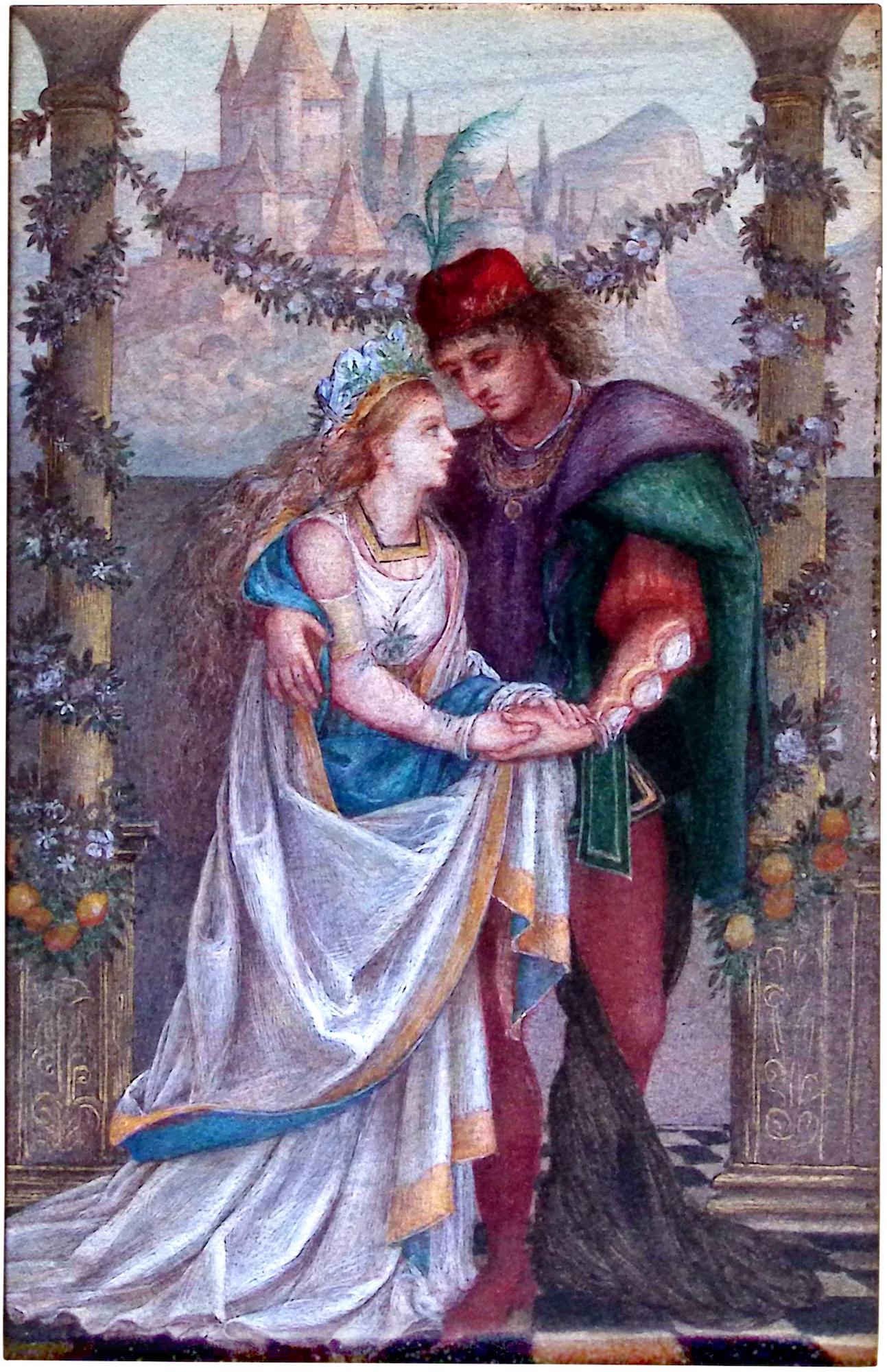
Illustration for Beauty and the Beast (the wedding), c. 1875
Eleanor Vere Boyle (1825 – 1916) illustrated poetry and prose by some of the most popular authors of her time. She regularly drew and painted using ink and watercolour, sketching landscapes, animals and her children from life. She also made drawings from her imagination, often reflecting spiritual themes. This illustration is from Boyle’s 1875 retelling of Beauty and the Beast, a fairy tale where a woman is imprisoned by a monster and falls in love with him. Unlike other illustrated versions before or since, Boyle gave her beast walrus-like tusks and flippers. In several of her illustrations, Boyle used shell gold – a mixture of finely ground gold powder and gum arabic (tree sap) that would have been stored in a shallow seashell. In the final publication, the caption for this illustration reads, "Love is the magic, that makes all things fair."
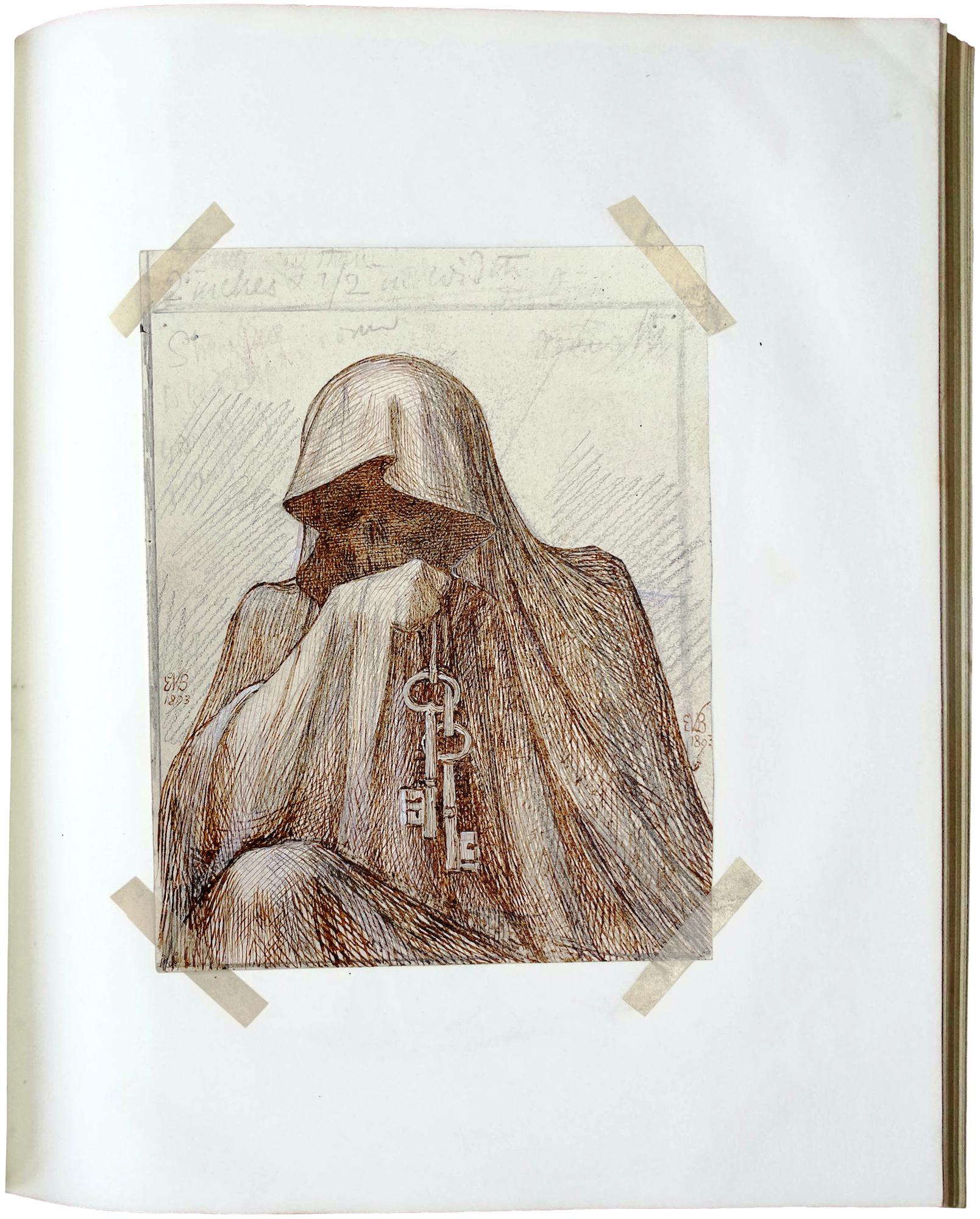
Untitled (illustration for A Book of Heavenly Birthdays, 'The Shadow Waiting with the Keys'), 1893
Eleanor Vere Boyle (1825 – 1916) illustrated poetry and prose by some of the most popular authors of her time. She regularly drew and painted using ink and watercolour, sketching landscapes, animals and her children from life. She also made drawings from her imagination, often reflecting spiritual themes. This drawing was used as one of the final illustrations printed in the artists' publication A Book of Heavenly Birthdays (1893, London Elliot Stock)
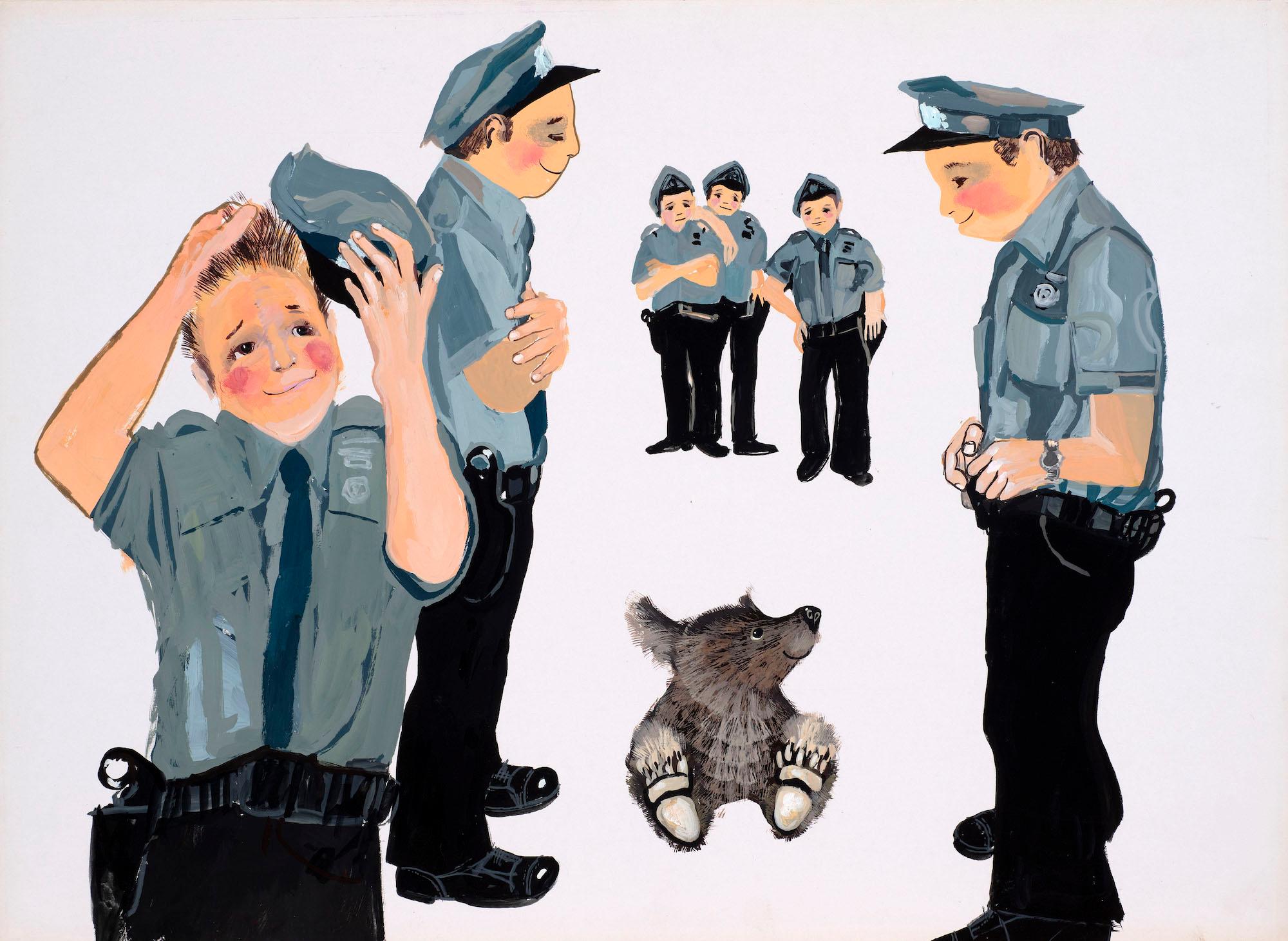
Untitled illustration for Jackanory (Mary Plain Goes to America) , 1972
British illustrator Janina Ede (1937-2018) created covers and illustrations for over 100 books from the 1950s to the 1980s. In the 1970s, she made illustrations for Jackanory, a BBC television programme. During each episode, an actor read a story, while specially-commissioned illustrations were shown on screen. For the televised version of Mary Plain Goes to America, Ede created paintings on large boards. These allowed the camera to pan across her image, showing a little at a time. BBC1 had only been in colour for three years, and so Ede used bold colours painted in gouache and reflective collaged foil to make the most of the new technology. This storyboard illustration was produced by Janina Ede for Jackanory episode #1427, 'Mary Plain Goes to America: Part 2 - The Most Popular Person on Board'. It aired on 14 November 1972.
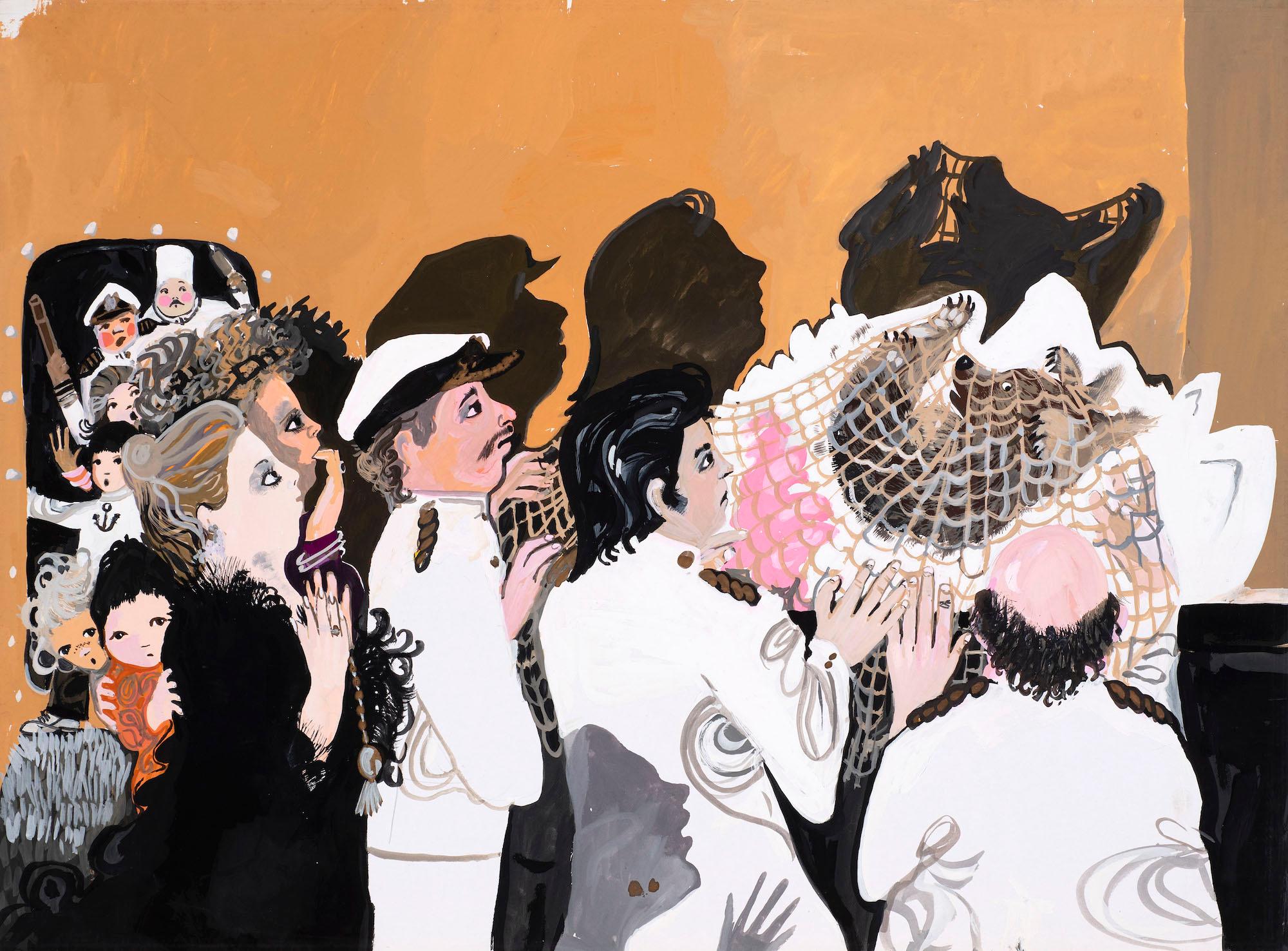
Untitled illustration for Jackanory (Mary Plain Goes to America) , 1972
British illustrator Janina Ede (1937-2018) created covers and illustrations for over 100 books from the 1950s to the 1980s. In the 1970s, she made illustrations for Jackanory, a BBC television programme. During each episode, an actor read a story, while specially-commissioned illustrations were shown on screen. For the televised version of Mary Plain Goes to America, Ede created paintings on large boards. These allowed the camera to pan across her image, showing a little at a time. BBC1 had only been in colour for three years, and so Ede used bold colours painted in gouache and reflective collaged foil to make the most of the new technology. This storyboard illustration was produced by Janina Ede for Jackanory episode #1426, 'Mary Plain Goes to America: Part 1 - An invitation'. It aired on 13 November 1972.
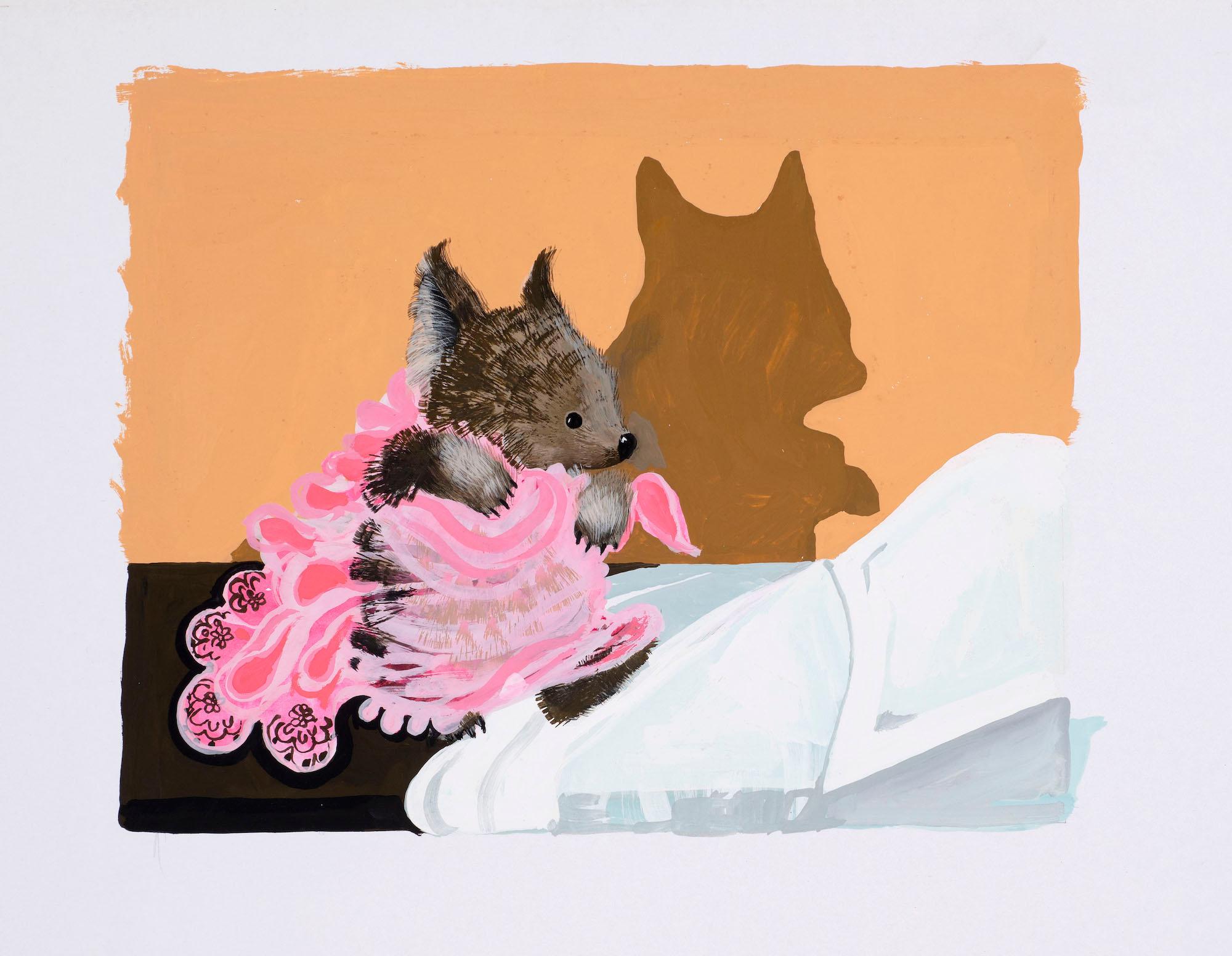
Untitled illustration for Jackanory (Mary Plain Goes to America) , 1972
British illustrator Janina Ede (1937-2018) created covers and illustrations for over 100 books from the 1950s to the 1980s. In the 1970s, she made illustrations for Jackanory, a BBC television programme. During each episode, an actor read a story, while specially-commissioned illustrations were shown on screen. For the televised version of Mary Plain Goes to America, Ede created paintings on large boards. These allowed the camera to pan across her image, showing a little at a time. BBC1 had only been in colour for three years, and so Ede used bold colours painted in gouache and reflective collaged foil to make the most of the new technology. This storyboard illustration was produced by Janina Ede for Jackanory episode #1426, 'Mary Plain Goes to America: Part 1 - An invitation'. It aired on 13 November 1972.
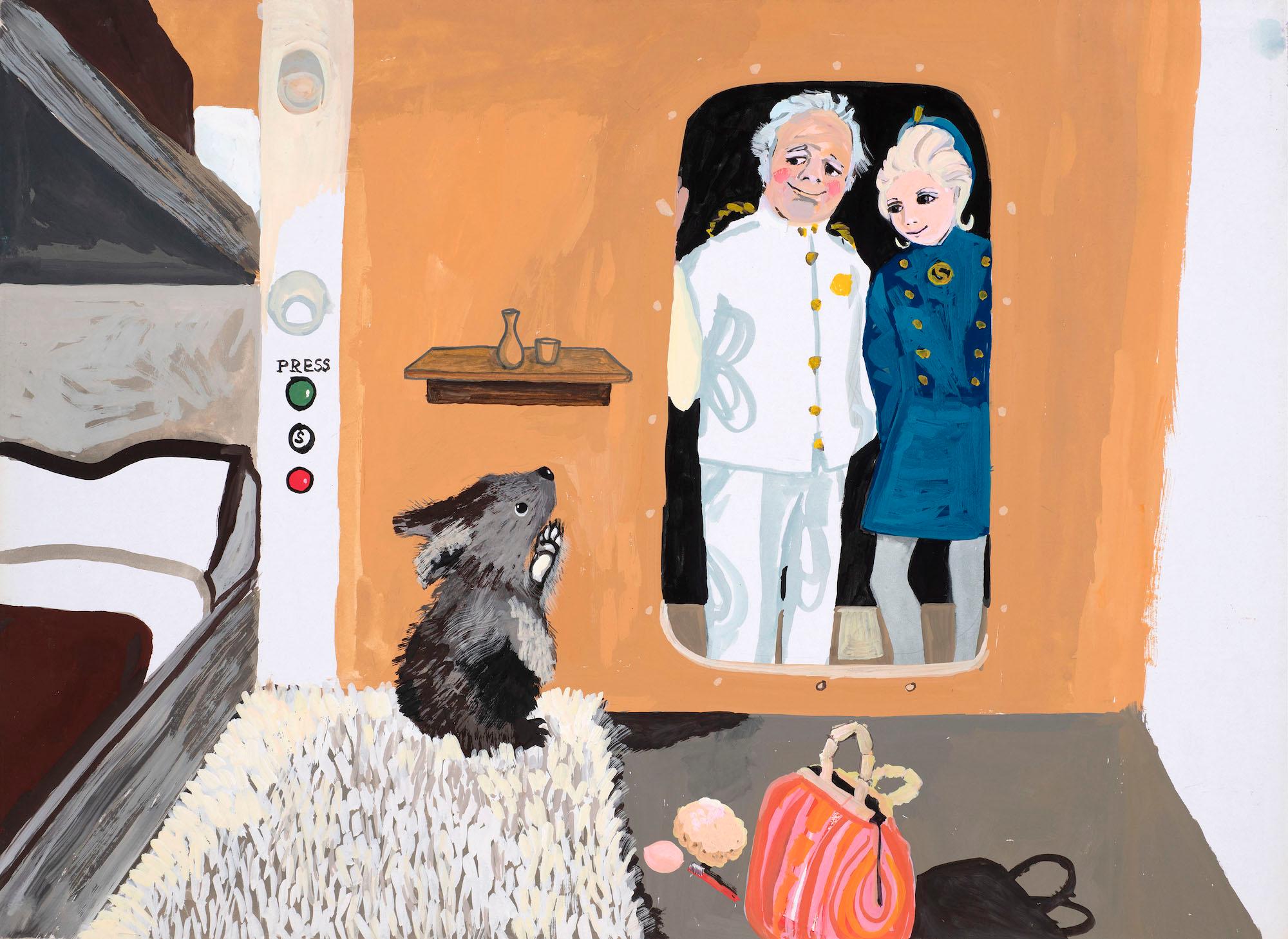
Untitled illustration for Jackanory (Mary Plain Goes to America) , 1972
British illustrator Janina Ede (1937-2018) created covers and illustrations for over 100 books from the 1950s to the 1980s. In the 1970s, she made illustrations for Jackanory, a BBC television programme. During each episode, an actor read a story, while specially-commissioned illustrations were shown on screen. For the televised version of Mary Plain Goes to America, Ede created paintings on large boards. These allowed the camera to pan across her image, showing a little at a time. BBC1 had only been in colour for three years, and so Ede used bold colours painted in gouache and reflective collaged foil to make the most of the new technology. This storyboard illustration was produced by Janina Ede for Jackanory episode #1426, 'Mary Plain Goes to America: Part 1 - An invitation'. It aired on 13 November 1972.
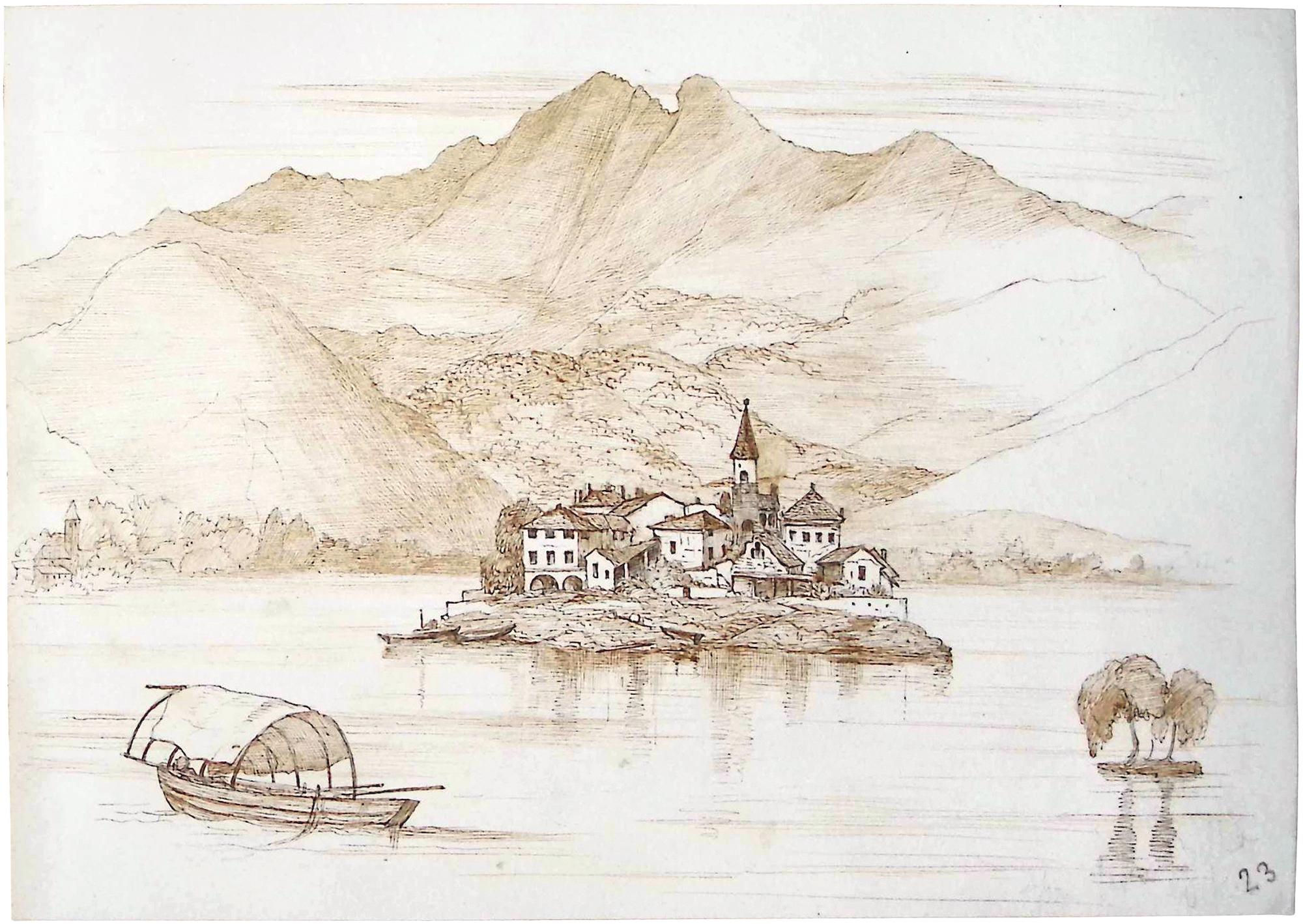
Untitled (From Isola Bella), Date unknown
Eleanor Vere Boyle (1825 – 1916) illustrated poetry and prose by some of the most popular authors of her time. She regularly drew and painted using ink and watercolour, sketching landscapes, animals and her children from life. She also made drawings from her imagination, often reflecting spiritual themes.
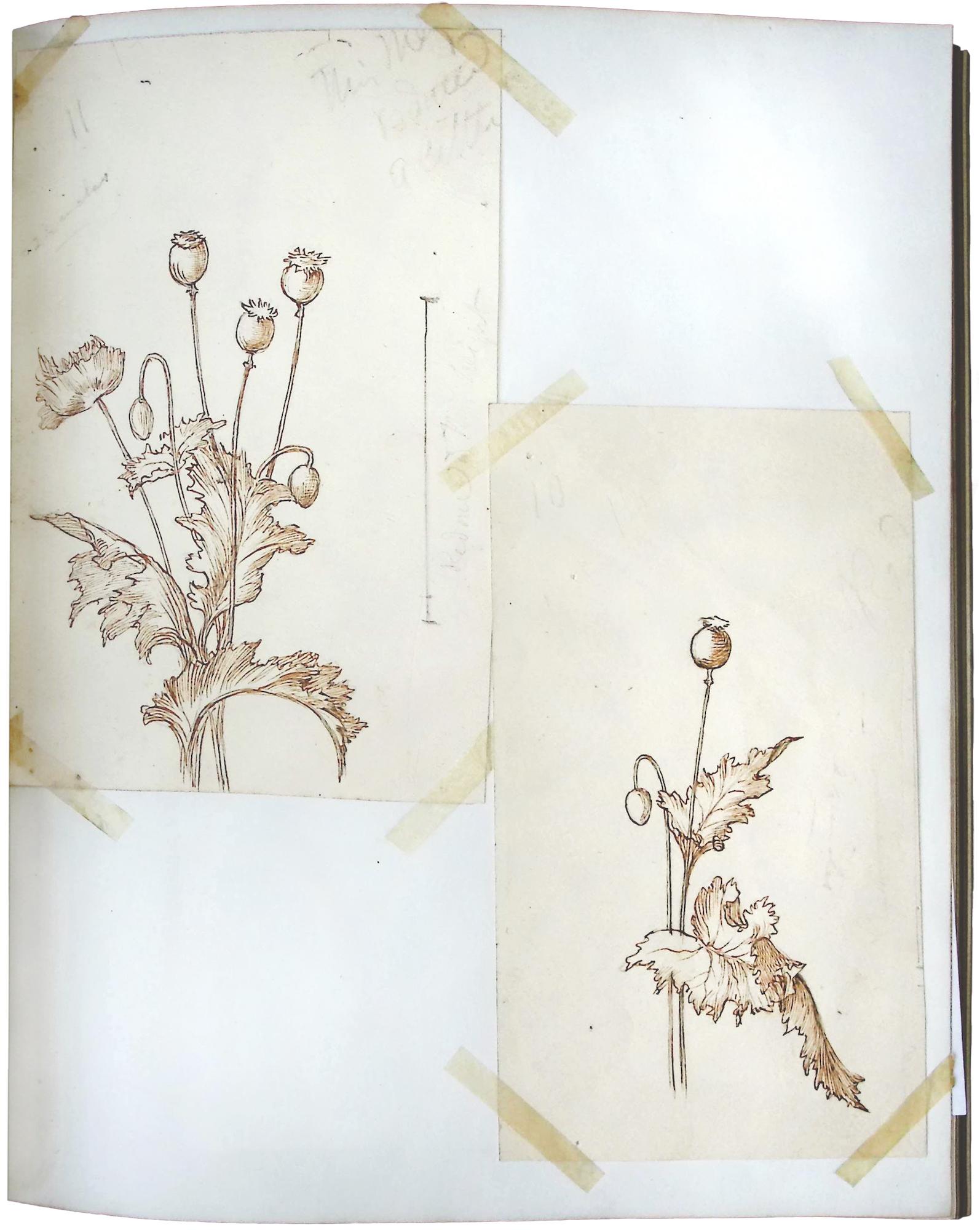
Untitled, c. 1893
Eleanor Vere Boyle (1825 – 1916) illustrated poetry and prose by some of the most popular authors of her time. She regularly drew and painted using ink and watercolour, sketching landscapes, animals and her children from life. She also made drawings from her imagination, often reflecting spiritual themes. These drawings were used as some of the final illustrations printed in the artists' publication A Book of Heavenly Birthdays (1893, London Elliot Stock)
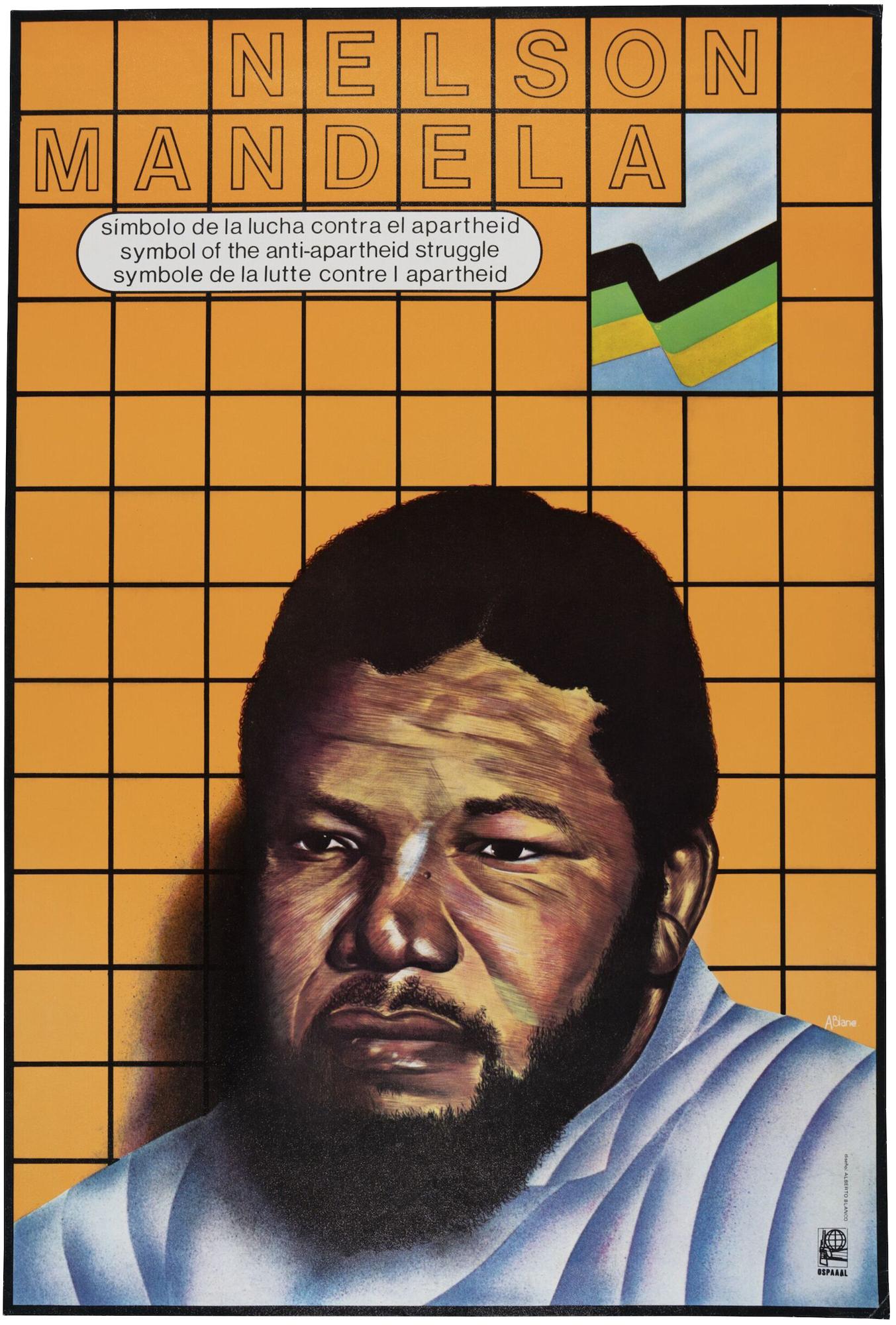
NELSON MANDELA - symbol of the anti-apartheid struggle, 1989
Between the 1960s and 1990s, more than fifty designers worked at OSPAAAL. Based in Cuba, they made magazines and posters that were sent around the world. Their aim was to promote radical political ideas. Many of their posters celebrate socialist revolutions and liberation movements from the Global South. This poster was issued to show support for anti-apartheid activist Nelson Mandela while he was imprisoned in South Africa. Through his prison window is the flag of the African National Congress; its three colours represent the people, land and resources of South Africa.
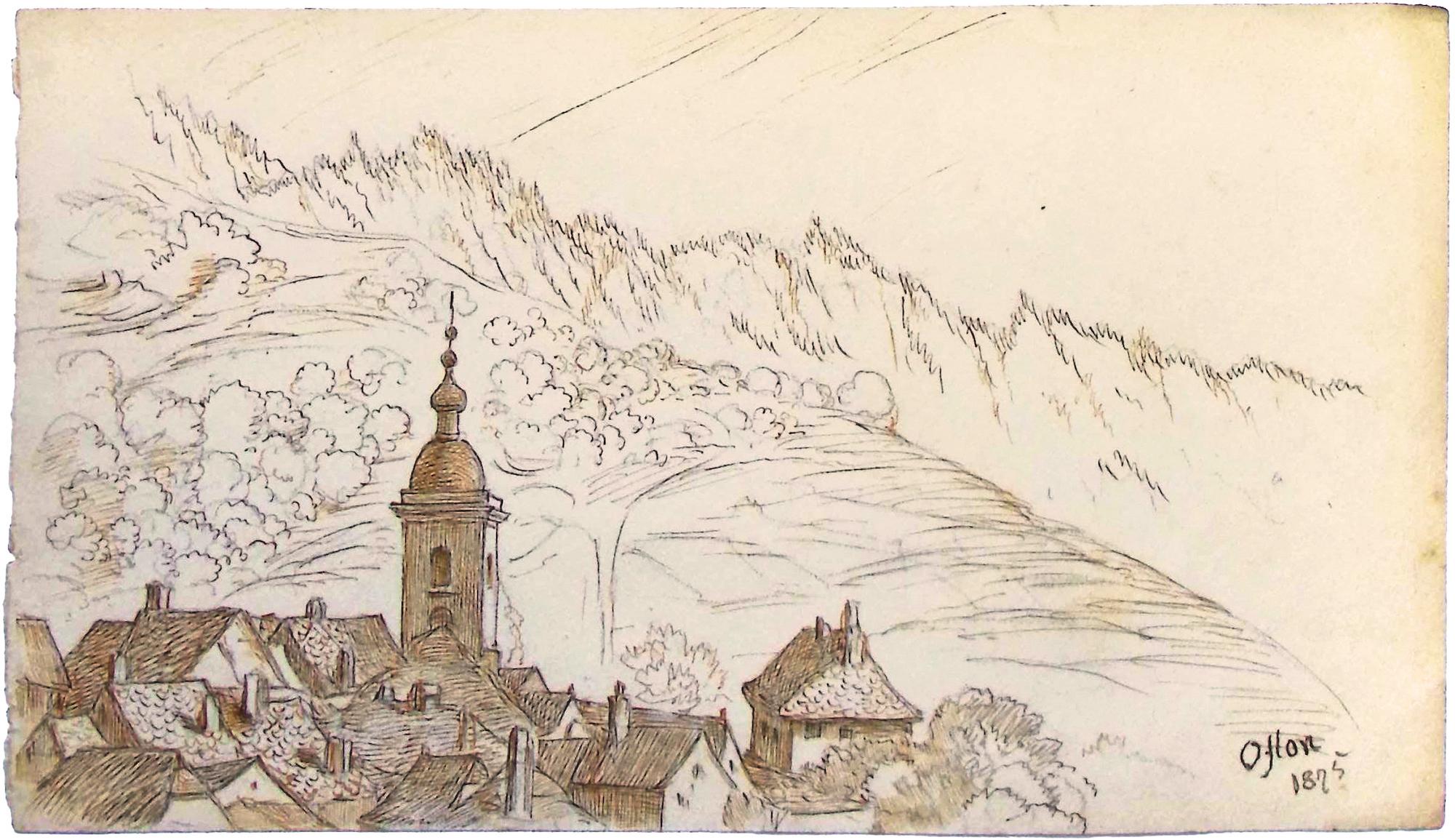
Untitled, 1875
Eleanor Vere Boyle (1825 – 1916) illustrated poetry and prose by some of the most popular authors of her time. She regularly drew and painted using ink and watercolour, sketching landscapes, animals and her children from life. She also made drawings from her imagination, often reflecting spiritual themes.
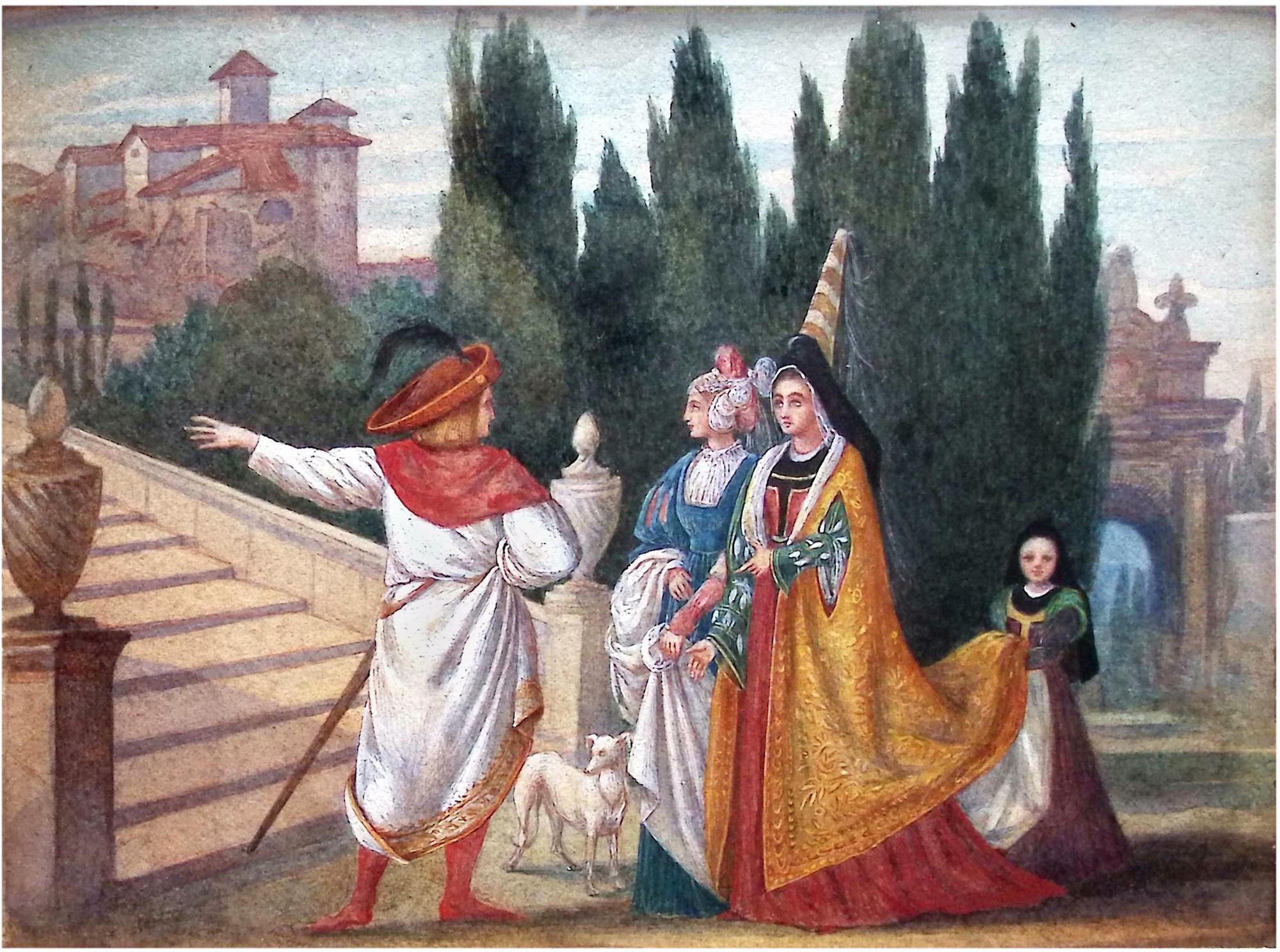
Illustration for Beauty and the Beast (Beauty and her two sisters), c. 1875
Eleanor Vere Boyle (1825 – 1916) illustrated poetry and prose by some of the most popular authors of her time. She regularly drew and painted using ink and watercolour, sketching landscapes, animals and her children from life. She also made drawings from her imagination, often reflecting spiritual themes. This illustration is from Boyle’s 1875 retelling of Beauty and the Beast, a fairy tale where a woman is imprisoned by a monster and falls in love with him. Unlike other illustrated versions before or since, Boyle gave her beast walrus-like tusks and flippers. In several of her illustrations, Boyle used shell gold – a mixture of finely ground gold powder and gum arabic (tree sap) that would have been stored in a shallow seashell. In the final publication, the caption for this illustration reads, "In the King's Garden the feast is ready, and the minstrels wait."
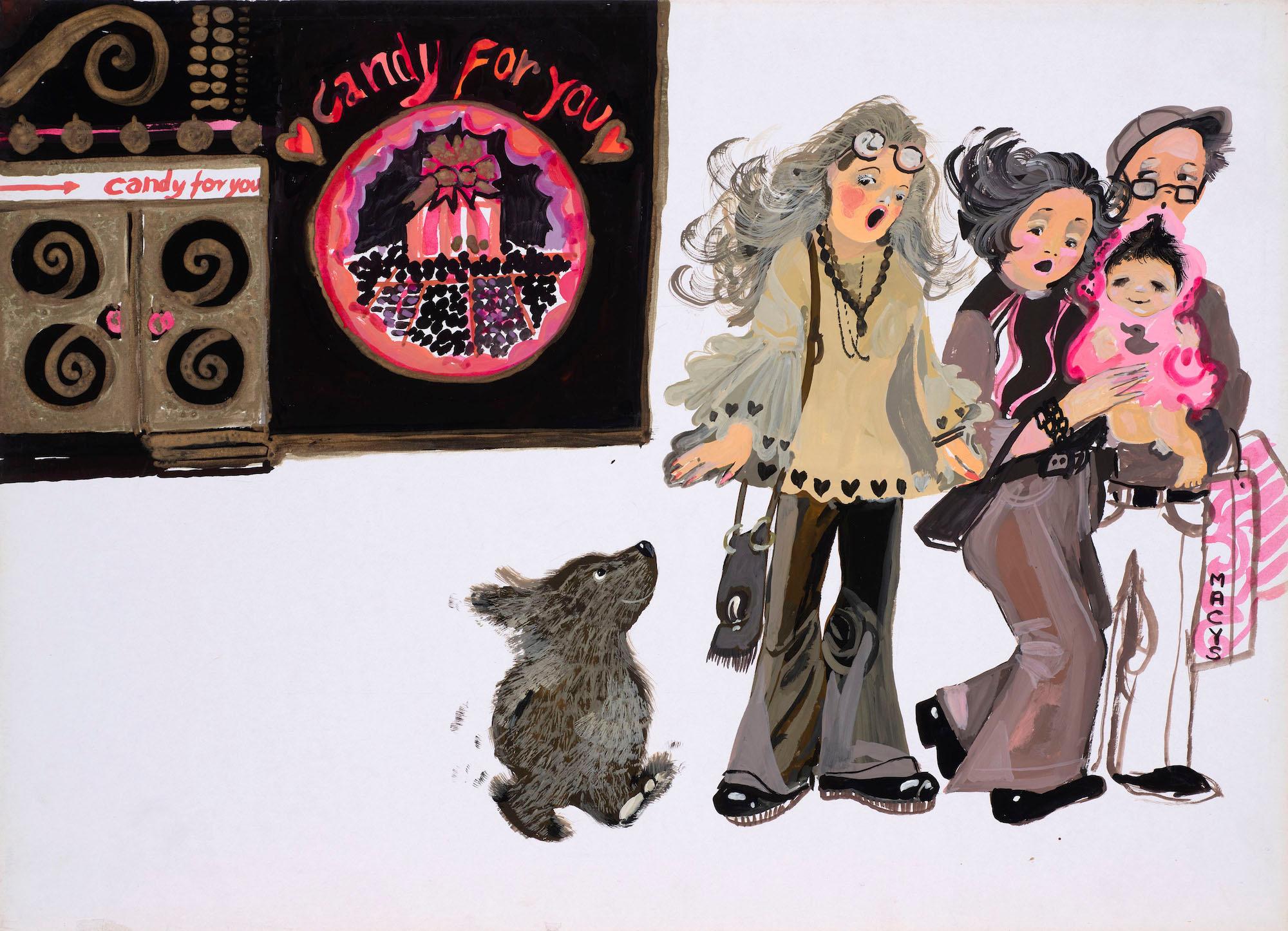
Untitled illustration for Jackanory (Mary Plain Goes to America) , 1972
British illustrator Janina Ede (1937-2018) created covers and illustrations for over 100 books from the 1950s to the 1980s. In the 1970s, she made illustrations for Jackanory, a BBC television programme. During each episode, an actor read a story, while specially-commissioned illustrations were shown on screen. For the televised version of Mary Plain Goes to America, Ede created paintings on large boards. These allowed the camera to pan across her image, showing a little at a time. BBC1 had only been in colour for three years, and so Ede used bold colours painted in gouache and reflective collaged foil to make the most of the new technology. This storyboard illustration was produced by Janina Ede for Jackanory episode #1427, 'Mary Plain Goes to America: Part 2 - The Most Popular Person on Board'. It aired on 14 November 1972.
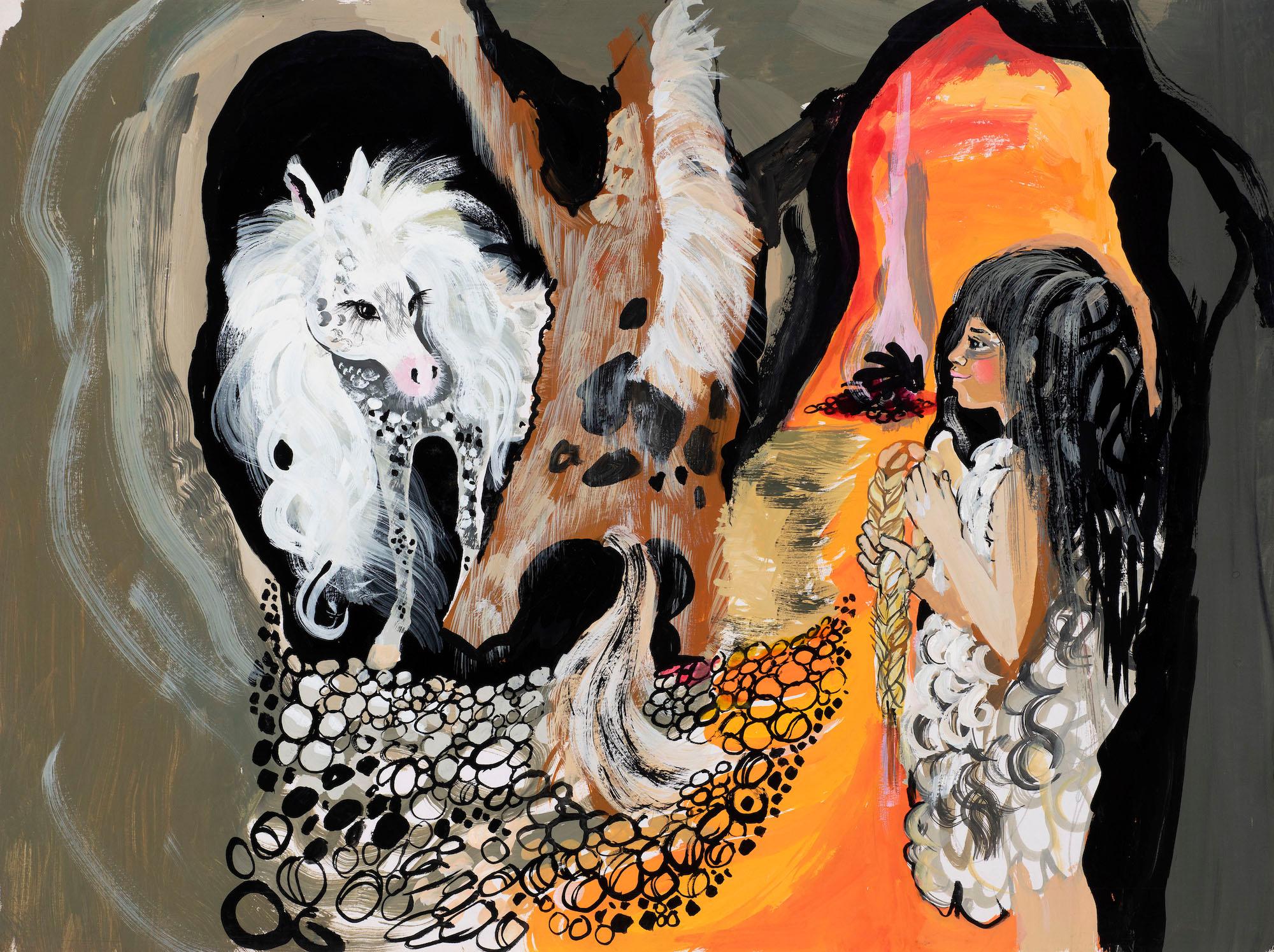
Untitled illustration for Jackanory (Just So Stories: The Cat who Walked by Himself), 1973
Janina Ede (1937-2018) created covers and illustrations for over 100 books in the 1960s, 70s and 80s. Many of her illustrations feature animals, which she drew from life. In the 1970s, Ede was commissioned to create large colourful illustrations for the BBC children’s television series, Jackanory. Each episode was dedicated to a story read by an actor, while specially commissioned illustrations were shown on screen during each programme. Some of these illustrations were for programmes featuring stories by author Rudyard Kipling. His ‘Just So’ stories were short tales that imagined how various animals attained their distinguishing features. Kipling set the stories in parts of India, West Asia and Africa. His descriptions of places and people included racist and exoticised stereotypes. Ede’s illustrations draw extensively on Kipling’s descriptions, and therefore reflect the racism in his work, as well as the prevailing stereotypical views that existed in 1970s Britain. Her own personal views are not documented. This storyboard illustration was produced by Janina Ede for Jackanory episode #1452, 'Just So Stories - The Cat that Walked by Himself'. It aired on 3 January 1973.
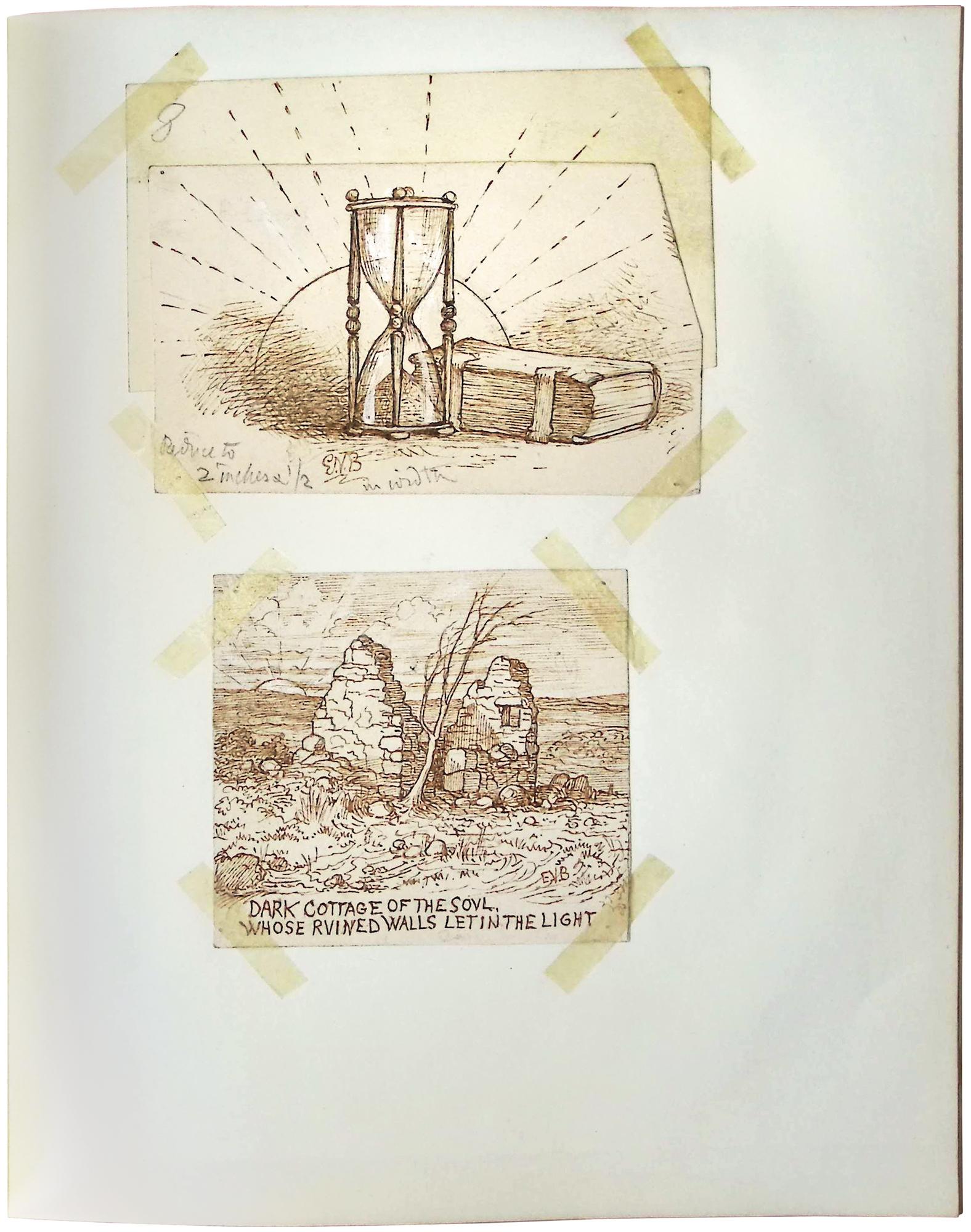
Untitled (illustrations for A Book of Heavenly Birthdays), c. 1893
Eleanor Vere Boyle (1825 – 1916) illustrated poetry and prose by some of the most popular authors of her time. She regularly drew and painted using ink and watercolour, sketching landscapes, animals and her children from life. She also made drawings from her imagination, often reflecting spiritual themes. These drawings were used as some of the final illustrations printed in the artists' publication A Book of Heavenly Birthdays (1893, London Elliot Stock)
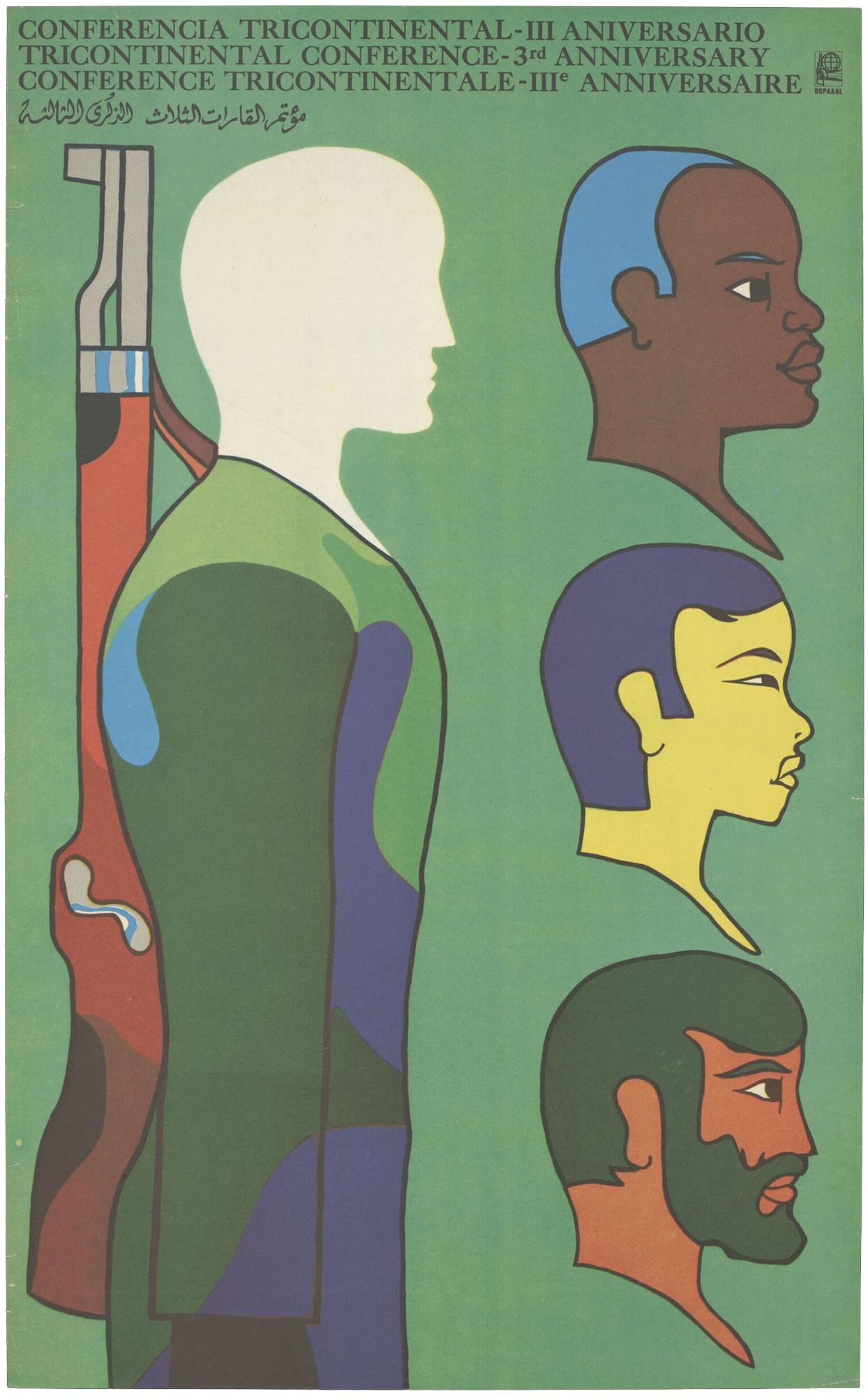
TRICONTINENTAL CONFERENCE - 3rd ANNIVERSARY, 1969
Between the 1960s and 1990s, more than fifty designers worked at OSPAAAL (the Organisation of Solidarity with the People of Africa, Asia and Latin America). Based in Cuba, they made magazines and posters that were sent around the world. Their aim was to promote radical political ideas. Many of their posters celebrate socialist revolutions and liberation movements from the Global South. OSPAAAL was established after the Tricontinental conference held in Havana in 1966. Representatives from 82 governments and national liberation movements discussed their positions on politics, economics, development and culture. Fidel Castro summarised their unifying aim as “the struggle against colonialism, racism and imperialism.” This commemorative poster uses three characters to represent Africa, Asia and Latin America as united by a common purpose.
Content warning: weaponry
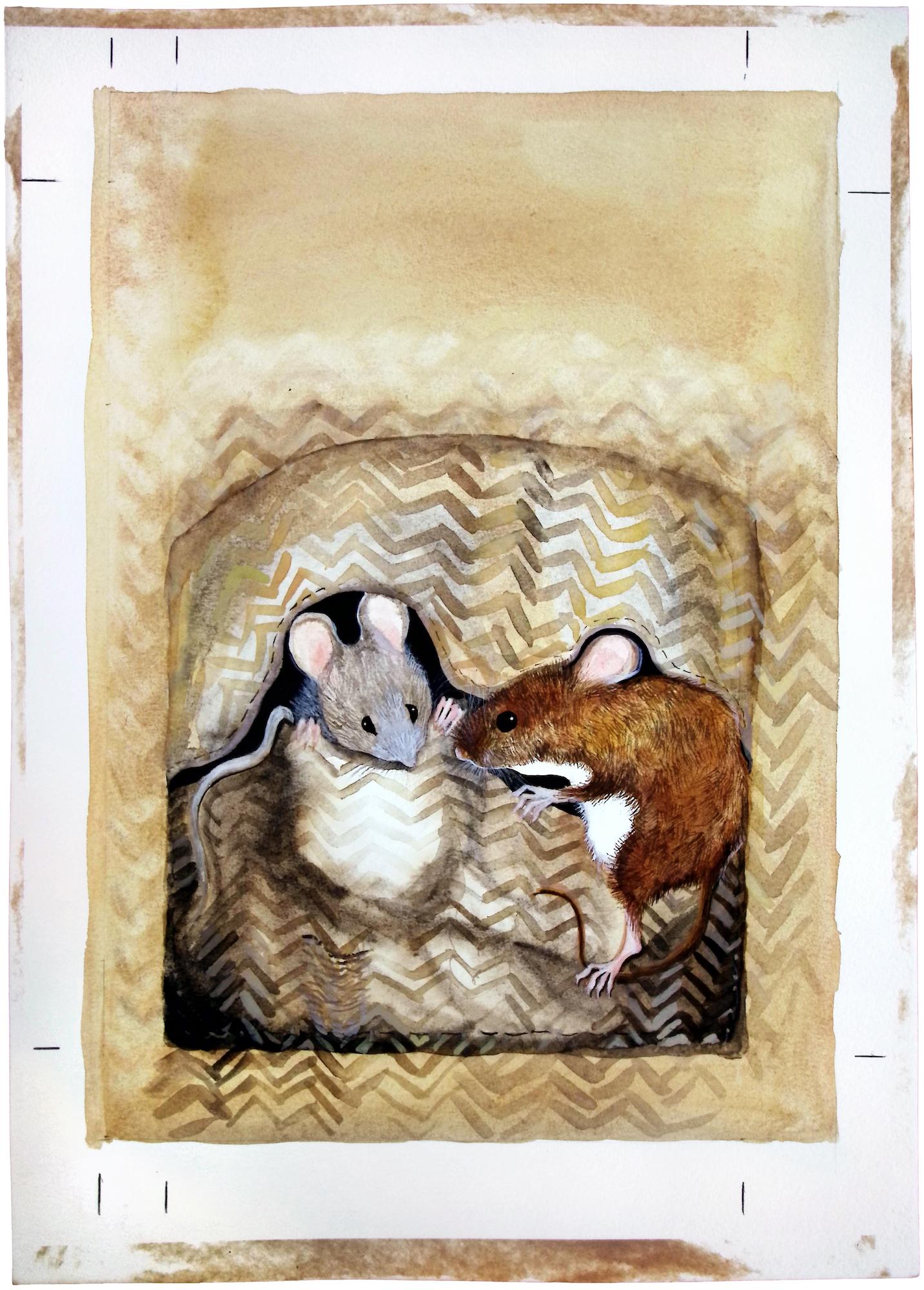
Draft cover illustration for A Pocket Full of Mice , c. 1984
British illustrator Janina Ede (1937-2018) created covers and illustrations for over 100 books from the 1950s to the 1980s. Many of her illustrations feature animals, which she drew from life.
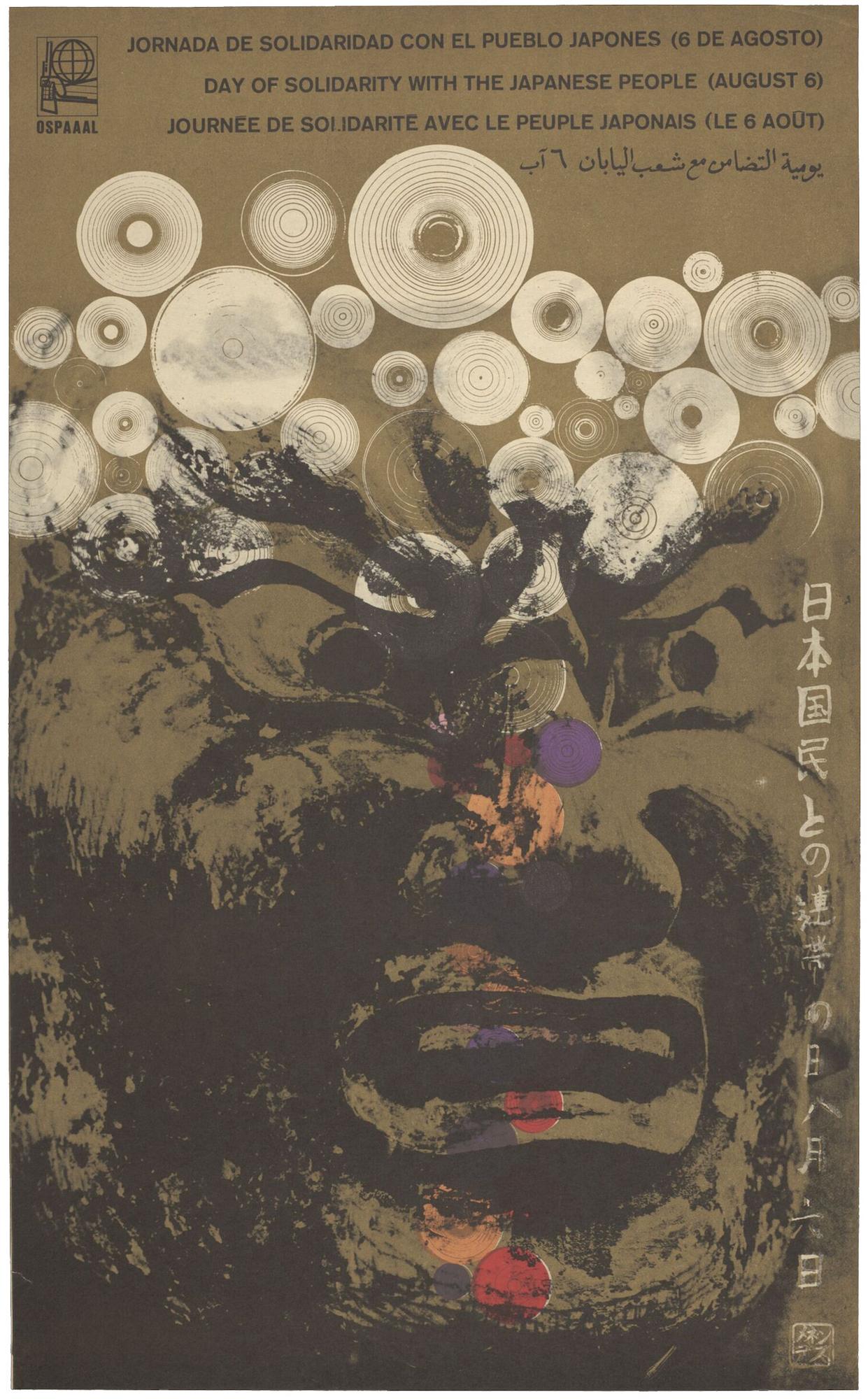
DAY OF SOLIDARITY WITH THE JAPANESE PEOPLE (AUGUST 6), 1968
Between the 1960s and 1990s, more than fifty designers worked at OSPAAAL (the Organisation of Solidarity with the People of Africa, Asia and Latin America). Based in Cuba, they made magazines and posters that were sent around the world. Their aim was to promote radical political ideas. Many of their posters celebrate socialist revolutions and liberation movements from the Global South. OSPAAAL marked the date of the atomic bombing of the city of Hiroshima by the U.S.A. as a day of solidarity with Japanese citizens. The design appears to incorporate a photograph of Raijin, a Japanese god of thunder, lightning and storms.
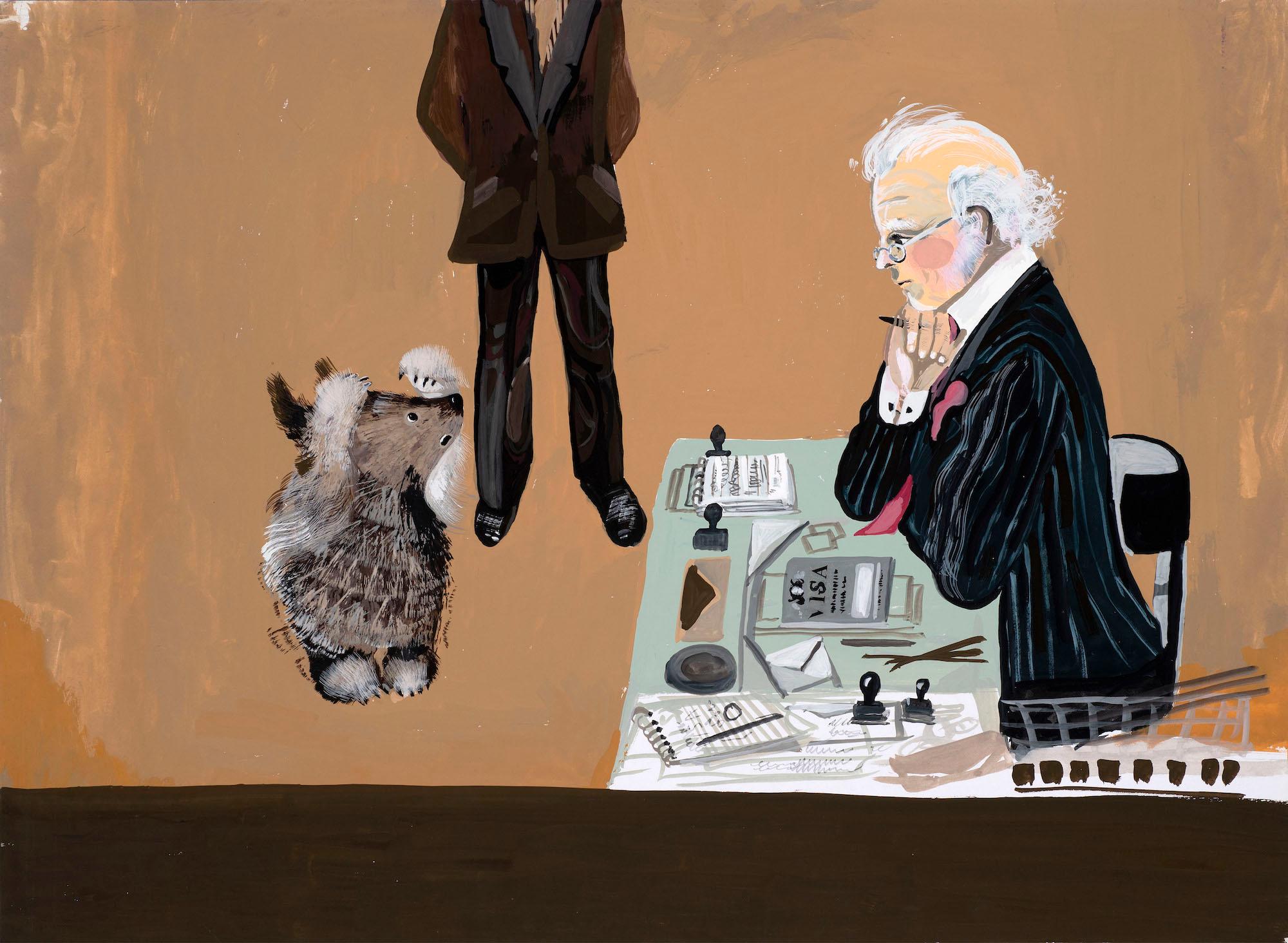
Untitled illustration for Jackanory (Mary Plain Goes to America) , 1972
British illustrator Janina Ede (1937-2018) created covers and illustrations for over 100 books from the 1950s to the 1980s. In the 1970s, she made illustrations for Jackanory, a BBC television programme. During each episode, an actor read a story, while specially-commissioned illustrations were shown on screen. For the televised version of Mary Plain Goes to America, Ede created paintings on large boards. These allowed the camera to pan across her image, showing a little at a time. BBC1 had only been in colour for three years, and so Ede used bold colours painted in gouache and reflective collaged foil to make the most of the new technology. This storyboard illustration was produced by Janina Ede for Jackanory episode #1426, 'Mary Plain Goes to America: Part 1 - An invitation'. It aired on 13 November 1972.
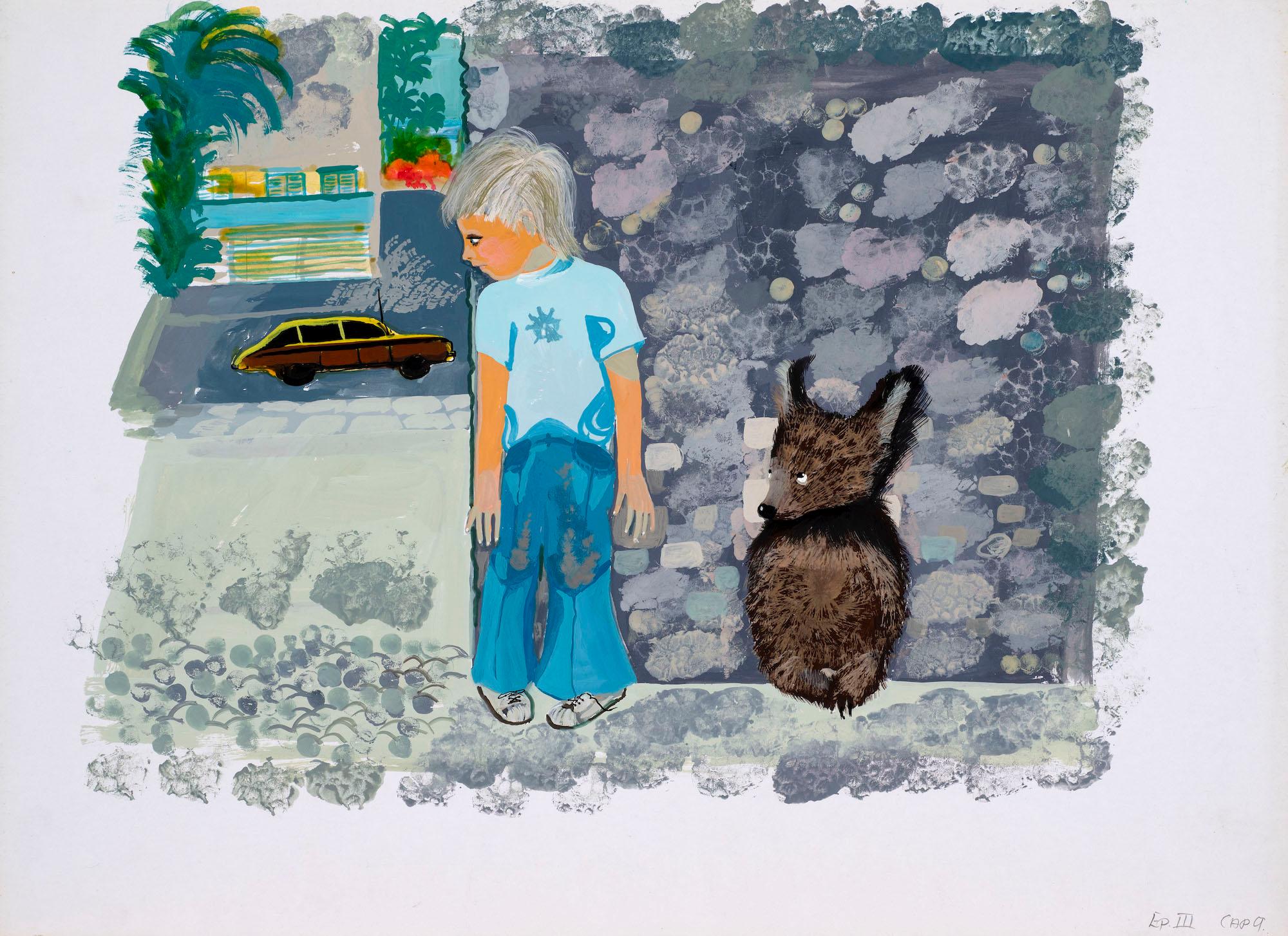
Untitled illustration for Jackanory (Mary Plain Goes to America) , 1972
British illustrator Janina Ede (1937-2018) created covers and illustrations for over 100 books from the 1950s to the 1980s. In the 1970s, she made illustrations for Jackanory, a BBC television programme. During each episode, an actor read a story, while specially-commissioned illustrations were shown on screen. For the televised version of Mary Plain Goes to America, Ede created paintings on large boards. These allowed the camera to pan across her image, showing a little at a time. BBC1 had only been in colour for three years, and so Ede used bold colours painted in gouache and reflective collaged foil to make the most of the new technology. This storyboard illustration was produced by Janina Ede for Jackanory episode #1428, 'Mary Plain Goes to America: Part 3 - Mary the Hero'. It aired on 15 November 1972.
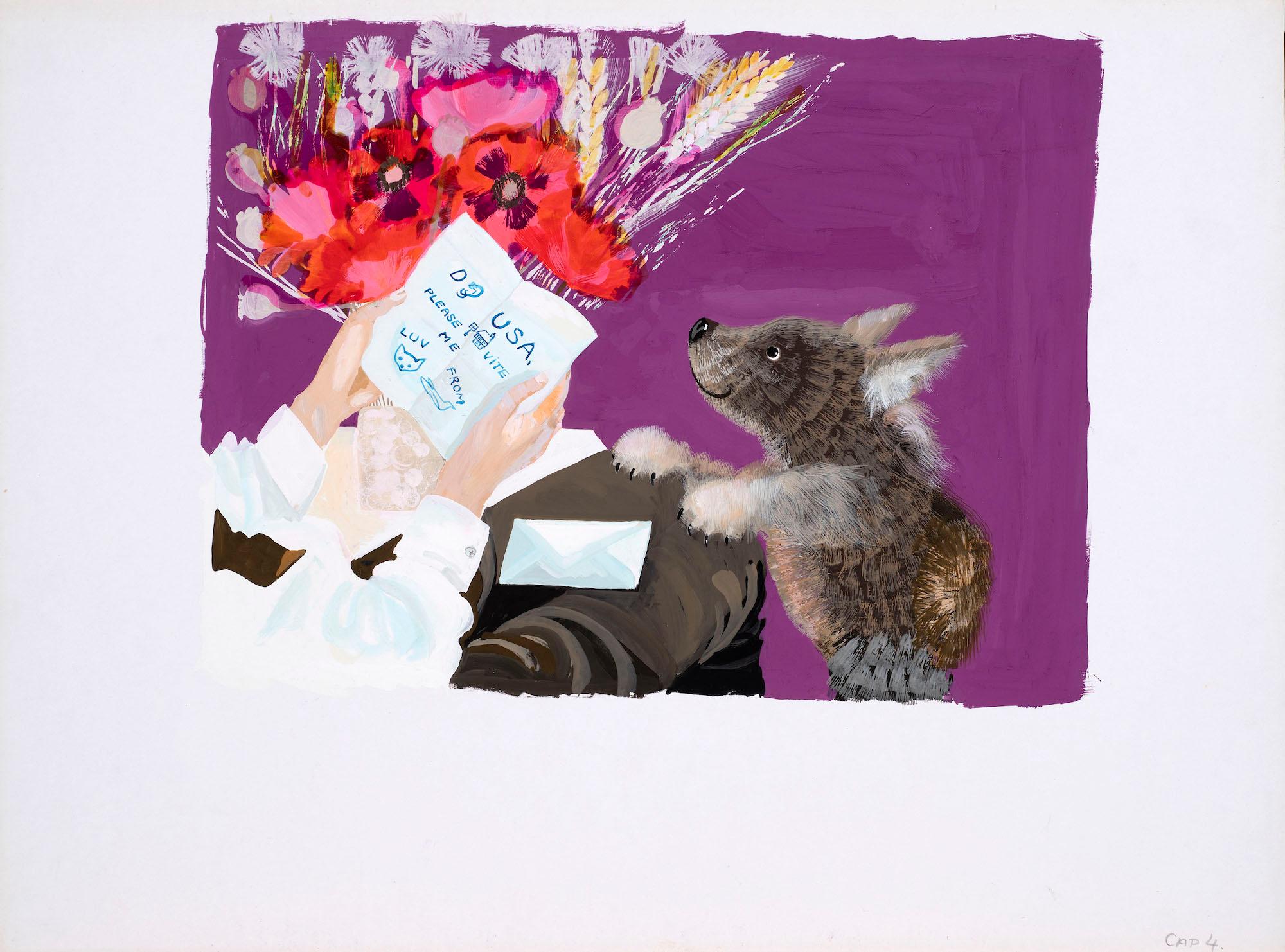
Untitled illustration for Jackanory (Mary Plain Goes to America) , 1972
British illustrator Janina Ede (1937-2018) created covers and illustrations for over 100 books from the 1950s to the 1980s. In the 1970s, she made illustrations for Jackanory, a BBC television programme. During each episode, an actor read a story, while specially-commissioned illustrations were shown on screen. For the televised version of Mary Plain Goes to America, Ede created paintings on large boards. These allowed the camera to pan across her image, showing a little at a time. BBC1 had only been in colour for three years, and so Ede used bold colours painted in gouache and reflective collaged foil to make the most of the new technology. This storyboard illustration was produced by Janina Ede for Jackanory episode #1426, 'Mary Plain Goes to America: Part 1 - An invitation'. It aired on 13 November 1972.
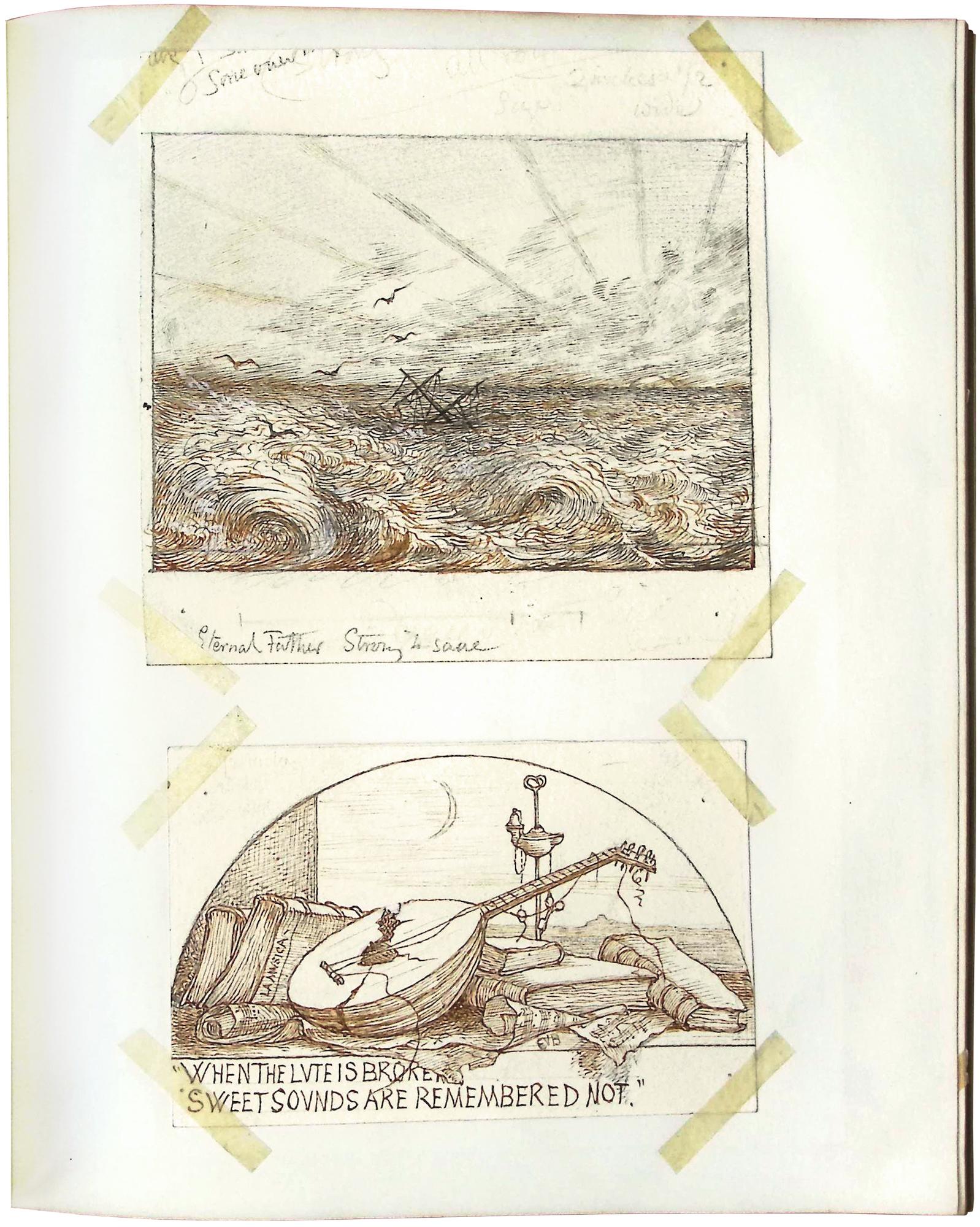
Untitled (illustrations for A Book of Heavenly Birthdays), c. 1893
Eleanor Vere Boyle (1825 – 1916) illustrated poetry and prose by some of the most popular authors of her time. She regularly drew and painted using ink and watercolour, sketching landscapes, animals and her children from life. She also made drawings from her imagination, often reflecting spiritual themes. These drawings were used as some of the final illustrations printed in the artists' publication A Book of Heavenly Birthdays (1893, London Elliot Stock)
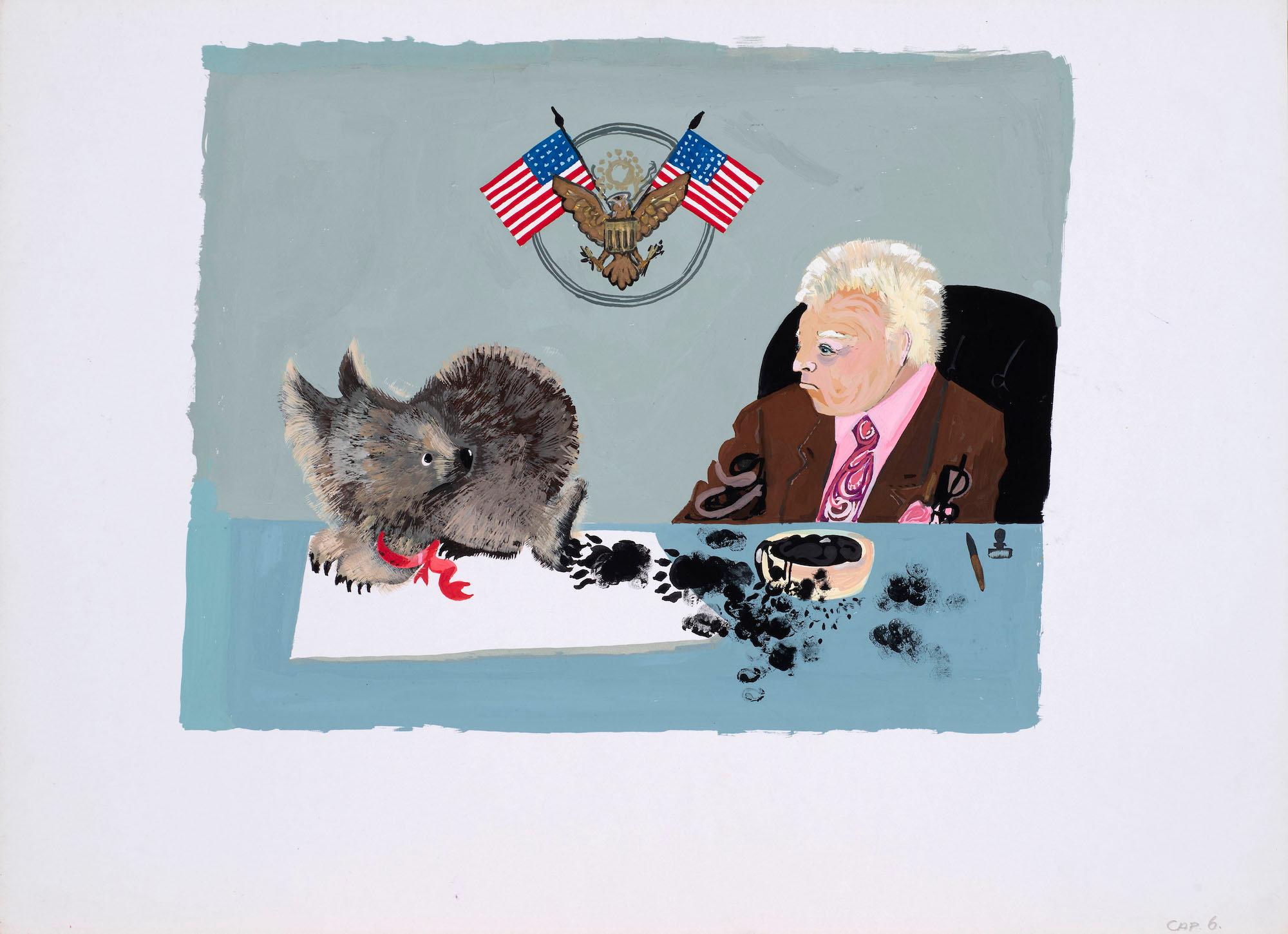
Untitled illustration for Jackanory (Mary Plain Goes to America) , 1972
British illustrator Janina Ede (1937-2018) created covers and illustrations for over 100 books from the 1950s to the 1980s. In the 1970s, she made illustrations for Jackanory, a BBC television programme. During each episode, an actor read a story, while specially-commissioned illustrations were shown on screen. For the televised version of Mary Plain Goes to America, Ede created paintings on large boards. These allowed the camera to pan across her image, showing a little at a time. BBC1 had only been in colour for three years, and so Ede used bold colours painted in gouache and reflective collaged foil to make the most of the new technology. This storyboard illustration was produced by Janina Ede for Jackanory episode #1426, 'Mary Plain Goes to America: Part 1 - An invitation'. It aired on 13 November 1972.
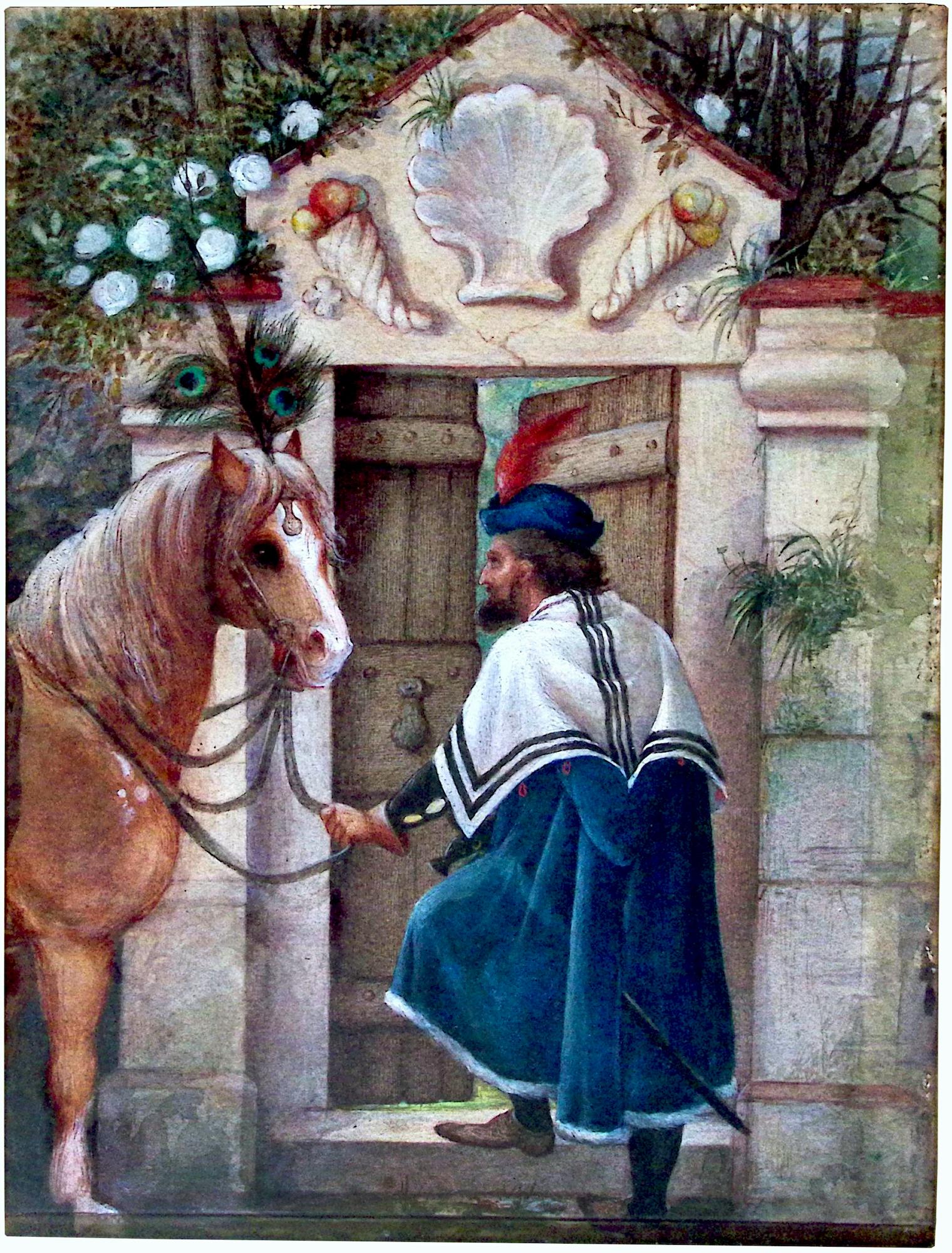
Illustration for Beauty and the Beast (the Merchant entering the Beast's Garden), c. 1875
Eleanor Vere Boyle (1825 – 1916) illustrated poetry and prose by some of the most popular authors of her time. She regularly drew and painted using ink and watercolour, sketching landscapes, animals and her children from life. She also made drawings from her imagination, often reflecting spiritual themes. This illustration is from Boyle’s 1875 retelling of Beauty and the Beast, a fairy tale where a woman is imprisoned by a monster and falls in love with him. Unlike other illustrated versions before or since, Boyle gave her beast walrus-like tusks and flippers. In several of her illustrations, Boyle used shell gold – a mixture of finely ground gold powder and gum arabic (tree sap) that would have been stored in a shallow seashell. In the final publication, the caption for this illustration reads, "The Merchant found a little door in the wall, and he opened it, and went into the Beast's Garden."
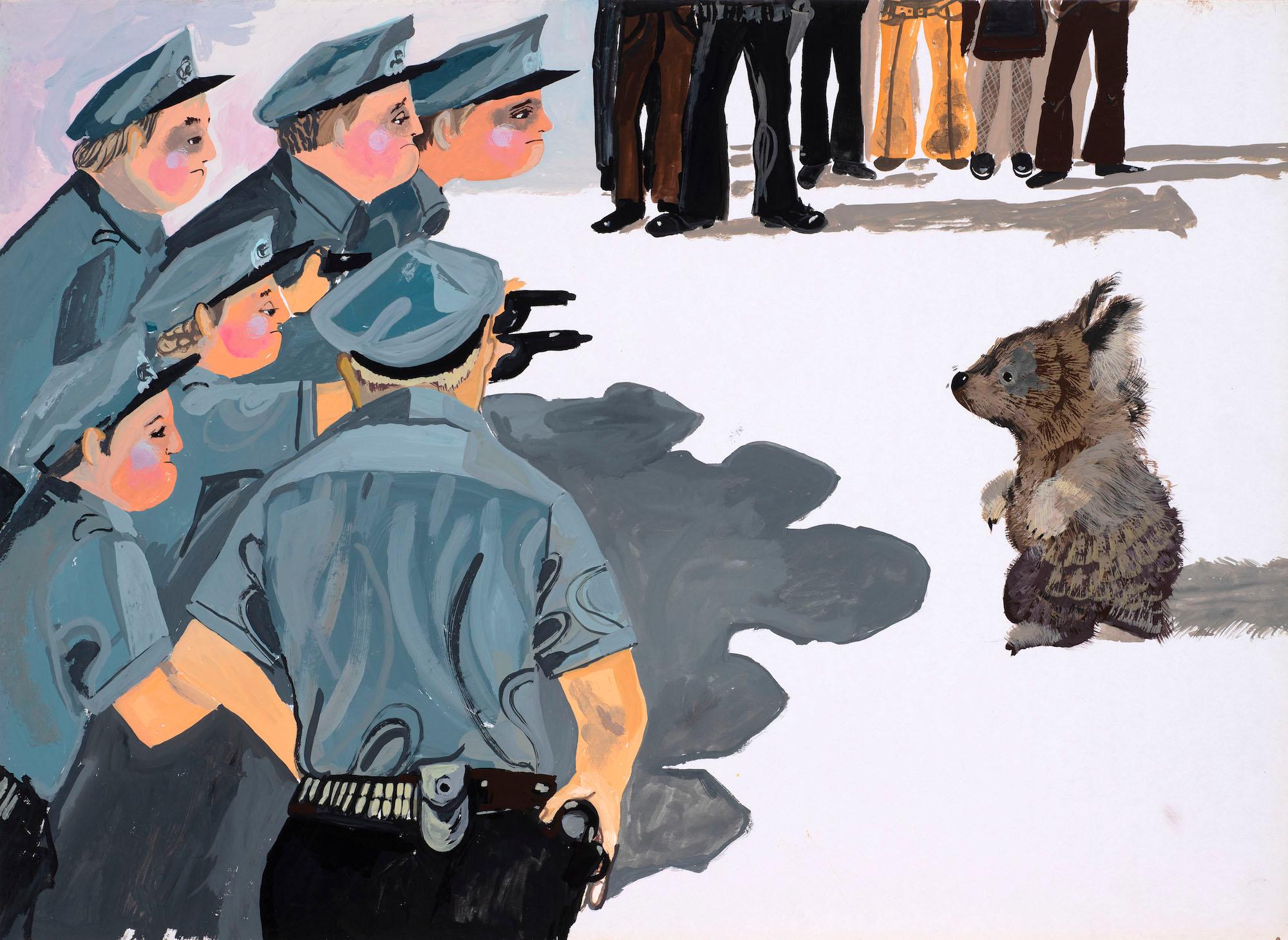
Untitled illustration for Jackanory (Mary Plain Goes to America) , 1972
British illustrator Janina Ede (1937-2018) created covers and illustrations for over 100 books from the 1950s to the 1980s. In the 1970s, she made illustrations for Jackanory, a BBC television programme. During each episode, an actor read a story, while specially-commissioned illustrations were shown on screen. For the televised version of Mary Plain Goes to America, Ede created paintings on large boards. These allowed the camera to pan across her image, showing a little at a time. BBC1 had only been in colour for three years, and so Ede used bold colours painted in gouache and reflective collaged foil to make the most of the new technology. This storyboard illustration was produced by Janina Ede for Jackanory episode #1427, 'Mary Plain Goes to America: Part 2 - The Most Popular Person on Board'. It aired on 14 November 1972.
Content warning: weaponry
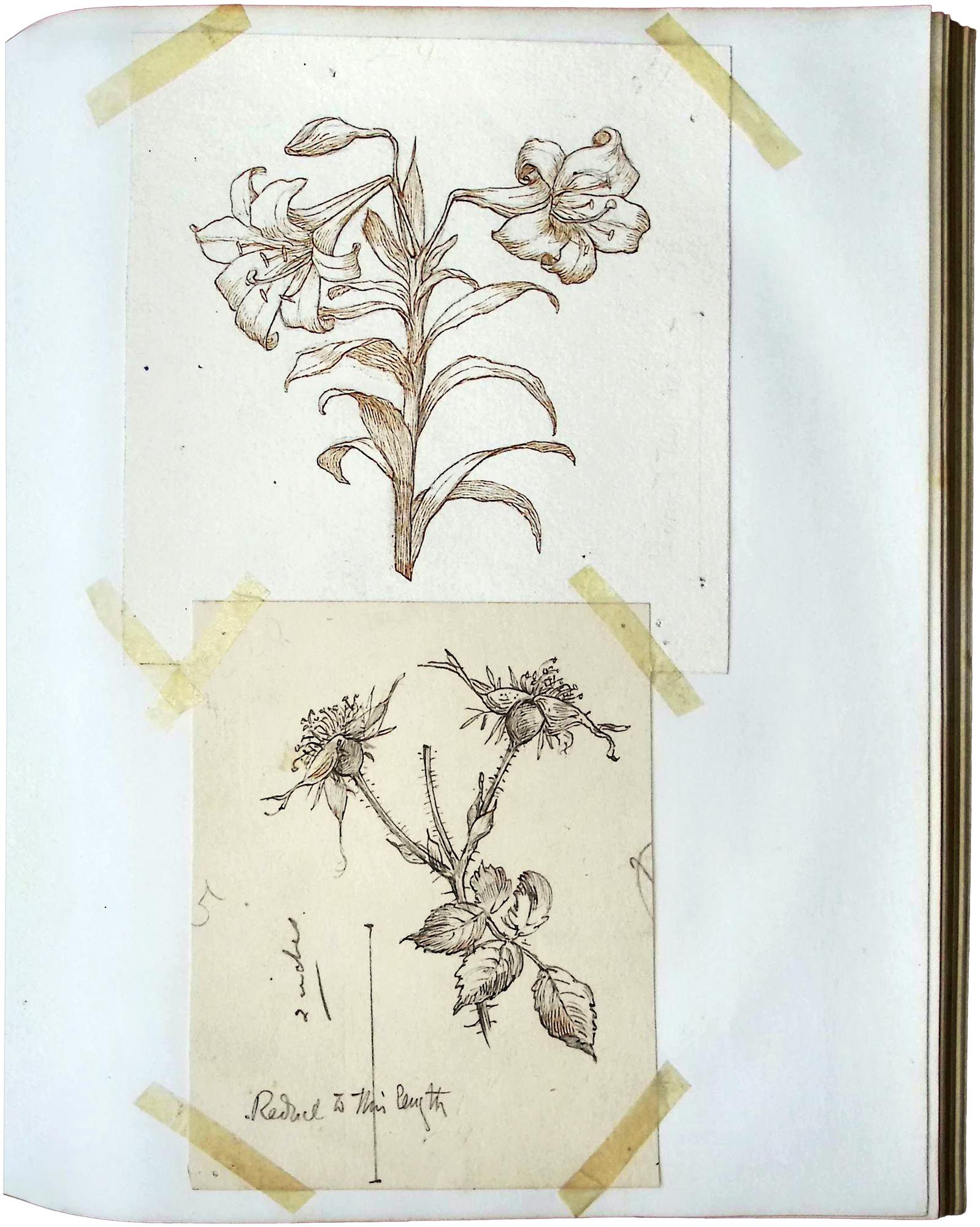
Untitled, c. 1893
Eleanor Vere Boyle (1825 – 1916) illustrated poetry and prose by some of the most popular authors of her time. She regularly drew and painted using ink and watercolour, sketching landscapes, animals and her children from life. She also made drawings from her imagination, often reflecting spiritual themes. These drawings were used as some of the final illustrations printed in the artists' publication A Book of Heavenly Birthdays (1893, London Elliot Stock)
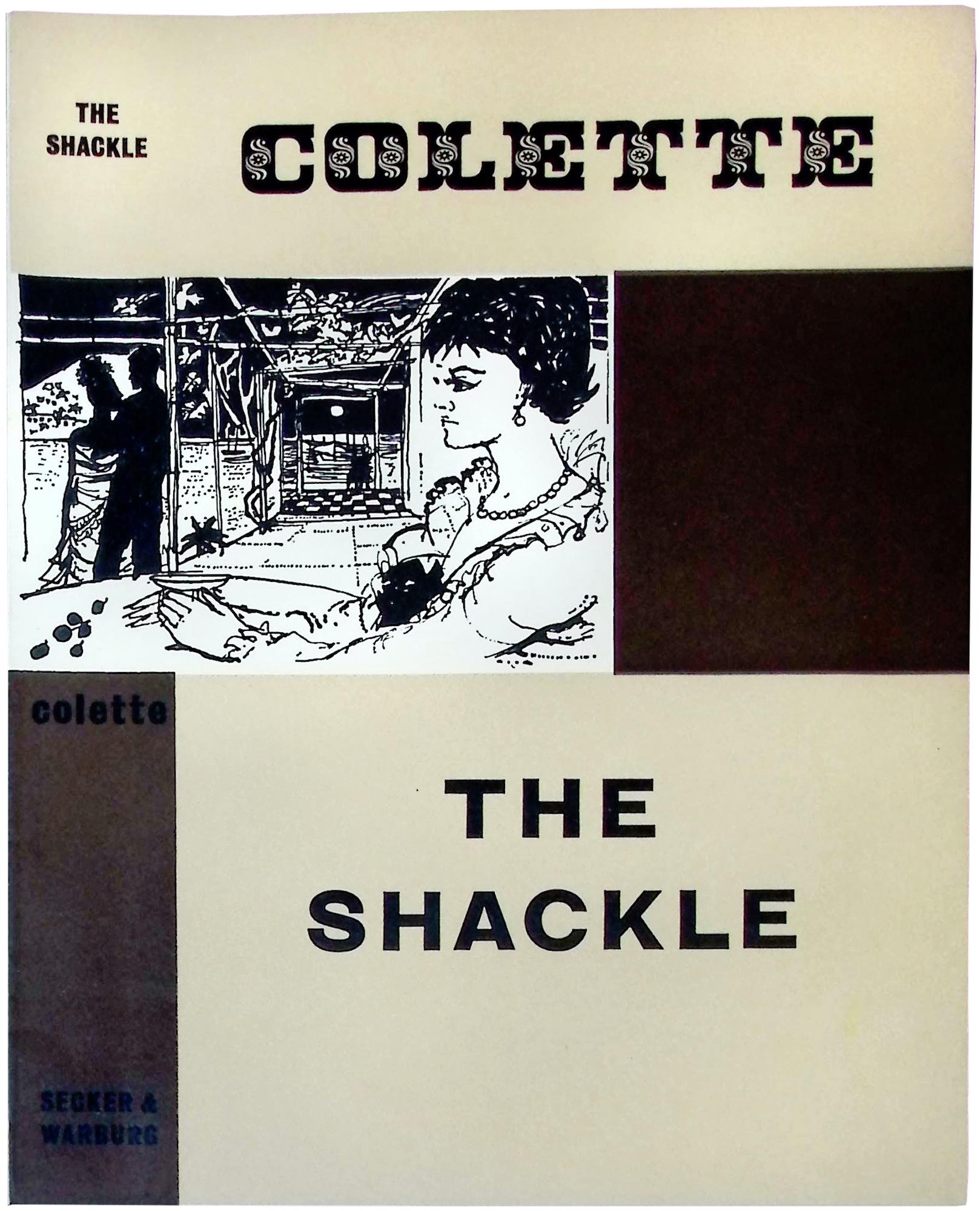
Book cover proof for Colette's "The Shackle", 1964
British illustrator Janina Ede (1937-2018) created covers and illustrations for over 100 books from the 1950s to the 1980s. She designed the covers of several books by French author and pioneer of autofiction Sidonie-Gabrielle Colette.
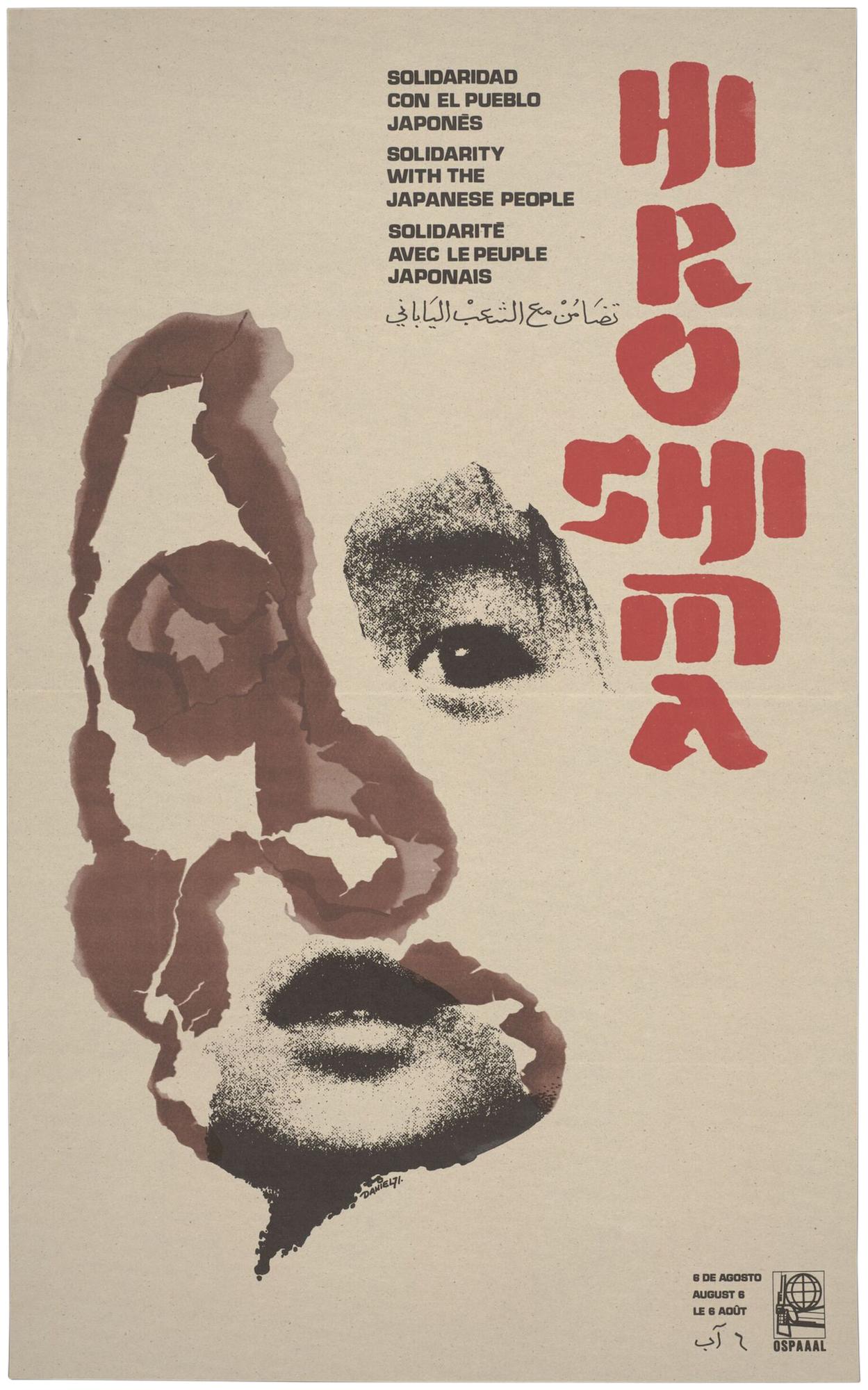
HIROSHIMA - SOLIDARITY WITH THE JAPANESE PEOPLE, 1972
Between the 1960s and 1990s, more than fifty designers worked at OSPAAAL (the Organisation of Solidarity with the People of Africa, Asia and Latin America). Based in Cuba, they made magazines and posters that were sent around the world. Their aim was to promote radical political ideas. Many of their posters celebrate socialist revolutions and liberation movements from the Global South. OSPAAAL marked the date of the atomic bombing of the city of Hiroshima by the U.S.A. as a day of solidarity with Japanese citizens. By collaging fragments of a photograph and burned paper, Daniel García stressed the horrific consequences of deploying nuclear weapons. OSPAAAL’s designers regularly used adapted photographs from the organisation’s news desk. Photographs were sometimes used out of context, with the same photographs appearing in posters and magazine illustrations to represent different themes. The identity of the person in this photograph is not recorded.
Content warning: Injury, burns
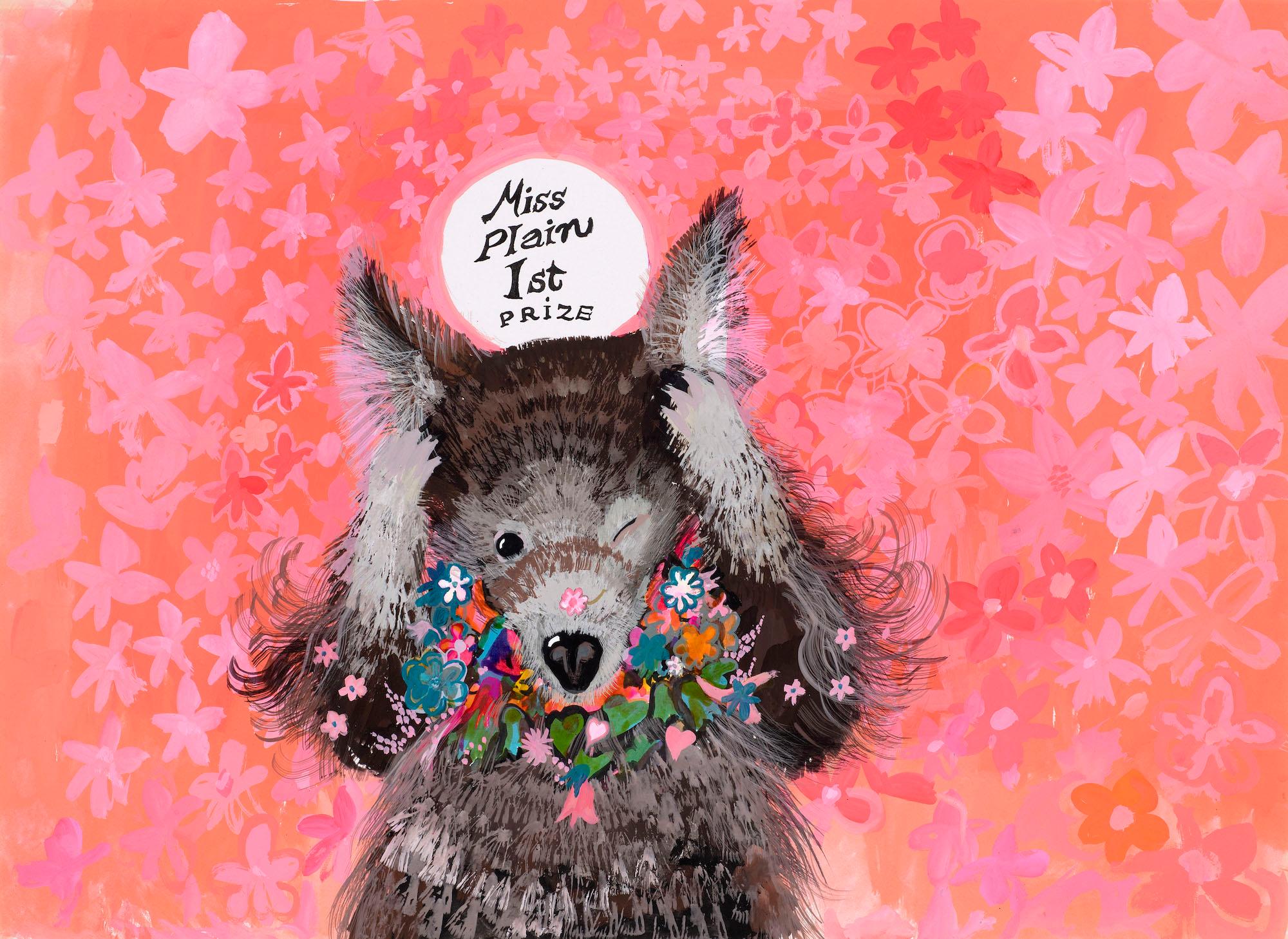
Untitled illustration for Jackanory (Mary Plain Goes to America) , 1972
British illustrator Janina Ede (1937-2018) created covers and illustrations for over 100 books from the 1950s to the 1980s. In the 1970s, she made illustrations for Jackanory, a BBC television programme. During each episode, an actor read a story, while specially-commissioned illustrations were shown on screen. For the televised version of Mary Plain Goes to America, Ede created paintings on large boards. These allowed the camera to pan across her image, showing a little at a time. BBC1 had only been in colour for three years, and so Ede used bold colours painted in gouache and reflective collaged foil to make the most of the new technology. This storyboard illustration was produced by Janina Ede for Jackanory episode #1427, 'Mary Plain Goes to America: Part 2 - The Most Popular Person on Board'. It aired on 14 November 1972.

Draft cover illustration for A Pocket Full of Mice , c. 1984
British illustrator Janina Ede (1937-2018) created covers and illustrations for over 100 books from the 1950s to the 1980s. Many of her illustrations feature animals, which she drew from life.
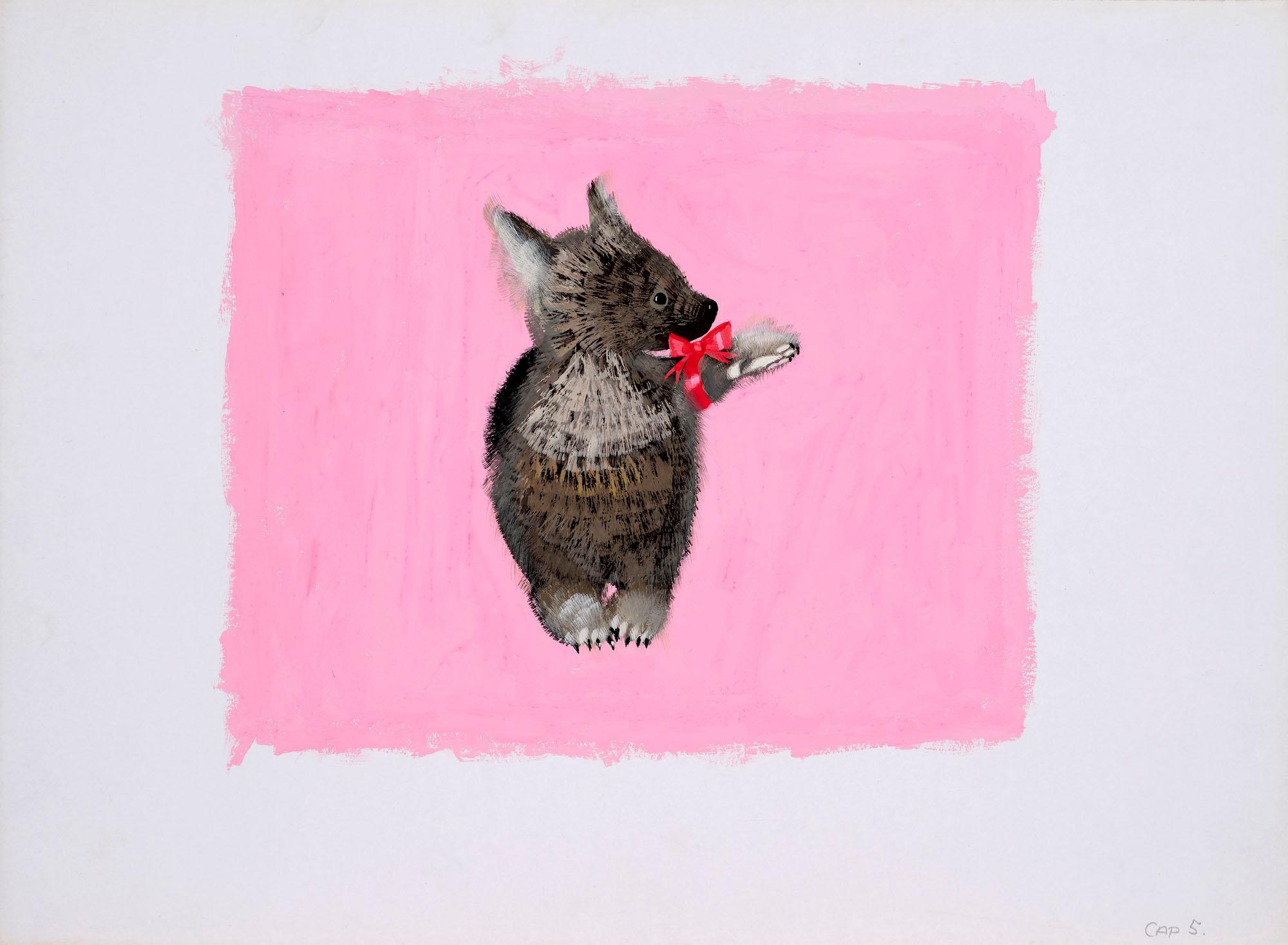
Untitled illustration for Jackanory (Mary Plain Goes to America) , 1972
British illustrator Janina Ede (1937-2018) created covers and illustrations for over 100 books from the 1950s to the 1980s. In the 1970s, she made illustrations for Jackanory, a BBC television programme. During each episode, an actor read a story, while specially-commissioned illustrations were shown on screen. For the televised version of Mary Plain Goes to America, Ede created paintings on large boards. These allowed the camera to pan across her image, showing a little at a time. BBC1 had only been in colour for three years, and so Ede used bold colours painted in gouache and reflective collaged foil to make the most of the new technology. This storyboard illustration was produced by Janina Ede for Jackanory episode #1426, 'Mary Plain Goes to America: Part 1 - An invitation'. It aired on 13 November 1972.
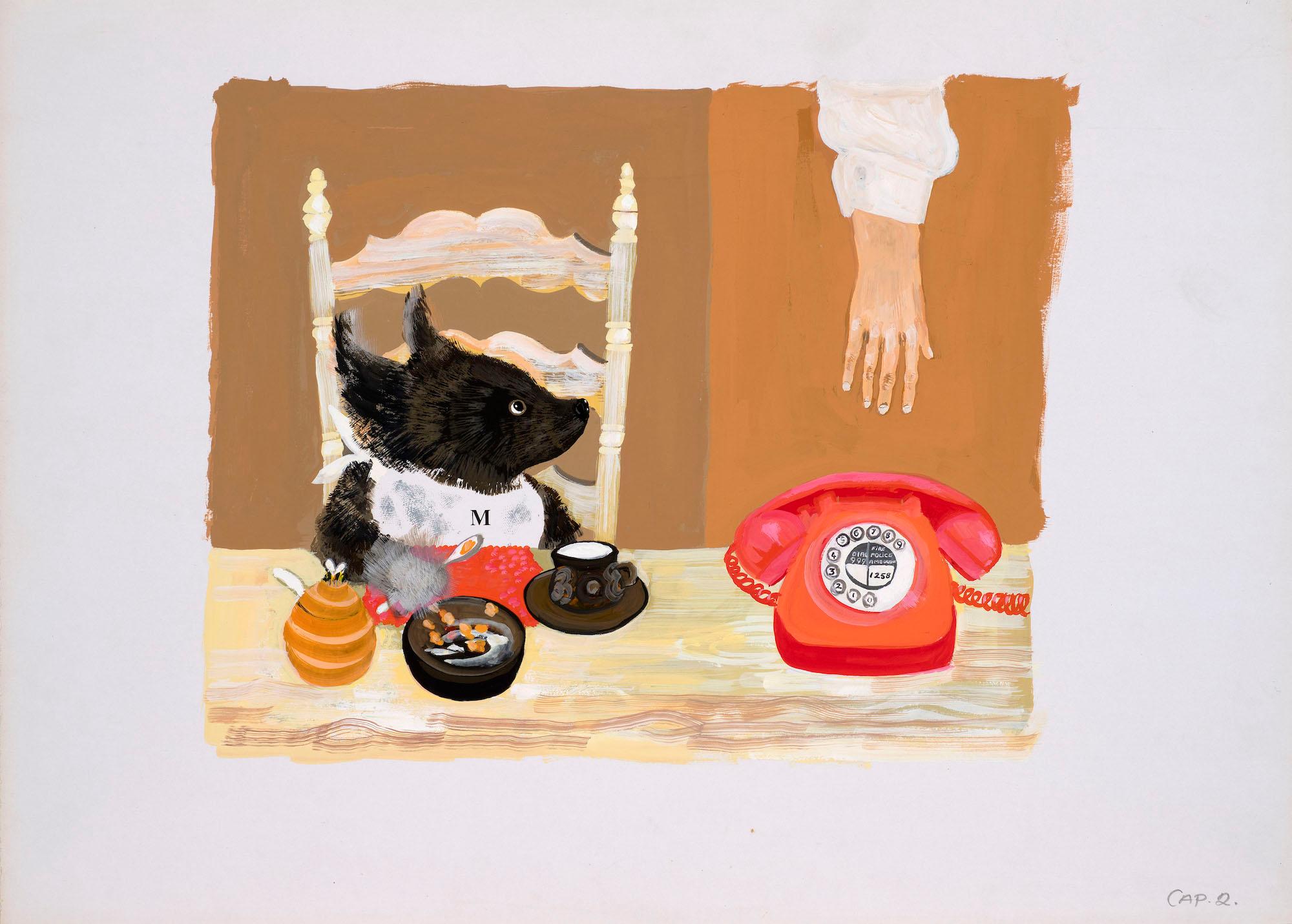
Untitled illustration for Jackanory (Mary Plain Goes to America) , 1972
British illustrator Janina Ede (1937-2018) created covers and illustrations for over 100 books from the 1950s to the 1980s. In the 1970s, she made illustrations for Jackanory, a BBC television programme. During each episode, an actor read a story, while specially-commissioned illustrations were shown on screen. For the televised version of Mary Plain Goes to America, Ede created paintings on large boards. These allowed the camera to pan across her image, showing a little at a time. BBC1 had only been in colour for three years, and so Ede used bold colours painted in gouache and reflective collaged foil to make the most of the new technology. This storyboard illustration was produced by Janina Ede for Jackanory episode #1426, 'Mary Plain Goes to America: Part 1 - An invitation'. It aired on 13 November 1972.